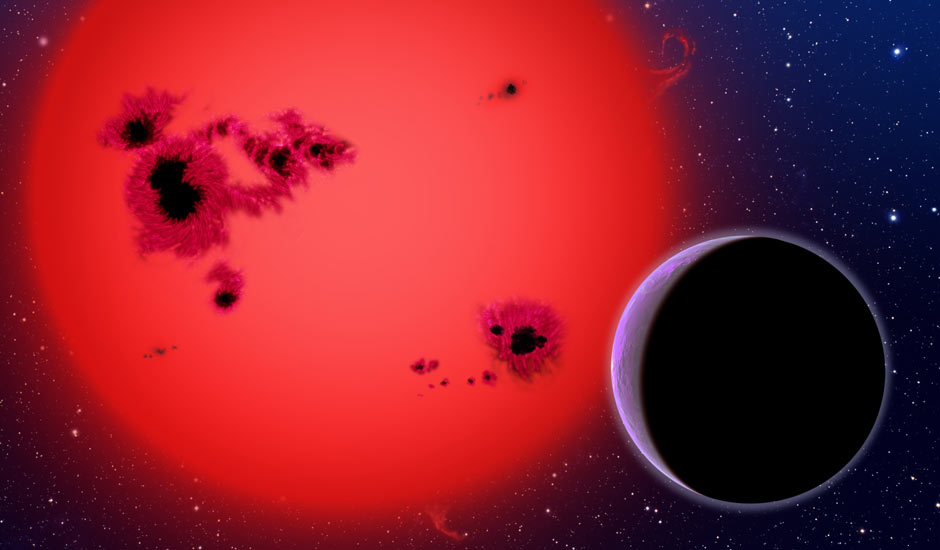
The latest planet is only a stone’s throw away in astronomical terms, meaning scientists will be able to turn the Hubble Space Telescope towards it and analyse its atmosphere, potentially revealing signs of life. Charbonneau’s team has already requested time on the space telescope. “Using the Hubble, we can look at the atmosphere and say not only whether it’s habitable, but whether it’s inhabited,” Charbonneau told the Guardian. “If we find oxygen in the atmosphere things will get really interesting, because on Earth all the oxygen in the atmosphere comes from life.” After spotting GJ1214b in orbit, the astronomers measured tiny movements in the parent star as the planet circled around it. From these wobbles they calculated the mass of the planet to be 6.6 times as great as the Earth’s. The most likely composition of the planet is 75% water, with 22% silicon and 3% iron forming a solid core, the scientists report. (via Waterworld planet is more Earth-like than any discovered before | Science | guardian.co.uk)
 The Committee to Nuke Elysium