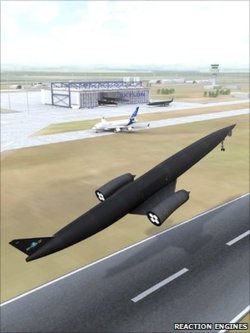
The proposed Skylon vehicle would do the job of a big rocket but operate like an airliner, taking off and landing at a conventional runway.
The European Space Agency’s propulsion experts have assessed the details of the concept and found no showstoppers.
They want the next phase of development to include a ground demonstration of its key innovation – its Sabre engine.
…
Realising the Sabre propulsion system is essential to the success of the project.
The engine would burn hydrogen and oxygen to provide thrust – but in the lower atmosphere this oxygen would be taken directly from the air.
This means the 84m-long spaceplane can fly lighter from the outset with a higher thrust-to-weight ratio, enabling it to make a single leap to orbit, rather than using and dumping propellant stages on the ascent – as is the case with current expendable rockets.
…
The price for launching a kilogram of payload into a geostationary orbit – the location for today’s big telecoms satellites – is currently more than $15,000 (£9,000). Skylon’s re-usability could bring that down to less than $1,000, claims REL.
 The Committee to Nuke Elysium