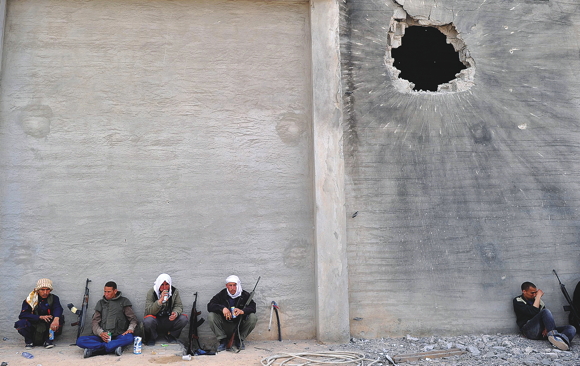
Then, in the third week of February, the revolution began. Shaka stuck close to his uncle, who had fought in Libya’s war with Chad in the 1980s. His uncle grabbed an RPG launcher when Misurata’s armory was overrun. After blasting two of Qaddafi’s tanks, he was shot dead. His weapon, still stained with blood, was handed to Shaka. Essraity, whose house had been hit by a tank shell, joined him on the front line, as did Hazim “Haz” Bozaid, a powerfully built 29-year-old with a goatee, a stocking on his head, and a black Sepultura T-shirt. An import manager, he was also the lead vocalist and guitarist in a local thrash and death-metal band called Acacus. “I was inspired by Megadeth, Cannibal Corpse, Morbid Angel, Chuck Schuldiner’s Death, that sort of stuff. It was not easy to find in Libya, so if you got something on tape, you guarded it like gold,” he told me.
At first, their unit moved around the city, so bringing guitars to the battlefield was not possible. Shaka left his acoustic model in his car, and his electric guitar—“a Gibson, but a Chinese Gibson”—at home. Both were stolen when Qaddafi’s troops raided his house. They also kidnapped his father, who had not been seen since.
…
The revolutionaries’ strategy was to starve the snipers out, cutting off their supply stream by blocking the road with huge shipping containers full of wet sand and metal filings. Shaka’s job was to shoot the tanks, armored cars, and bulldozers that tried to move the containers. Before loading his weapon, he wrote his uncle’s name on the RPG. For Bozaid, a machine gunner who put his body count at more than 25, preparation for battle meant listening to Slayer on his smart phone.
 The Committee to Nuke Elysium