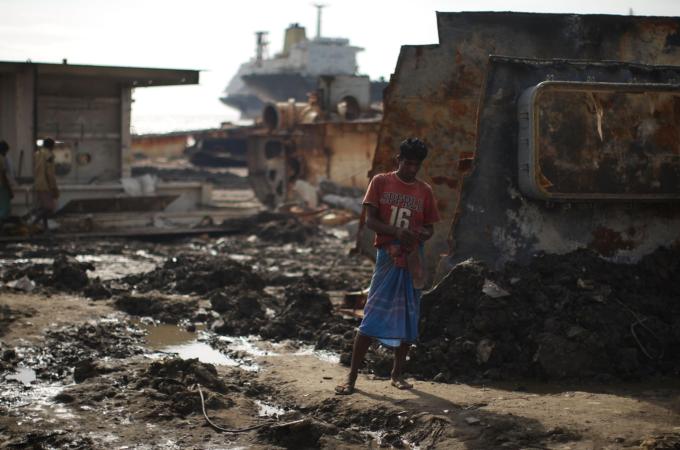
Bangladesh tops the list of countries having the greatest number of ships scrapped every year, with India and Pakistan trailing far behind. Some 200 Bangladeshi companies pay a combined $100 million in taxes each year. The metal scrapping business is so lucrative it supplies about 1.5 million tonnes out of the nation’s total steel consumption of about five million tonnes, the World Bank study said.
Most of the ship breaking companies are located on a roughly 20km stretch of beach in Chittagong district, situated on the Bay of Bengal in southeastern Bangladesh. Some 18,000 unskilled and unprotected workers manually handle poisonous chemicals and are also exposed to the risk of explosion.
Between 2005 and 2007, a total of 270 ocean-going vessels, categorised as end-of-life-ships, were dismantled there. This year alone, some 70 such vessels have been cleared for scrapping, a majority of which failed to obtain either prior clearance to use the yards or no-objection certificates to continue scrapping operations.
On June 1, the US Maritime Administration cleared the cargo vessel Harriette for scrapping on the beaches of Chittagong, with support from the US Environmental Protection Agency. Earlier, the ship Probo Koala, which figured in a controversial toxic waste dumping off the Ivory Coast in August 2006, was also sold for scrapping and docked on the ship breaking beaches of Chittagong. The ship has since been renamed the Gulf Jash.
The soil and waters in ship breaking areas are showing high levels of toxicity, with environmental protection limited and virtually no proper management of deadly chemicals – among them asbestos, polychlorinated biphenyls (PCBs), and other ozone-depleting substances (ODS) and heavy metals. According to the World Bank report, soil contamination tests showed concentrations of cadmium, chromium, lead, mercury and oil. The same report predicts the accumulation of substantial amounts of poisonous chemicals including asbestos, PCBs, ODS (mainly polyurethane foam) and paints during the next 20 years if safety measures are not put in place immediately.
According to an investigation conducted by the Department of Explosives, Greenpeace, the International Federation of Human Rights Leagues, and BELA, 123 workers have died while dismantling ships on the beaches of Shitakunda in Chittagong from 1998 to March this year. “The figures are those which are actually reported. We have no knowledge on workers whose bodies are simply thrown into the sea. So, we assume deaths could be much higher,” said Taslima Islam, senior lawyer at BELA.
Since 1998, a total of 72 incidents of violent explosions and chemical spillage have taken place in ship breaking yards. Hundreds of workers who have survived with chemical burns and life-long physical disabilities have never been compensated properly, the lawyers said.
On top of this, vast areas of mangrove trees – the lifeline of the local ecosystem – have been cleared to accommodate dismantling operations.
From Bangladeshi ship breakers defy court ruling – Features – Al Jazeera English
 The Committee to Nuke Elysium