The dark side of the universe is whispering, but scientists are still not sure what it is saying.
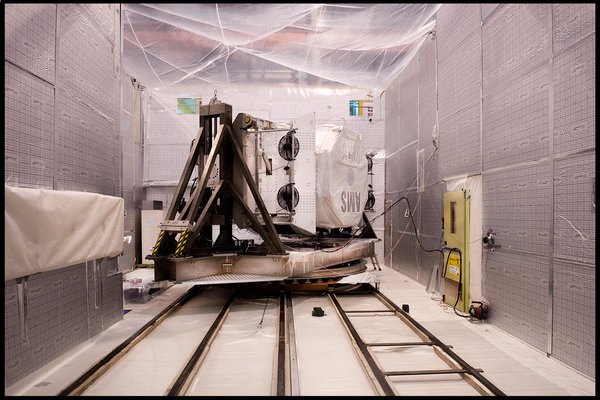
Samuel Ting, a professor at the Massachusetts Institute of Technology and a Nobel laureate particle physicist, said Wednesday that his $1.6 billion cosmic ray experiment on the International Space Station had found evidence of “new physical phenomena” that could represent dark matter, the mysterious stuff that serves as the gravitational foundation for galaxies and whose identification would rewrite some of the laws of physics.
The results, he said, confirmed previous reports that local interstellar space is crackling with an unexplained abundance of high energy particles, especially positrons, the antimatter version of the familiar electrons that comprise electricity and chemistry. They could be colliding particles of dark matter. Or they could be could be coming from previously undiscovered pulsars or other astronomical monsters, throwing off wild winds of radiation.
The tantalizing news is that even with the new data, physicists cannot tell yet which is the right answer, but they are encouraged that they soon might be able to. (via Tantalizing New Clues Into the Mysteries of Dark Matter – NYTimes.com)
 The Committee to Nuke Elysium