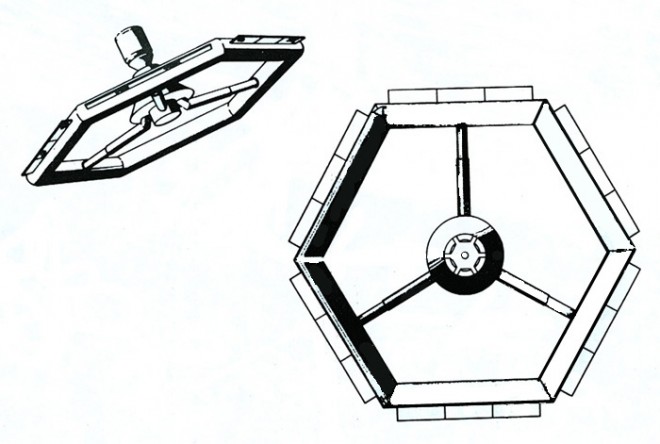
Langley Research Center (LaRC) was the early leader in NASA space station studies. A pioneering player in station work at the Hampton, Virginia-based laboratory was engineer Rene Berglund. He often designed stations that took advantage of existing or planned space hardware. In 1960, for example, Berglund designed a one-man space station comprising a metal-walled core, an inflatable fabric torus, a dish-shaped solar array, and a Mercury capsule at one end. At the time, Project Mercury had only recently begun flight testing. In May 1962, Berglund filed a patent for an “erectable” artificial-gravity space station that would reach orbit on a single two-stage Saturn C-5 (as the planned Saturn V rocket was then known). Folded atop its launch vehicle, Berglund’s station would measure just 33 feet across (the diameter of the rocket’s second stage, to which the station would joined as it ascended to orbit). The station would unfold in orbit into a hexagon 150 feet wide. Three spokes would link the hexagon to a central hub where piloted Apollo-derived logistics spacecraft would dock. The hexagon would revolve like a merry-go-round to create acceleration, which the crew inside would feel as gravity. “Down” would be away from the hub, toward the hexagon’s outer rim. (via Project Olympus (1962) – Wired Science)
 The Committee to Nuke Elysium