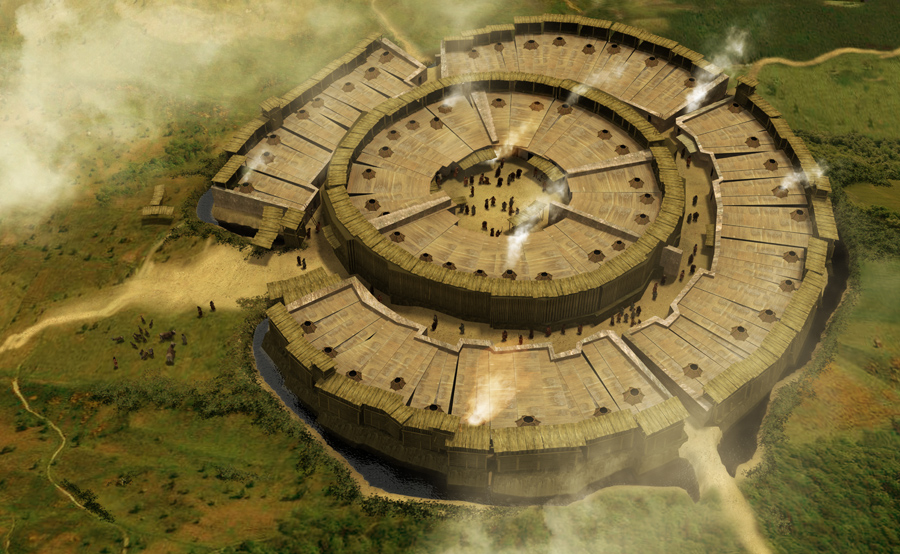
Arkaim is the remnants of an ancient settlement, which is basically a village that was fortified by two large stone circular walls. The settlement covers an area of some 220,000sq-ft and consists of two circles of dwellings separated by a street, with a central community square in the center. The site was discovered (rediscovered?) in 1987 by a team of Russian archaeologists, and a wave of excitement washed through the world of archaeology. The site and associated artefacts have been dated to the 17th century BCE and it’s generally agreed that it was built somewhere between 4000-5000 years ago, which puts it in the same age bracket as Stonehenge.
…
It has been of great interest to archaeoastronomers, and therein lies the reason for its association with Stonehenge. It’s long been known that Stonehenge has and was built with astronomical observation in mind. In fact it’s technically called an observatory. Stonehenge allowed for, and possibly may still allow for observations of 10 astronomical phenomena using 22 elements, whereas some archaeoastronomers claim that Arkaim allows for observations of 18 phenomena using 30 elements. This essentially means that certain events in the sky could be observed and tracked by using the site in particular ways and from different positions, and that Arkaim offered more observable events than Stonehenge.
…
It may seem obvious to some, but the fact that these sites were apparently constructed, deliberately, to act as astronomical observatories and even calendars of a sort, before the same expertise was achieved in the great foundational empires of antiquity, like the Egyptians and the Greeks, is seemingly strong evidence for attributing greater development and sophistication to these pre-historic cultures. The more conspiratorial among us might even say that these sites offer clues to the existence of an unknown or lost civilization in our distant past.
 The Committee to Nuke Elysium