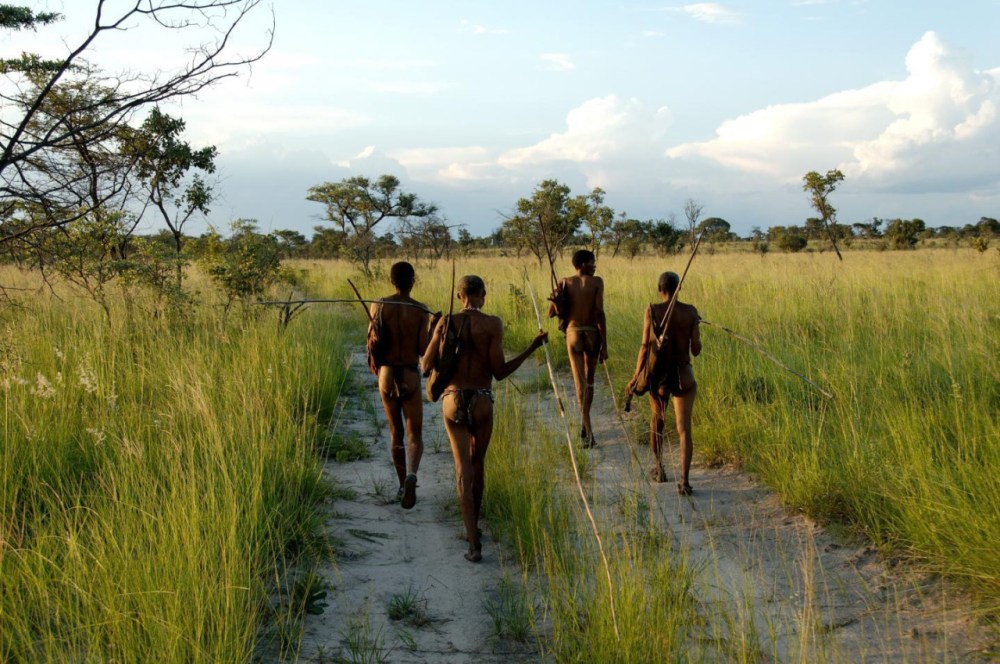
“Khoisan hunter-gatherers in Southern Africa always have perceived themselves as the oldest people” said Stephan Schuster of Nanyang Technological University in Singapore and a leader of the research team.
The group analyzed five study participants from different tribes in Namibia. The study investigated 420,000 genetic variants across 1,462 genomes from 48 ethnic groups in populations worldwide. These analyses reveal that Southern African Khoisans are genetically distinct not only from Europeans and Asians, but also from all other Africans. First author Hie Lim Kim of Nanyang Technological University, said, “It is fascinating to unravel the population history of humankind over the last 150,000 years.”
By conducting extensive computational analyses, the team demonstrated that two of the sequenced individuals showed no signs of having inherited any genetic material from members of other ethnic groups. Interestingly, these individuals are the oldest members of the Ju/‘hoansi tribe, which still live in protected areas of Northwest Namibia.
“This and previous studies show that the Khoisan peoples and the rest of modern humanity shared their most recent common ancestor approximately 150,000 years ago, so it was entirely unexpected to find that this group apparently did not intermarry with non-Khoisan neighbors for many thousand years,” said Webb Miller, professor of Bioinformatics at Penn State and a member of the research team. “The current Khoisan culture and tradition, where marriage occurs either among Khoisan groups or results in female members leaving their tribes after marrying non-Khoisan men, appears to be long-standing.”
The cultural and genetic persistence of the Ju/’hoansi tribe is intriguing, the researchers say, because genetic and genomic analysis of ancient hominid lineages such as the Neanderthals, as well as non-African humans, have shown that intermarrying does occur frequently in these groups and is traceable over the entire time span of 150,000 history during which anatomically modern humans have lived.
“We also observed gene flow for some of the other Khoisan groups, as defined by their largely varying language, but a key finding of this study is that, even today, individuals without genes from other communities can be identified within the Ju/’hoansi population and possibly others,” Schuster said.
“Having identified non-admixed Khoisan individuals, we could compare the effective population size of the Khoisan with that of other humans over more than 100,000 years,” said research-team member Aakrosh Ratan, an assistant professor at the University of Virginia. “In a twist of fate, the major ethnic groups today in Africa, Asia, and Europe increased in size only after overcoming a population decline about 20,000 years ago.”
 The Committee to Nuke Elysium