After several failed attempts, they managed to reconstruct the man’s entire genome from DNA found in the root of a third molar. It is the first time researchers have obtained the complete genome of a modern European who lived before the Neolithic revolution.

The DNA threw up a series of surprises. When Lalueza-Fox looked at the genome, he found that rather than having light skin, the man had gene variants that tend to produce much darker skin. “This guy had to be darker than any modern European, but we don’t know how dark,” the scientist said.

Another surprise finding was that the man had blue eyes. That was unexpected, said Lalueza-Fox, because the mutation for blue eyes was thought to have arisen more recently than the mutations that cause lighter skin colour. The results suggest that blue eye colour came first in Europe, with the transition to lighter skin ongoing through Mesolithic times.

The Spanish team went on to compare the genome of the hunter-gatherer to those of modern Europeans from different regions to see how they might be related. They found that the ancient DNA most closely matched the genetic makeup of people living in northern Europe, in particular Sweden and Finland.

The discovery of mutations that bolstered the immune system against bacteria and viruses suggests that the shift to a farming culture in Neolithic times did not drive all of the changes in immunity genes that Europeans carry today. At least some of those genetic changes have a history that stretches further back. “One thing we don’t know is what sort of pathogens were affecting these people,” said Lalueza-Fox.

Martin Jones, professor of archaeological science at Cambridge University, said the immunity genes were the most striking result. “There is a no doubt oversimplified grand narrative that the move from a hunter-gatherer lifestyle to settled farming was initially bad for our health. A number of factors contributed, particularly living closely together with other humans and animals, shrinking the food web, and crowding-out water supplies. The authors are drawing attention to the role of pathogens in pre-agricultural lives, and that is interesting.”

Read more
The European discovery of Australia has officially been credited to the Dutch voyage headed by Willen Janszoon in 1606, but historians have suggested the country may already have been explored by other western Europeans.

“A kangaroo or a wallaby in a manuscript dated this early is proof that the artist of this manuscript had either been in Australia, or even more interestingly, that travellers’ reports and drawings of the interesting animals found in this new world were already available in Portugal,” Les Enluminures researcher Laura Light said.

“Portugal was extremely secretive about her trade routes during this period, explaining why their presence there wasn’t widely known.”

Peter Trickett, an award-winning historian and author of Beyond Capricorn, has long argued that a Portuguese maritime expedition first mapped the coast of Australia in 1521-22, nearly a century before the Dutch landing.

“It is not surprising at all that an image of a kangaroo would have turned up in Portugal at some point in the latter part of the 16th century. It could be that someone in the Portuguese exhibition had this manuscript in their possession,” Mr Trickett said.

Read more

wolvensnothere:

writersblockbuster:

More of Robert Chew’s “Big Five” animal mechs

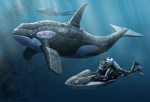
Black Fish“ by Robert Chew

Big Five: African Wild Dog” by Robert Chew

Wild Dogs are cheap, light weight, and easy to assemble. Used mostly for recon and scouting purposes, they can also function in offensive roles when operating in large packs. Speed and numbers make up for their general lack of defense and small size. Their low cost and ease of operations has made them popular among poaching organizations. Parts are relatively easy to smuggle and readily available on the black market. After market modifications are commonplace. Typical modifications include teeth swapping, leg reinforcements, modified optics, and tail transmitter replacement.

Big Five: Lion Attack“ by Robert Chew

Big Five: White-Backed Vulture” by Robert Chew

Medivulture. Provides aerial recon and basic first aid. Used for spotting poached animals and tracking marked contraband (marked rhino horn and elephant ivory.)

You have NO idea how much I love this.

Read more

ineedthatseat:

Soviet space propaganda posters, 1958-1963

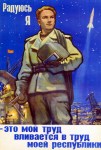
“I am happy – this is my work joining the work of my republic”

“Soviet man – be proud, you opened the road to stars from Earth!”

“We will open the distant worlds!”

“Glory to the Fatherland of Heroes!”

“We were born to make the fairy tale come true!”

“Socialism is our launching pad”

“Conquer space!”

“Fatherland! You lighted the star of progress and peace. Glory to the science, glory to the labor! Glory to the Soviet regime!”

“Through the worlds and ages.”

“In the name of peace and progress!”

Read more

Why are you here?Because the situation is even less simple than you think.Do you know what your sin is, Doctor?I wonder if… It’s pride.Key members of Parliament have personally observed this subject.I was told that the Alliance’s support…“Key members of Parliament. ”Key.The minds behind every military…diplomatic, and covert operation…in the galaxy, and you put them…in […]

Read more

For years, astronomers have been scanning nearby asteroids, the moon, Mars, and deeper space for evidence of the building blocks of life.

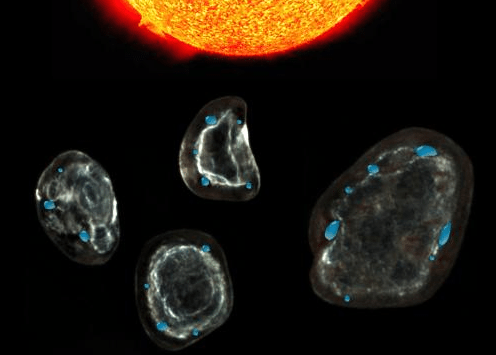
Now, a new study in the Proceedings of the National Academy of Sciences finds that both water and organic material could actually have our planet surrounded, floating around space on ubiquitous interplanetary dust particles that constantly rain down on Earth and the other bodies in our solar system.

“It is a thrilling possibility that this influx of dust has acted as a continuous rainfall of little reaction vessels containing both the water and organics needed for the eventual origin of life on Earth and possibly Mars,” researcher and study co-author Hope Ishii of the Hawaii Institute of Geophysics and Planetology said in a release.

In the case of comets, the icy space rocks import frozen water from beyond the solar system when they come to visit, but the traces of water on interplanetary dust particles are actually a product of the solar wind that blasts them with hydrogen ions, shaking up the atoms of the silicate mineral crystals in the dust particles. This process leaves behind some oxygen to react with hydrogen and create water molecules.

“Perhaps more exciting,” Ishii said, “interplanetary dust, especially dust from primitive asteroids and comets, has long been known to carry organic carbon species that survive entering the Earth’s atmosphere, and we have now demonstrated that it also carries solar-wind-generated water. So we have shown for the first time that water and organics can be delivered together.”

(via Ingredients for life hitching ride on space dust, study says | Crave – CNET)

Read more

The absence of event horizons mean that there are no black holes – in the sense of regimes from which light can’t escape to infinity. There are however apparent horizons which persist for a period of time. This suggests that black holes should be redefined as metastable bound states of the gravitational field.

Stephen Hawking declares: ‘There are no black holes’ | Technically Incorrect – CNET News

Please update your space lexicons pronto. Black Holes, to be filed next to Pluto is a Planet.

Read more