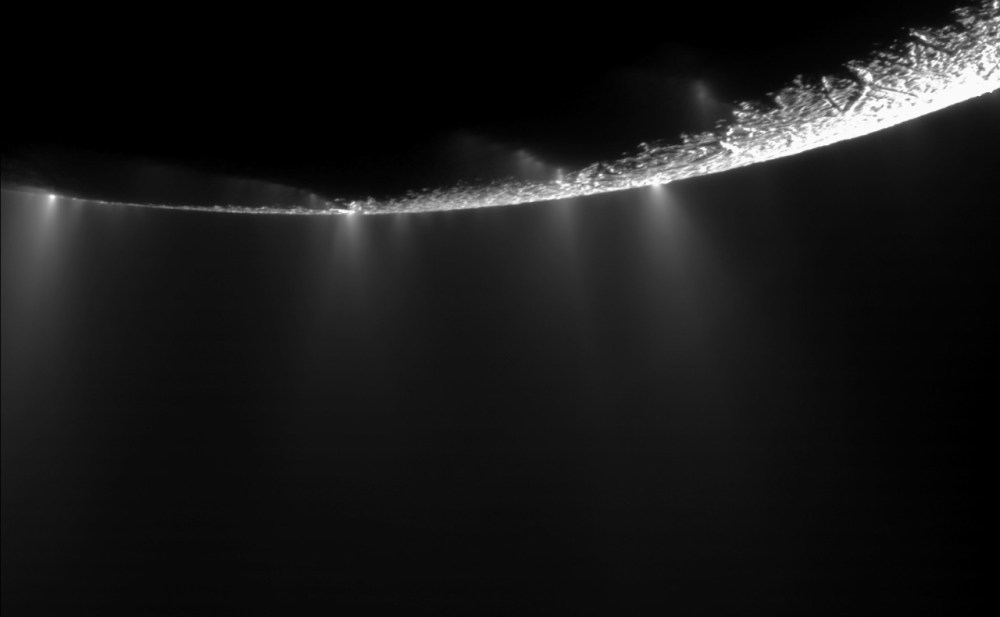
Enceladus seems to have liquid water under its icy surface. Cryovolcanoes at the south pole shoot large jets of water vapor, other volatiles and some solid particles (ice crystal, NaCl etc) into space (total approximately 200 kg per second).[14] Some of this water falls back onto the moon as “snow”, some of it adds to Saturn’s rings, and some of it reaches Saturn. The whole of Saturn’s E Ring is believed to have been made from these ice particles. Because of the apparent water at or near the surface, Enceladus may be one of the best places for humans to look for extraterrestrial life.

Read more
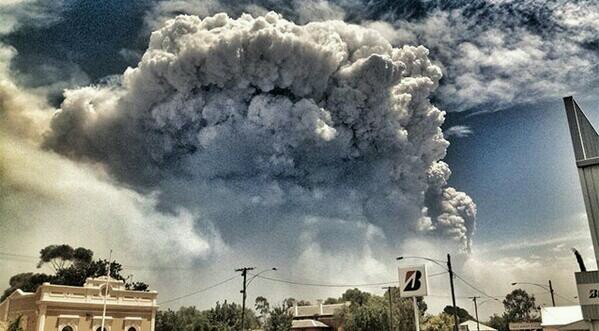
Ed Lu interviewed the other day on NPR about the Near Earth Asteroid Defense system his B612 Foundation are constructing, in partnership with NASA. I went into detail on that in a post on Grinding last year, after his Long Now talk. And the Overview Effect Enforcement Agency may have been mentioned. He also talks […]

Read more

Behold the Superhabitable World

Superhabitability describes a perfect storm of life-friendly factors. In their recent paper, astrobiologists René Heller and John Armstrong describe no fewer than 18 of them. First and foremost, superhabitability arises on terrestrial planets with masses two to three times that of Earth. Planets that size have a number of things working for them, including: Long […]

Read more "Behold the Superhabitable World"

aleskot:

sacredkarcram:

MODOK demands ice cream.

SECRET AVENGERS #14 came out yesterday. Two more issues and the current run will be wrapped up. Then, in March 2014: Mike Walsh, Tradd Moore, Matt Wilson and I restart the series with SECRET AVENGERS #1.

M.O.D.O.K hanging out with the Young Avengers, because PANCAKES and BACON DIVINATION.

Read more

afrofuturistaffair:

In a future Serengeti, illegal poaching continues to deplete the wildlife population, but conservationists have extraordinary new tools to protect endangered animals: robots that take the forms of those animals to blend in with the wildlife and capture poachers.

Artist Robert Chews Big Five series of illustrations imagine a network of wildlife rangers and the animal inspired robots they use in an attempt to make poaching a thing of the past. (Although one illustration reveals that the poachers have fearsome robots of their own.) He frequently adds companion drawings showing off the features of his robots, and usually includes short blurbs about the roles of the robots, including this one about the White-Back Vulture robots:

Vultures patrol protection zones providing aerial recon and basic first aid capabilities. Their main job is to locate recently poached animals and mark them for investigation. If anti-poaching units are in the area the Vulture can land near the corpse of the animal and protect the body from consumption by other animals. Compartments in the wings and the chest area house basic first aid supplies to aid in field operations. These include bandages, tourniquets, antivenom, antiseptics, resuscitators, field rations, and water among other things. Another function is to transport DNA samples of poached animals quickly and efficiently for analysis to help keep records up to date about the remaining animal populations.Vultures also serve as locators for tagged ivory and rhino horn. By locating signals from planted GPS units Vultures can help anti-poaching units and law enforcement locate the contraband and hopefully the poachers as well.

Overall the Vulture units serve as aerial watchdogs as well as CSI. Though they are non-combatant’s their auxiliary functions aid greatly in field operations.

THIS

Read more