
Author: m1k3y



Read moreTrying to get a bead on the New Year in the atemporal landscape of the end of the world.
The puma leave the bones behind to bleach next to the trail, reminding you to give them their space.
You sleep in a shelter folded into the hill, like a wing built by cargo cultists with advanced degrees.
You try to see the summits of the torres through the clouds, and glimpse a future where new modes of deferentially weaving our lives into planetary wonder are more evenly distributed.
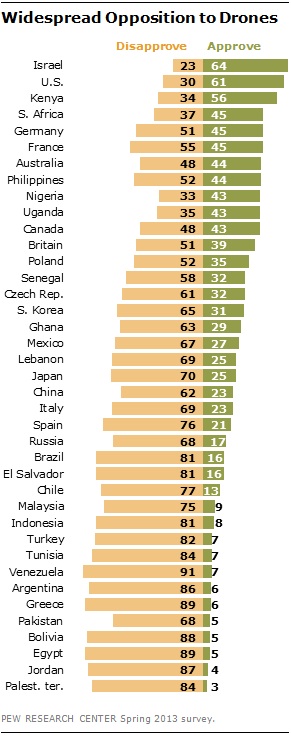
Read more*Opinion polling about drones.
*Q. Did anybody else’s drones blow you up yet? A. No, so I like them”
For these troubled humans, the easy emotional satisfaction gained from technology is so gratifying that everything can be sacrificed on its behalf, including the autonomy of their inner lives. That is the nightmarish economic vision of Her: the distinction between production and consumption is meaningless, affective labor has spread from the office to the most private realms, and technology has become so sophisticated that the brutality of that economy vanishes into air. […] Just because there aren’t any killer robots around doesn’t mean you’re free. In Jonze’s all too plausible dystopia, we are enslaved not to robots but corporations, and the invisibility, even desirability of that enslavement is what makes Her so chilling.
Jason Farago, “‘Her’ is the Scariest Movie of 2013” http://www.newrepublic.com/article/116063/spike-jonzes-her-scariest-movie-2013 (via aeromenthe)
Read more

The plan for 2014 is to spend half the year waiting to see this, then the other half repeatedly watching it and telling other people to go see it.
Also… Hypnotoad sez <blink>watch CLOUD ATLAS</blink>
(Source: https://www.youtube.com/)
Read more
Read moreCyberpunk genre (and post-cyberpunk) is frequently centered on the transitional inter-periods between Type-0 and Type-I status. While frequently focused on how the concepts of “Transhumanism” and “Singularity” will eventually overcome the problems that have, up until now, been endemic to human nature, Cyberpunk subverts this to describe the Dystopian side should a civilization “self-destruct” in the process of achieving Type-I status. In such fiction, most current world problems are local in warfare, local in culture, and usually mono-cultural, and theistic; further aggravated by various groups trying to retain a Type-0 monoculture through religious fanaticism and opposition to technological progress, and others trying to move forward to a Type-I global civilization through technological advances and institutional change.
A lot of the sci-fi stuff in Orwell and Huxley, and cyberpunk too, looks “eerily similar to what’s real” because it was built to look that way, on purpose. It was science fiction, but derived from events that were genuinely going on in real life. Only people didn’t talk about them much in polite society. The readers hadn’t caught on yet.
Bruce Sterling qna on /. – http://m.slashdot.org/story/195971
A Genre in Crisis: On Paul Di Filippo’s “Wikiworld”
This style is akin to the “eyeball kicks” so enamored of the cyberpunks, among whom Di Filippo is sometimes taxonomized by association. But cyberpunk’s eyeball kicks were intended as the colorful gelatin capsule around a payload of cognitive dissonance, a Trojan horse concealing mind-expanding new ideas about human relationships as mediated by information technology; in Di Filippo, by contrast, the dazzling cascades of technical nomenclature perform a superficially contemporary science-fictionality that fails to disguise the unexamined narrative clichés of the Golden Age that lie beneath. The cyberpunks – whether successfully or not – set out to subvert and undermine (and ultimately replace) their predecessors, but Di Filippo simply dresses the plot-shapes of older men in trendier clothes.
A Genre in Crisis: On Paul Di Filippo’s “Wikiworld”
Read more "A Genre in Crisis: On Paul Di Filippo’s “Wikiworld”" The Committee to Nuke Elysium