The Stargazer. Mass Effect 3 post-credits scene.
(Source: https://www.youtube.com/)
Read more
What does the world look like when you know that mankind is significantly older than is publicly stated, probably originated offworld, possibly on at least one highly anomalous nearby planet, that UFOs are real but are much stranger than aliens and that magic and psi effects work… and yet your primary concern is to become slightly richer?
…
Getting into space? Well, does there happen to be an entire civilisation built on precise astronomic observations and timings that existed and flourished for longer than we have been around? Can we retrofit any of that tech into the space programme if it will move the needle a little bit? Should we?
Well, yes. Shuttles are expensive. We probably should.
And so we come back to Bush and the Saudis, and Rockefeller and the crop circles. You and I may be philosophically interested in these matters, but at the very top you’re really just looking for strategic advantage.
Will this move the needle? Will I get slightly richer? If the cost of deploying ritual tech is near-zero then of course you’re going to do it. In your heart of hearts, do you really believe that any of the Bushes give the slightest crap that our solar system may well contain vastly ancient offworld ruins?
I am one person removed from an anecdote to do with one of the new crop of space billionaires, but for very obvious reasons you’ll have to ask me about it in person. The gist of it is that no one is “briefed” or “read into” the current conclusions of whoever is formulating such conclusions (it’s unlikely to be a single group, anyway), but they do appear to be quietly told out of the corner of someone’s mouth “you might see some shit up there” and that’s it. There’s money to be made, after all.
Returning to the original question about billionaires and astrology. They don’t believe in it because it is a beautiful cultural expression of mankind’s stellar origins and unique place in the Cosmos, they believe in it because it works.
There is no room on the ledger for anything else.
Billionaires And Astrology: Elite Belief Systems
Read more "Billionaires And Astrology: Elite Belief Systems "
The Almaz (Russian: Алмаз, “Diamond”) program was a highly secretive Soviet military space station program, began in the early 1960s.
Three crewed military reconnaissance stations were launched between 1971 and 1974: Salyut 2, Salyut 3 and Salyut 5. To cover the military nature of the program the three launched Almaz stations were designated as civilian Salyut space stations. Salyut 2 failed shortly after achieving orbit, but Salyut 3 and Salyut 5 both conducted successful manned testing. Following Salyut 5, the Soviet Ministry of Defence judged in 1978 that the time consumed by station maintenance outweighed the benefits relative to automatic reconnaissance satellites.
The space stations cores were known internally as OPS (Russian: ОПС, GRAU index 11F71 and 11F71B), from “Orbital Piloted Station” (Russian: Орбитальная Пилотируемая Станция).[1]As part of the Almaz program several spacecraft for supportive roles were developed: The VA spacecraft, the Functional Cargo Block and the TKS spacecraft, which were to be used in several combinations.[2][3] The heritage of the Almaz program continues to this day with the ISS module Zarya being one example.
Almaz had been promoted by Vladimir Chelomei at the OKB-52 design bureau as a response to the US Air Force’s Manned Orbiting Laboratory (MOL) project – MOL had been widely published in the early 1960s in the US press, which provided plenty of material for Chelomei to lobby for a Soviet response to this perceived US threat.
The Almaz space station programme consisted of three major parts:
Much like its counterpart MOL/Gemini, the initial Almaz APOS space station design would call for an Almaz-OPS space station to be launched together with its initial three man crew in a VA return capsule, mated together as OPS/VA atop Chelomei’s UR-500 Proton rocket.[3] Once in orbit, and same as MOL/Gemini, the crew would access the lab through a hatch in the heat shield at the bottom of the VA capsule. After an extended stay of 30 to 60 days of military observation and photography the crew would return to Earth by way of a reusable VA return vehicle – the capsule would have been reusable for a total of up to 10 flights.[4][5] The OPS basic design features are 4.15 metres (13.6 ft) in diameter, a weight of roughly 20 tonnes (20 long tons; 22 short tons) and 90 cubic metres (3,200 cu ft) total pressurized volume.
Unlike the American MOL design, the Almaz was designed to be recrewed and resupplied. For this the TKS resupply craft was created, which would be launched with the crew in its VA return craft – the launch vehicle would be again a Proton rocket. At the station, one docking port was available to receive the TKS craft, once the previous crew had left the station with their VA capsule.
While the MOL was canceled in 1969, the Almaz program would be integrated into the Salyut programme and result in three flown space stations, two of which were crewed successfully. As “man-rating” the VA spacecraft and the Proton rocket took longer, the first phase called for the launch of three Almaz stations without the VA spacecraft, with the crew instead launched separately with a Soyuz rocket and a modified Soyuz spacecraft. Plans called for the first three Almaz stations to be visited by 3 two-month-long expeditions each. This was realized fully by two missions and partially with one; however, the initial intention of launching Almaz APOS and the TKS spacecraft together with its crew in VA spacecraft would never materialize during the program, and neither would the TKS craft play a role as the intended resupply craft. The Almaz APOS design – without VA spacecraft – would evolve into the Almaz OPS station cores of the Salyut programme.
In addition to reconnaissance equipment, Almaz was equipped with a unique 23mm Rikhter (factory index 261P or 225P) rapid-fire cannon mounted on the forward belly of the station.[citation needed] This revolver cannon was modified from the tail-gun of the Tu-22 bomber and was capable of a theoretical rate of fire of 1800-2000 (up to 2600) rounds per minute. Each 168 gram (ammo 23-OFZ-D-R ) or 173 gram (ammo 23-OFZ-G-R) projectile flew at a speed of 850 m/s relative to the station. The cannon had supply of 32 rounds and was tested at the end of the mission, when the station was operating in unmanned mode. To aim the cannon, which was on a fixed mounting, the entire station would be turned to face the threat.
Salyut 3/OPS-2 conducted a successful remote test firing with the station unmanned due to concerns over excessive vibration and noise.
OPS-4 was to have featured two rockets instead of the aircraft cannon, but this system has not been shown publicly and may have never been fully manufactured despite it being used experimentally.
Read more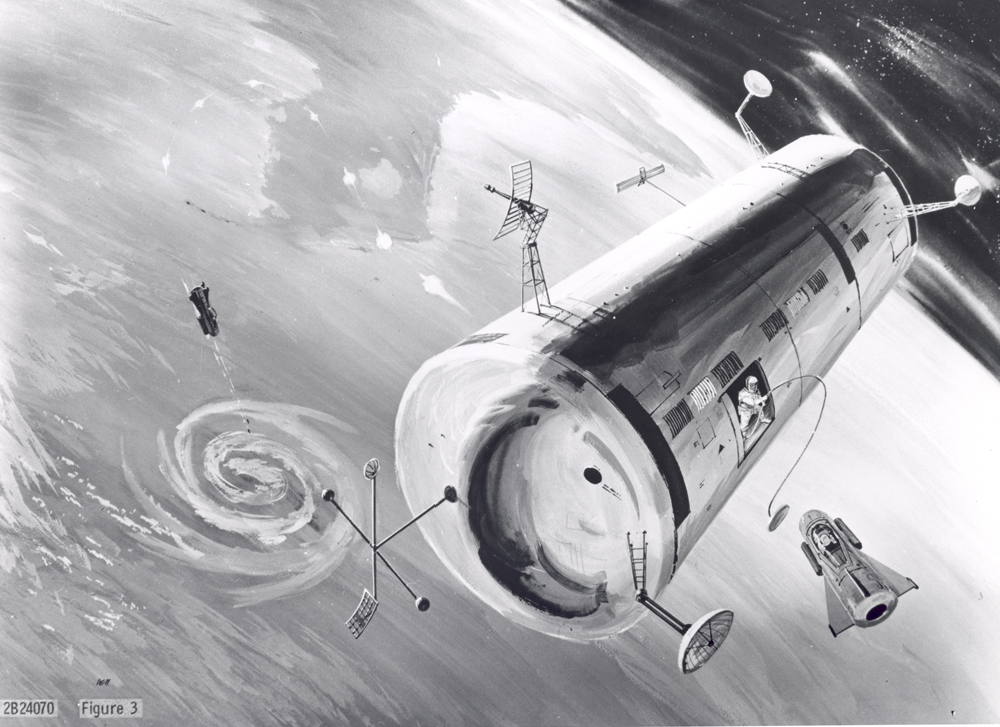
In this historical photo from the U.S. space agency, a 1960 concept image of the United States Air Force’s proposed Manned Orbiting Laboratory (MOL) that was intended to test the military usefulness of having humans in orbit. The station’s baseline configuration was that of a two-person Gemini B spacecraft that could be attached to a laboratory vehicle.
The structure was planned to launch onboard a Titan IIIC rocket. The station would be used for a month and then the astronauts could return to the Gemini capsule for transport back to Earth. The first launch of the MOL was scheduled for December 15, 1969, but was then pushed back to the fall of 1971.
The program was cancelled by Defense Secretary Melvin R. Laird in 1969 after the estimated cost of the program had risen in excess of $3 billion, and had already $1.3 billion. Some of the military astronauts selected for the program then transferred to NASA and became some of the first people to fly the Space Shuttle, including Richard Truly, who later became the NASA Administrator. (via Space History Photo: Proposed USAF Manned Orbiting Laboratory | Space.com)
Read more
Read more“Deep space, deep in the forest” location unknown by Constantinos Hinis
Source: CostaDinos (flickr)
Derin uzay, derin orman.
zerosociety: wolvensnothere: a-love-letter-to-atrocity: what the fuck is that about Fucking Royals is what. Mysterious childbirth. Strangers bearing tribute. Layer upon layer of co-opted images and occult ritual masquerading as tradition. Mammon ascendent and the powerful engaging in the most conspicuous consumption. Sol Invictus? Nay, Sol-in-Chains is the watchword in the gilded hives of the […]
Read more "The Outer Church from Grant Morrison’s “The Invisibles” is inexplicably part of my internet community’s zeitgeist this Christmas."
Read moreyoung Kate Middleton and Prince William
OMG THIS IS PERFECT HOW CAN YOU NOT REBLOG
This actually disturbs the shit out of me.
Royalty are monstrous and alien.
You can’t see where she has “MOONCHILD’S MUM” written on her chest.


 The Committee to Nuke Elysium