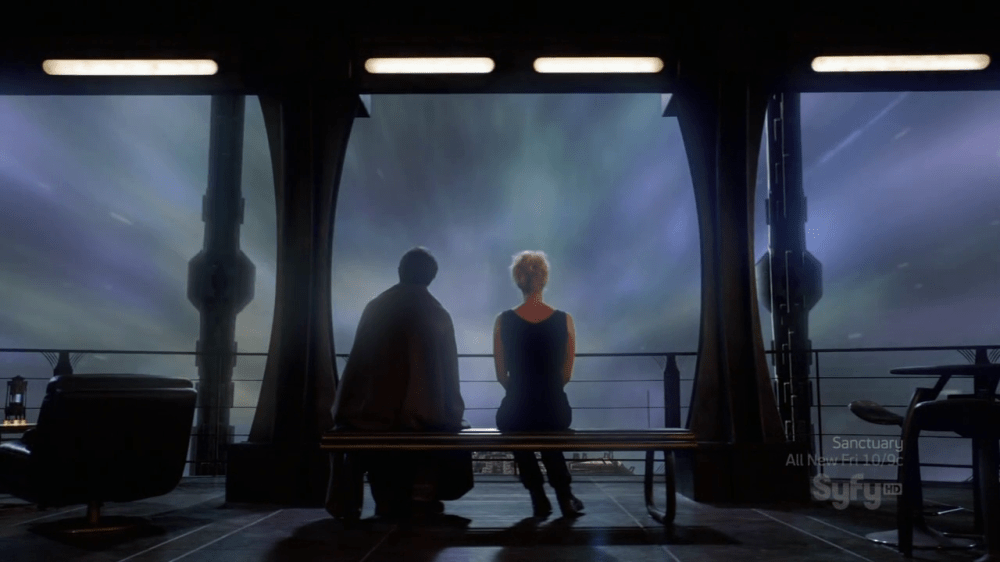
Dr Kane knows he’s dying.. or rather, is/was dead and is currently re-dying.
He asks to see The Stars one more time, realizing he’s just a shadow of his former self.
The FTL Effect – possible benefits include: mending fractured souls.
Read more
Dr Kane knows he’s dying.. or rather, is/was dead and is currently re-dying.
He asks to see The Stars one more time, realizing he’s just a shadow of his former self.
The FTL Effect – possible benefits include: mending fractured souls.
Read moreEvidence mounts that #theovervieweffect may also contain healing properties. New data suggests an “FTL effect” able to mend fractured souls. — m1k3y (@m1k3y) December 24, 2013 //platform.twitter.com/widgets.js
Read more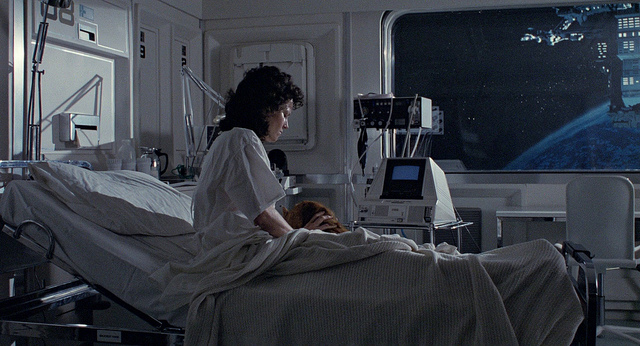
Hospital bed with an #overvieweffect on Flickr.
Via Flickr:
Ripley, recovering from an usually long hypersleep (57 years), has a bed in a hospital in space with a view.
(but what about Jonsie? Cat’s just bounce right back from hypersleep?!)
One of the screenplays inducted onto this year’s Black List (check out the complete list here) is by self-described “newbie” Stephany Folsom, and is intriguingly titled, 1969: A Space Odyssey or How Kubrick Learned to Stop Worrying and Land on the Moon (an obvious reference to both the title of Stanley Kubrick’s classic black-comedy satire from 1964, and to the director’s 2001: A Space Odyssey from 1968).
Folsom’s 108-page script (a drama) focuses on “Barbara,” a lone wolf working in the publicity department at NASA’s office in Washington, DC, in 1969. The story is an alternate history of how, as the Cold War rages, Barbara reaches out to and convinces acclaimed director Stanley Kubrick to work with NASA to fake the moon landing and one-up the Soviets.
“Hijinks ensue,” Folsom says.
The film is partly inspired by the famous conspiracy theory that Kubrick was recruited by the US government to direct a fake moon landing. “I’m a big conspiracy fan,” Folsom tells Mother Jones. “Now, I don’t necessarily believe in conspiracy theories—but I liked the idea.”
Read more "One of the Films on This Year’s Black List is an Alternate History of Stanley Kubrick Faking the Moon Landing"Ultimately, Hadfield says, being in space and staring down at the twinkling “jewel” that is the Earth, one quickly comes to realize how complex and compassionate our planet really is: “I think what everyone would find if they could be [up in space] — if they could see the whole world every 90 minutes and look down on the places where we do things right, and look down where we’re doing stupid, brutal things to each other and the inevitable patience of the world that houses us — I think everybody would be reinforced in their faith, and maybe readdress the real true tenets of what’s good and what gives them strength.”
http://m.huffpost.com/us/entry/4235055 | http://www.npr.org/2013/10/30/241830872/astronaut-chris–hadfield-brings-lessons-from-space-down-to-earth
Altered States & DNA – Francis Crick origins of life, aliens, panspermia, LSD via Graham Hancock
Well, for starters, Communism went away, and we’ve got a conspicuous lack of imminent nuclear armageddon. Now we’ve got a terrifying, major-league climate crisis that nobody talks about much, because oil companies and banks took over the world for a while.
The twenty-teens are about as different from the 1980s as the 1980s were from the 1950s. It’s still the same civilization, just a different point in time.
…
Well, look at it this way. The year 2014 is the centenary of World War One. When you hang out in Europe like I do, you stumble over the rubble of World War One, quite a lot. Humanity was in a truly dreadful place, one hundred years ago. The world situation of humanity was truly bitter and hateful and and deadly, and, well, here we are anyway. That’s the big picture.
There are a lot of times and places where “humanity” is headed in no place in particular. Those scenes interest me. Like, little European cultures with weird minority languages, who are just hanging around in obscure mountain valleys, making clay pots and singing, and knifing each other on Tuesdays. You might think that a chrome-and-matte-black science fiction writer would lack a cordial interest in penny-ante cultural scenes like that, but they have their merits. It’s not like we all line up and dash like mad for some end-goal called “The Future.” There’s no victory-condition for being human. The future is just a kind of history that hasn’t happened yet.
…
I recommend this high-tech dystopian flick called “Aelita, Queen of Mars.” “Aelita” was made by a crew of Soviet Communist-Futurists, and practically everybody involved in it was either rounded up by the secret police or forced into exile. Also, they had to stick a crap ending onto their sci-fi Mars movie, so that the Communist censor approved. Now that’s a really “dystopian” movie, you know? The kind where the guys *making* the movie are in a dystopia. The rest of it is kid stuff!
As for the “cyberpunk” part, forget about “the movies.” Abstract motion-graphics coded in Processing and posted on Vimeo, that’s “cyberpunk.” You don’t wanna make movies that are about guys with computers. You want to use digital composition to seize control of the means of producing cinema. And then do it all yourself! That’s “punk.” Hollywood product is commerce, it’s about fanboy culture.
…
Search engines are a major research aid for writers, but in the past few years, they’ve all been turning into surveillance-marketing engines. Now it’s like trying to get some fiction done, while Google is all like, “So! Finish that Coke yet? Hey, how about a six-pack?” It’s like Larry and Sergei are right in the room now, staring with Google Glass, and holding their breath.
…
We’ve gone away from science because our whole society’s gone away from science. We’re in a science-hostile society now, it’s politically dominated by Creationists and climate denialists.
Highlights from Chairman Bruce qna on /. – http://m.slashdot.org/story/195971



 The Committee to Nuke Elysium