
Read moreFYI – ZERO. Vol 1 – in stores February 19.
Diamond Code: DEC130554
RRP: $9.99Come to us.
Read moreMounting evidence from genome analysis of archaic populations has indicated that the various hominin species mated with each other.
When Neanderthal and modern human populations crossed paths, they interbred too. The Neanderthal genome data confirms that there was “leakage of DNA” from these extinct hominins into modern humans.
“Neanderthals live on a little bit in people living outside Africa today,” Pääbo said, making up about two percent of the genome of all humans that don’t originate from Africa.
Collating the genetic material of two related hominin species — the Neanderthals and Denisovans — and comparing it with sequence data of 25 humans, the researchers have triangulated in on a section of the hominin genome that is unique to our species.
“It’s a definitive recipe if you like for making a modern human,” Pääbo said. “We can now start doing experiments to ask what is it that makes modern humans special.”
“There is also an interesting question of what, if anything, Neanderthal and Denisovan DNA may be doing in the people that have it today, and whether it has been of benefit or detriment to our species,” Chris Stringer, a paleoanthropologist at the Natural History Museum in London, who was unconnected with the work, wrote in a comment sent to press.
Further research into what those areas coded for may reveal why we, homo sapiens, lived on while Denisovans, Neanderthals, and scores of our hominin relatives vanished.
wolvensnothere: I was on the road when you sent this, so I was unable to answer with the level of nuance and detail your question deserves. My problem with Transcendence is that it seems to recapitulate (I really like that word; it’s very evocative) the very rift that any science fiction focusing on human augmentation […]
Read more "i got all excited by your reblogging of the Transcendence trailer, and then a bit puzzled by your reaction. Care to expand upon it a lil bit pretty please? :)"


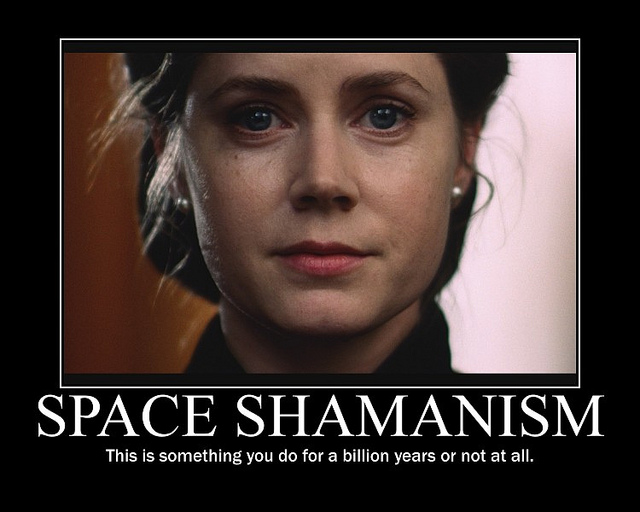
Behold the healing power of the Upsized #OverviewEffect! In this case a glimpse of a whole solar system. For Eli’s mother who’s been missing him terribly and is super depressed without her reason for being, and has stopped taking her meds because she has HIV donchaknow, but after a bit of Clarkean magix she’s transported to be with her boy via a loaner body, on the other side of the universe, and VOILÀ: from sad in hospital to beatific believer of the gospel of spaaace.
Read moreThe Titius–Bode law (sometimes termed just Bode’s law) is a hypothesis that the bodies in some orbital systems, including the Sun’s, orbit at semi-major axes in a function of planetary sequence. The hypothesis correctly predicted the orbits of Ceres and Uranus, but failed as a predictor of Neptune’s orbit. … When originally published, the law was approximately satisfied by all the known planets — Mercury through Saturn — with […]
Read more "Titus-Bode Law"The hyoid bone is crucial for speaking as it supports the root of the tongue. In non-human primates, it is not placed in the right position to vocalise like humans.
An international team of researchers analysed a fossil Neanderthal throat bone using 3D x-ray imaging and mechanical modelling.
This model allowed the group to see how the hyoid behaved in relation to the other surrounding bones.
Stephen Wroe, from the University of New England, Armidale, NSW, Australia, said: “We would argue that this is a very significant step forward. It shows that the Kebara 2 hyoid doesn’t just look like those of modern humans – it was used in a very similar way.”
Neanderthals could speak like modern humans, study suggests
Read more "Neanderthals could speak like modern humans, study suggests "Only about 600 Mangarevan speakers now remain on the island, and in any case its indigenous number system has long been superseded by Arabic digits because of the influence of French colonialism. But Bender and Beller have reconstructed it from descriptions written by (mostly European) authors in the nineteenth and early twentieth centuries.
They find that the former Mangarevans combined base-10 representation with a binary system. They had number words for 1 to 10, and then for 10 multiplied by several powers of 2. The word takau (which Bender and Beller denote as K) means 10; paua (P) means 20; tataua (T) is 40; and varu (V) stands for 80. In this notation, for example, 70 is TPK and 57 is TK7.
Bender and Beller show that this system retains the key arithmetical simplifications of true binary, in that you don’t need to memorize lots of number facts but follow only a few simple rules, such as 2 × K = P and 2 × P = T.
Polynesian people used binary numbers 600 years ago
Read more "Polynesian people used binary numbers 600 years ago"Only about 600 Mangarevan speakers now remain on the island, and in any case its indigenous number system has long been superseded by Arabic digits because of the influence of French colonialism. But Bender and Beller have reconstructed it from descriptions written by (mostly European) authors in the nineteenth and early twentieth centuries.
They find that the former Mangarevans combined base-10 representation with a binary system. They had number words for 1 to 10, and then for 10 multiplied by several powers of 2. The word takau (which Bender and Beller denote as K) means 10; paua (P) means 20; tataua (T) is 40; and varu (V) stands for 80. In this notation, for example, 70 is TPK and 57 is TK7.
Bender and Beller show that this system retains the key arithmetical simplifications of true binary, in that you don’t need to memorize lots of number facts but follow only a few simple rules, such as 2 × K = P and 2 × P = T.
Polynesian people used binary numbers 600 years ago
Read more "Polynesian people used binary numbers 600 years ago"


 The Committee to Nuke Elysium