
forever reblog
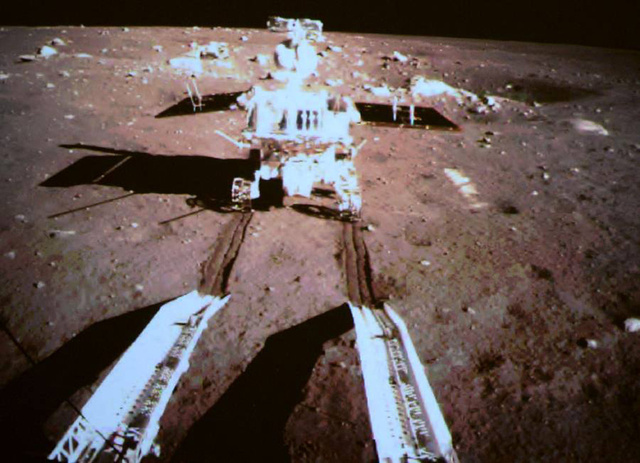
China’s “Jade Rabbit” lands safely on the Moon (in fast motion).

It is accepted by mainstream archaeology that civilization started in Iraq, in ancient Mesopotamia with the great civilisation of Sumeria. However, there is an archaeological discovery at the Al Ubaid archaeological site, where many pre-Sumerian 7,000-year-old artefacts were found, depicting humanoid figures with lizard characteristics.
The Ubaidian culture is a prehistoric culture in Mesopotamia that dates between 4000 and 5500 BC. As with the Sumerians, the origins of the Ubaidian people is unknown. They lived in large village settlements in mud-brick houses and they had developed architecture, agriculture and farmed the land using irrigation. The domestic architecture included large T-shaped houses, open courtyards, paved streets, as well as food processing equipment. Some of these villages began to develop into towns, temples began to appear, as well as monumental buildings such as in Eridu, Ur and Uruk, the major sites of the Sumerian Civilization. According to the Sumerian texts, Ur was believed to be the first city.
The main site where the unusual artefacts were discovered is called Tell Al’Ubaid – although figurines were also found in Ur and Eridu. The Al’Ubaid site is a small mound of about half a kilometre in diametre and two meters above ground. The site was first excavated by Harry Reginald Hal in 1919. Male and female figurines were found in different postures and in most of the figurines, they appear to be wearing a helmet and have some kind of padding on the shoulders. Other figurines were found to hold a staff or sceptre, possibly as a symbol of justice and ruling. Each figurine has a different pose but the strangest of all is that some female figurines hold babies suckling milk, with the child also represented as a lizard-type creature.
The figurines are presented with long heads, almond shaped eyes, long tapered faces and a lizard-type nose. What exactly they represent is completely unknown. According to archaeologists, their postures, such as a female figure breast-feeding, does not suggest that they were ritualistic objects. So what did these lizard figures represent?
Read more
Nestled in an acid-free corrugated cardboard container was the earliest known example of telephone technology in the Western Hemisphere, evoking a lost civilization—and the anonymous ancient techie who dreamed it up.
The gourd-and-twine device, created 1,200 to 1,400 years ago, remains tantalizingly functional—and too fragile to test out. “This is unique,” NMAI curator Ramiro Matos, an anthropologist and archaeologist who specializes in the study of the central Andes, tells me. “Only one was ever discovered. It comes from the consciousness of an indigenous society with no written language.”
We’ll never know the trial and error that went into its creation. The marvel of acoustic engineering—cunningly constructed of two resin-coated gourd receivers, each three-and-one-half inches long; stretched-hide membranes stitched around the bases of the receivers; and cotton-twine cord extending 75 feet when pulled taut—arose out of the Chimu empire at its height. The dazzlingly innovative culture was centered in the Río Moche Valley in northern Peru, wedged between the Pacific Ocean and the western Andes. “The Chimu were a skillful, inventive people,” Matos tells me as we don sterile gloves and peer into the hollowed interiors of the gourds. The Chimu, Matos explains, were the first true engineering society in the New World, known as much for their artisanry and metalwork as for the hydraulic canal-irrigation system they introduced, transforming desert into agricultural lands.
Read moreteaser for new Nolan movie, Interstellar.
could this be what i wished Star Trek had been? http://blog.m1k3y.com/?p=1558

The idea that Neanderthals buried their dead fits with recent findings that they were capable of symbolic thought and of developing rich cultures. For example, findings show they likely decorated themselves using pigments, and wore jewelry made of feathers and colored shells.
Evidence from the La Chapelle site also suggests that Neanderthals were like us in that they cared for their sick and elderly. The skeleton discovered by the Bouyssonie brothers belonged to a Neanderthal who was missing most of his teeth and showed signs of hip and back problems that would have made movement difficult without assistance.
“Before they took care of his dead body, the other members of his group would have had to have taken care of his living one,” Rendu said.
Read moreThe early Martian atmosphere appears to have been warm and wet – prime conditions for the development of life.
And if Martian microbes ever did exist, transfer to Earth is “highly probable” due to the heavy traffic of meteorites between our planets, Ms Worth told BBC News.
“Billions have fallen on Earth from Mars since the dawn of our planetary system. It is even possible that life on Earth originated on Mars.”
While her team are not the first to calculate that panspermia is possible, their 10-million-year simulation is the most extended yet, said astrobiologist Prof Jay Melosh, of Purdue University.
“The study strongly reinforces the conclusion that, once large impacts eject material from the surface of a planet such as the Earth or Mars, the ejected debris easily finds its way from one planet to another,” he told BBC News.
“The Chicxulub impact itself might not have been a good candidate because it occurred in the ocean (50 to 500m deep water) and, while it might have ejected a few sea-surface creatures, like ammonites, into space, it would not likely have ejected solid rocks.
"I sometimes joke that we might find ammonite shells on the Moon from that event.
"But other large impacts on the Earth may indeed have ejected rocks into interplanetary space.”
Another independent expert on panspermia, Mauricio Reyes-Ruiz of the National Autonomous University of Mexico, said the new findings were “very significant”.
“The fact such different pathways exist for the interchange of material between Earth and bodies in the Solar System suggests that if life is ever found, it may very well turn out to be our very, very distant relatives,” he said.
Dinosaur asteroid ‘sent life to Mars’
Read more "Dinosaur asteroid ‘sent life to Mars’"


 The Committee to Nuke Elysium