

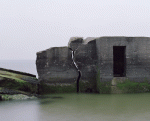

Read moreLandscape as a Witness to War by Marc Wilson
Along European coastline, unintentional monuments to past conflicts still stand. Built to keep foreign forces out during WWII.
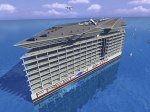


Read moreFreedom Ship – Freedom Ship International, 1990s
Seasteading – The Seasteading Institute, 2008
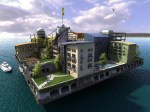
Cities in The Sea – Venus Project, 2002
Operation Atlantis – Werner Stiefel,1971 (no image)
Blueseed – Blueseed 2011
New Utopia – Lazarus Long, 1990s
Eugene Tsui – Nexus, 1986
Floating Utopias, China Mieville
Floating cities are dreamed of because how cool is that?–an entirely legitimate, admirable reason. The archives of seasteading are irresistible reading, the best of the utopias are awesome, and floating-city imaginings are in themselves a delightful mental game. The problem is the crippling of this tradition by free-market vulgarians.
The uncompromising monoliths of fascist and Stalinist architecture expressed their paymasters’ monstrous ambitions. The wildest of the libertarian seasteaders, New Utopia, manages to crossfertilize its drab Miami-ism with enough candy floss Las Vegaries to keep a crippled baroque distantly in sight. Freedom Ship, however, is a floating shopping mall, a buoyant block of midrange Mediterranean hotels. This failure of utopian imagination is nowhere clearer than in the floating city of the long defunct but still influential Atlantis Project.
It is a libertarian dream. Hexagonal neighborhoods of square apartments bob sedately by tiny coiffed parks and tastefully featureless marinas, an Orange County of the soul. It is the ultimate gated community, designed not by the very rich and certainly not by the very powerful, but by the middlingly so. As a utopia, the Atlantis Project is pitiful. Beyond the single one-trick fact of its watery location, it is tragically non-ambitious, crippled with class anxiety, nostalgic not for mythic glory but for the anonymous sanctimony of an invented 1950s. This is no ruling class vision: it is the plaintive daydream of a petty bourgeoisie, whose sulky solution to perceived social problems is to run away–set sail into a tax-free sunset.
Read moreWouldn’t it be nice if one day, told that Google’s mission is to “organize the world’s information and make it universally accessible and useful,” we would finally read between the lines and discover its true meaning: “to monetize all of the world’s information and make it universally inaccessible and profitable”? With this act of subversive interpretation, we might eventually hit upon the greatest emancipatory insight of all: Letting Google organize all of the world’s information makes as much sense as letting Halliburton organize all of the world’s oil.
Read moreIf you can’t get in your self-driving google car at the private airport and tell it to take you to the replacement limb clinic, then you’re just not going to get one.
The jacket has a sheep shearling collar, cotton grosgrain outer, quilted rayon inner, brass fasteners, and two hidden hand pockets. While the B-29 isn’t as highly technical as the 1957 replica MA-1, seller Self Edge describes it as “super warm.” If you’re in the market for a briefcase, there’s also Gibson’s collection of bags with Japanese bag company Porter and Buzz Rickson’s, which features military grade ballistic nylon and horse leather.
Sci-fi legend William Gibson teams up with Buzz Rickson’s on B-29 bomber jacket | The Verge
Read more "Sci-fi legend William Gibson teams up with Buzz Rickson’s on B-29 bomber jacket | The Verge"
ISRO was founded in 1969. In the last 44 years, it has achieved remarkable feats on a shoe-string budget. India has its own satellites for communication, weather data, agricultural data, and military applications. ISRO’s R&D has not just helped India remain a technologically advanced country, it has also saved lives. In 1999, a fierce cyclone hit India’s east coast, killing more than 10,000 people. Earlier this year, an even more powerful cyclone hit the same region but caused only a handful deaths. One of the main reasons for this contrast is that India’s improved weather-monitoring systems provided accurate early warnings.
Read more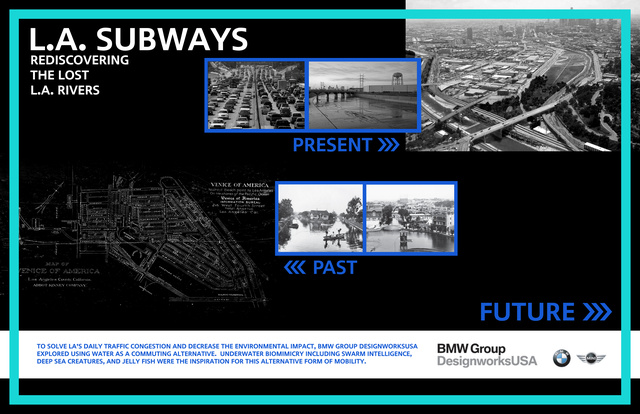
The other key part of BMW Designworks’ proposal is taking the L.A. River and other tributaries and filling them with enough water so these little submarines can travel around the city on these newly created “subways.” In the winter the water does flow tremendously deep through these channels, so they reasoned that flooding the channels permanently would create a dual benefit of replenishing L.A.’s groundwater and preventing billions of gallons of stormwater from flowing directly into the ocean.
…
While we probably won’t have these fleets of Mini-subs taking over our waterways just yet, this concept does help us start to think of L.A. as more of a river city. The BMW Designworks team sees us not only using existing rivers and bays for transportation, but also reinstating Venice Beach’s canal system (which was once much larger than it is now), and possibly daylighting more creeks that have been asphalted over.
Maybe more feasible is a coastal transportation network—which, right now, only really consists of private ferries to Catalina—that would allow people in, say, Marina del Rey to commute to Long Beach via ferry instead of the 405 Freeway, or to take a water taxi from Santa Monica to Malibu and thus avoid traffic on the Pacific Coast Highway.
Read more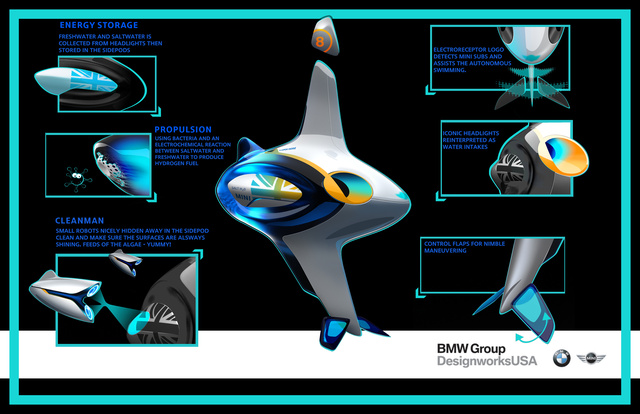
Inspired by bioluminescence in jellyfish, the Mini Cooper pods would use a chemical reaction created when salt and fresh water mix in the presence of certain bacteria, creating hydrogen fuel. This process not only generates energy, but the water intake/outtake system can also serve as the propulsion method for the craft. Tiny “cleaner” robots, inspired by many types of fish that do this in real life, keep the Mini clean by nibbling algae from its surfaces.
Read more
In reality, once helmet, gloves and an oxygen-supplying backpack were added, it was a wearable spacecraft. Cocooned within 21 layers of synthetics, neoprene rubber and metalized polyester films, Armstrong was protected from the airless Moon’s extremes of heat and cold (plus 240 Fahrenheit degrees in sunlight to minus 280 in shadow), deadly solar ultraviolet radiation and even the potential hazard of micrometeorites hurtling through the void at 10 miles per second.
The Apollo suits were blends of cutting-edge technology and Old World craftsmanship. Each suit was hand-built by seamstresses who had to be extraordinarily precise; a stitching error as small as 1/32 inch could mean the difference between a space-worthy suit and a reject. While most of the suit’s materials existed long before the Moon program, one was invented specifically for the job. After a spacecraft fire killed three Apollo astronauts during a ground test in 1967, NASA dictated the suits had to withstand temperatures of over 1,000 degrees Fahrenheit. The solution was a state-of-the-art fabric called Beta cloth, made of Teflon-coated glass microfibers, used for the suit’s outermost layer.
Read more
 The Committee to Nuke Elysium