"Practical Design Fiction", metafictional machine gods and the blocky prototypes of the Holographic Universe

Matt Jones gave this talk at #interaction15 earlier this year, which went up on vimeo some four weeks ago, which I’m only watching and processing now because I’ve been elsewhere. BUT… drilling deeper into the mechanics of design fiction and its implications for #thework are very high on my permanent #todolist for this hashtaggin’ year. […]

Read more ""Practical Design Fiction", metafictional machine gods and the blocky prototypes of the Holographic Universe"

“What we’re seeing is perhaps the beginning of a unique characteristic of our own species – the origins of diversity,” said Dr Jay Stock, co-author of the study from the University of Cambridge’s Department of Archaeology and Anthropology. “It’s possible to interpret our findings as showing that there were either multiple species of early human, such as Homo habilis, Homo ergaster and Homo rudolfensis, or one highly diverse species. This fits well with recent cranial evidence for tremendous diversity among early members of the genus Homo.”

“If someone asked you ‘are modern humans 6 foot tall and 70kg?’ you’d say ‘well some are, but many people aren’t,’ and what we’re starting to show is that this diversification happened really early in human evolution,” said Stock.

The study is the first in 20 years to compare the body size of the humans who shared the earth with mammoths and sabre-toothed cats between 2.5 and 1.5 million years ago. It is also the first time that many fragmentary fossils – some as small as toes and tiny ankle bones no more than 5cm long – have been used to make body size estimates.

Read more

Based on the concentration of Fe-60 in the crust, Knie estimated that the supernova exploded at least 100 light-years from Earth—three times the distance at which it could’ve obliterated the ozone layer—but close enough to potentially alter cloud formation, and thus, climate. While no mass-extinction events happened 2.8 million years ago, some drastic climate changes did take place—and they may have given a boost to human evolution. Around that time, the African climate dried up, causing the forests to shrink and give way to grassy savanna. Scientists think this change may have encouraged our hominid ancestors as they descended from trees and eventually began walking on two legs.

That idea, as any young theory, is still speculative and has its opponents. Some scientists think Fe-60 may have been brought to Earth by meteorites, and others think these climate changes can be explained by decreasing greenhouse gas concentrations, or the closing of the ocean gateway between North and South America. But Knie’s new tool gives scientists the ability to date other, possibly more ancient, supernovas that may have passed in the vicinity of Earth, and to study their influence on our planet. It is remarkable that we can use these dull, slow-growing rocks to study the luminous, rapid phenomena of stellar explosions, Fields says. And they’ve got more stories to tell.

Read more

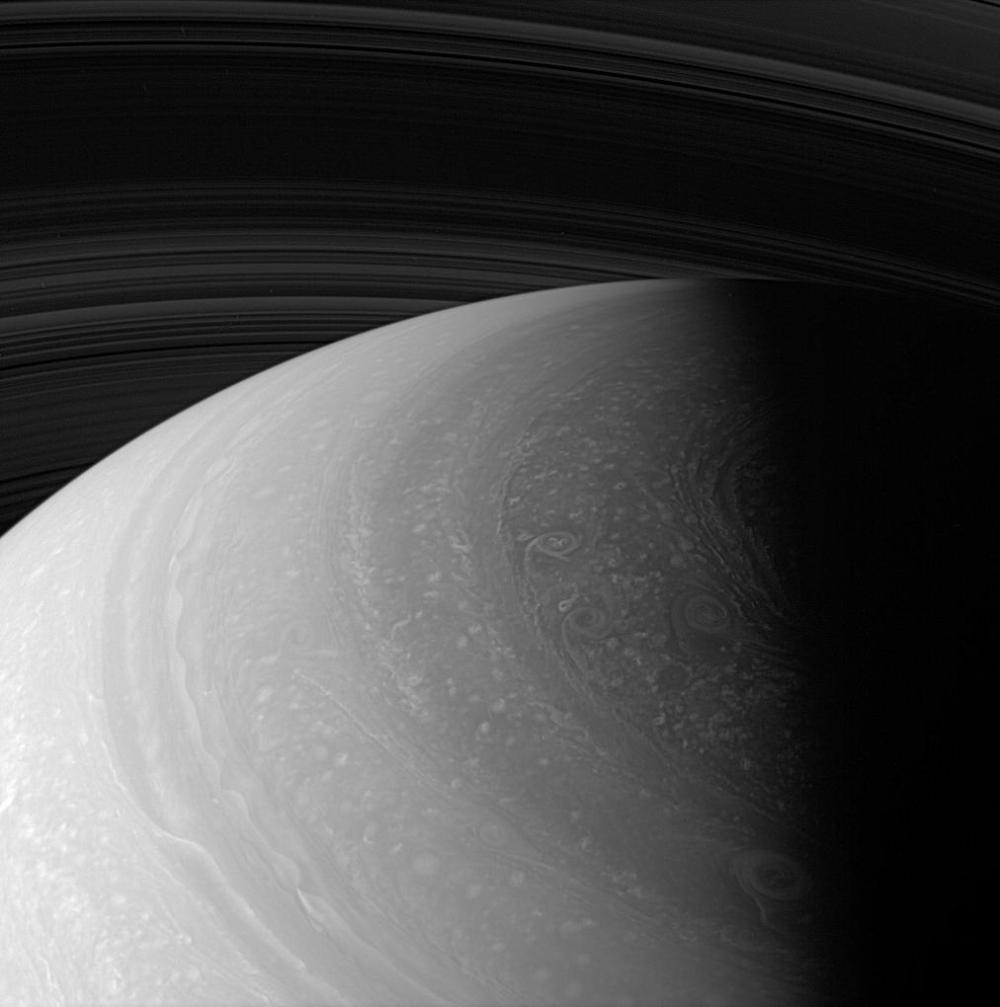
This scene reveals many features in Saturn’s dynamic and beautiful atmosphere, including a detail largely obscured from the imaging cameras until now. On the terminator at center right is part of the polar hexagon, which was previously observed by Cassini’s Visible and Infrared Mapping Spectrometer (VIMS) and Composite Infrared Spectrometer (CIRS). These instruments used heat radiated from Saturn to observe the polar hexagon (rather than reflected sunlight, as is the case in this view). The hexagon was first imaged by the Voyager spacecraft more than 25 years ago.

Read more

Nasa scientist Daniel Glavin described the results from the first “wet chemistry” experiment carried out by Curiosity.

A long-chain carboxylic acid, or fatty acid, was a good fit for one of the data peaks detected in a mudstone called Cumberland, he told an audience at the meeting. A form of alcohol molecule may also be among the compounds analysed.

The preliminary result will excite scientists because fatty acids are key components of the cell membranes found in all life forms, including microbial organisms.

Dr Glavin told an audience that the result was “provocative”, and said the link to biology was the “million-dollar question”. But he explained that a non-biological origin was equally plausible at this stage of the research.

One scientist commenting on the presentation suggested that contamination could not be ruled out as a cause of the signal.

The SAM team have been working to address the leak of a pre-existing chemical called MTBSTFA within the instrument.

The fact this is also an organic molecule has complicated the search for indigenous carbon-containing compounds in Martian rocks.

However, team members say they have turned the leak into an advantage, using their understanding of how MTBSTFA reacts with other compounds to identify Martian organics.

Read more

Using NASA’s Kepler satellite, astronomers have found about 1,000 planets around stars in the Milky Way and they have also found about 3,000 other potential planets. Many of the stars have planetary systems with 2-6 planets, but the stars could very well have more planets than those observable with the Kepler satellite, which is best suited for finding large planets that orbit relatively close to their stars.
Planets that orbit close to their stars would be too scorching hot to have life, so to find out if such planetary systems might also have planets in the habitable zone with the potential for liquid water and life, a group of researchers from the Australian National University and the Niels Bohr Institute at the University of Copenhagen made calculations based on a new version of a 250-year-old method called the Titius-Bode law.

The Titius-Bode law was formulated around 1770 and correctly calculated the position of Uranus before it was even discovered. The law states that there is a certain ratio between the orbital periods of planets in a solar system. So the ratio between the orbital period of the first and second planet is the same as the ratio between the second and the third planet and so on. Therefore, if you knew how long it takes for some of the planets to orbit around the Sun/star, you can calculate how long it takes for the other planets to orbit and can thus calculate their position in the planetary system. You can also calculate if a planet is ‘missing’ in the sequence.

“We decided to use this method to calculate the potential planetary positions in 151 planetary systems, where the Kepler satellite had found between 3 and 6 planets. In 124 of the planetary systems, the Titius-Bode law fit with the position of the planets. Using T-B’s law we tried to predict where there could be more planets further out in the planetary systems. But we only made calculations for planets where there is a good chance that you can see them with the Kepler satellite,” explains Steffen Kjær Jacobsen, PhD student in the research group Astrophysics and Planetary Science at the Niels Bohr Institute at the University of Copenhagen.

In 27 of the 151 planetary systems, the planets that had been observed did not fit the T-B law at first glance. They then tried to place planets into the ‘pattern’ for where planets should be located. Then they added the planets that seemed to be missing between the already known planets and also added one extra planet in the system beyond the outermost known planet. In this way, they predicted a total of 228 planets in the 151 planetary systems.

“We then made a priority list with 77 planets in 40 planetary systems to focus on because they have a high probability of making a transit, so you can see them with Kepler. We have encouraged other researchers to look for these. If they are found, it is an indication that the theory stands up,” explains Steffen Kjær Jacobsen.

Planets that orbit very close around a star are too scorching hot to have liquid water and life and planets that are far from the star would be too deep-frozen, but the intermediate habitable zone, where there is the potential for liquid water and life, is not a fixed distance. The habitable zone for a planetary system will be different from star to star, depending on how big and bright the star is.

The researchers evaluated the number of planets in the habitable zone based on the extra planets that were added to the 151 planetary systems according to the Titius-Bode law.

***The result was 1-3 planets in the habitable zone for each planetary system.***

Out of the 151 planetary systems, they now made an additional check on 31 planetary systems where they had already found planets in the habitable zone or where only a single extra planet was needed to meet the requirements.

“In these 31 planetary systems that were close to the habitable zone, our calculations showed that there was an average of two planets in the habitable zone. According to the statistics and the indications we have, a good share of the planets in the habitable zone will be solid planets where there might be liquid water and where life could exist,” explains Steffen Kjær Jacobsen.

If you then take the calculations further out into space, it would mean that just in our galaxy, the Milky Way, ***there could be billions of stars with planets in the habitable zone***, where there could be liquid water and where life could exist.

He explains that what they now want to do is encourage other researchers to look at the Kepler data again for the 40 planetary systems that they have predicted should be well placed to be observed with the Kepler satellite.


Planets in the habitable zone around most stars, researchers calculate  – http://www.sciencedaily.com/releases/2015/03/150318074515.htm
Read more