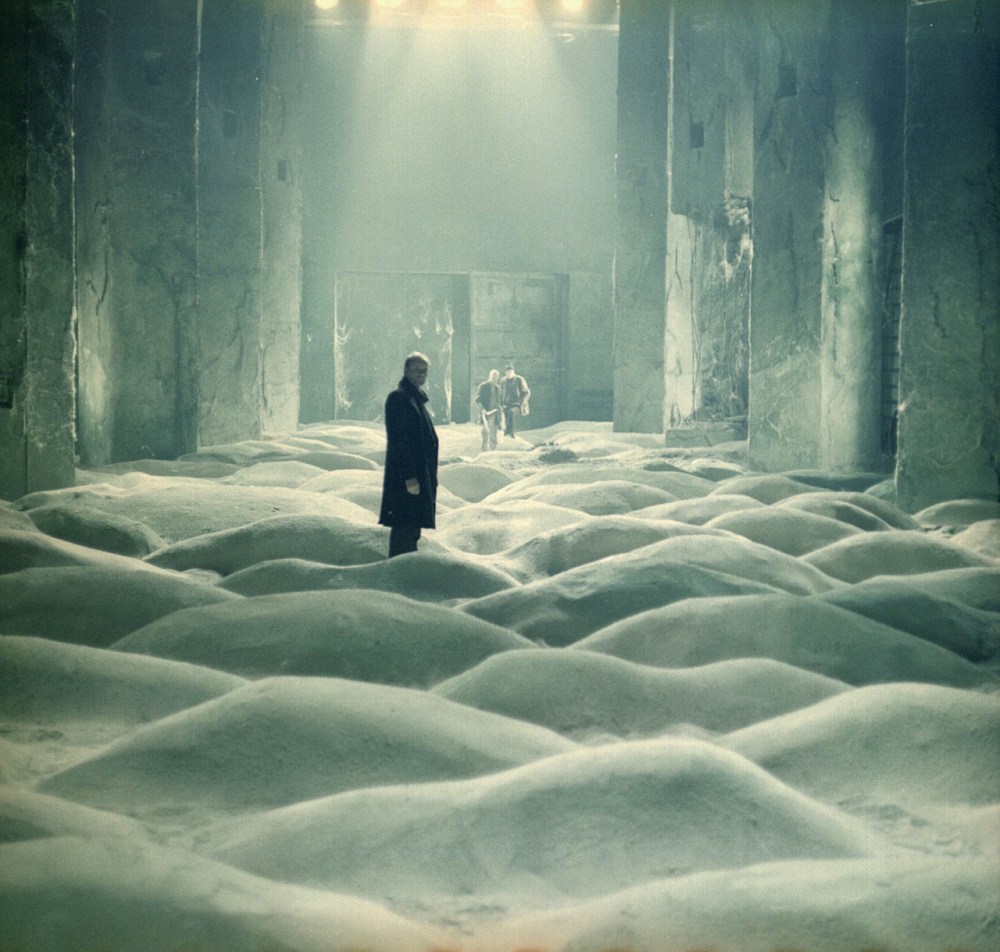
Read moreSTALKER, Andrei Tarkovsky, 1979.


Read moreThis was the state of space debris in 2008 according to the European Space Operations Centre. The amount of space debris has now become so large that it is threatening economically vital orbital regions.
Read moreIn 2005, a few years before Blomkamp made his feature directing debut with District 9, he was shooting a Nike commercial in San Diego when his exec producer suggested they pop down to Tijuana for the night. So they set off in a rental car and hit the main tourist drag, Avenida Revolución, at dusk, bought a couple of beers in brown paper bags, and started strolling down the street. Suddenly, two Federales (Mexican police) pulled up onto the curb. “They got out of the car, threw me onto the hood, cuffed me, took my passport, did the same to my friend and threw us into the back of the car,” Blomkamp says. “They weren’t speaking to us; they just started driving us out of the city.”
His exec producer, who was carrying petty cash from their commercial shoot, began rolling up bills and shoving them through the grate that separated the backseat from the front. “When we’d reached some critical mass — $900 or something — they let us out of the car,” Blomkamp says. It was dark, they had no idea where they were, and they had at least a two-hour trek ahead of them. “We were walking through these totally impoverished, insane areas with feral dogs and crying babies and people making fires, and on the horizon I could see the floodlights from the U.S. shining into Mexico, and there were multiple Black Hawks flying the perimeter, and it was like science fiction on Earth,” he says. “Nothing has changed, but now you’re on the other side of the border.” His goal with Elysium, he says, was to put all of us there.
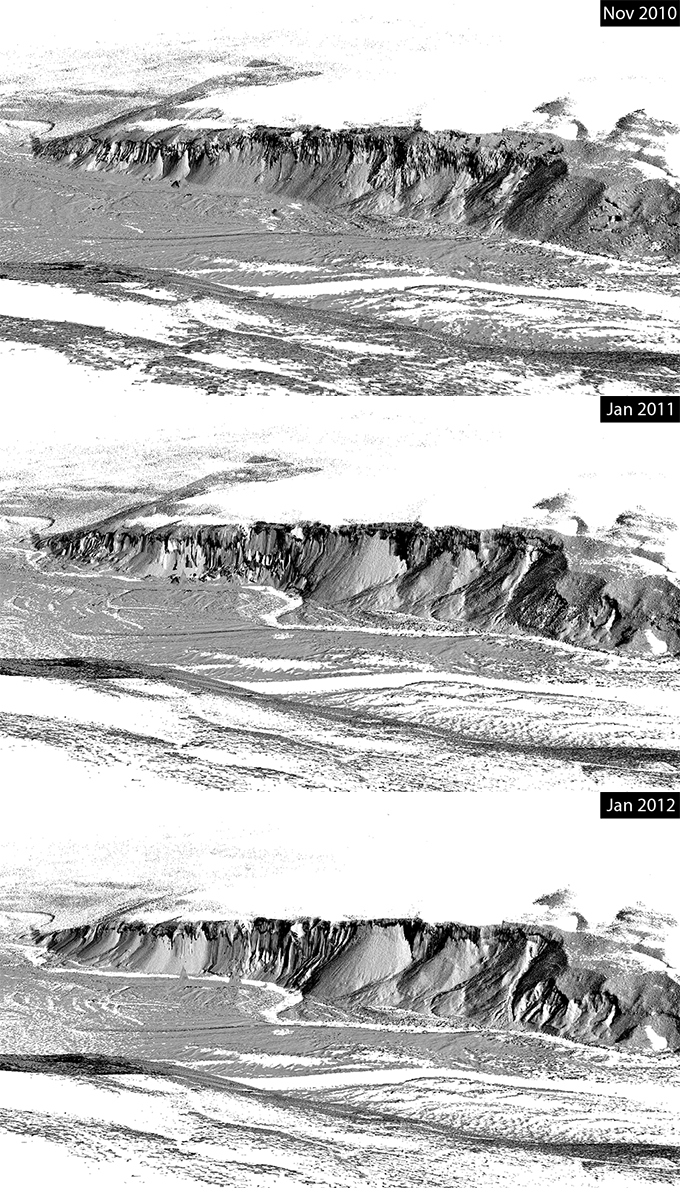
In another study, researchers from the University of Texas at Austin found that coastal Antarctic permafrost—which, unlike Arctic permafrost, was considered to be stable—is actually melting much faster than scientists had expected. Researchers had though that the permafrost in the region was in equalibrium—ice would melt during the summer, only to refreeze in the winter. But the Texas study, published in Scientific Reports, shows a rapid melting of permafrost in Antarctica’s Garwood Valley, diminishing the overall mass of ground ice. “The big tell here is that ice is vanishing—it’s melting faster each time we measure,” said Joseph Levy, a research associate at the University of Texas’s Institute for Geophysics and the lead author on the paper.
“That’s a dramatic shift from recent history.”
It’s important to note that global warming is not responsible for the permafrost melt here—that region of Antarctic actually experienced a cooling trend from 1986 to 2000, followed by relatively stable temperatures. The Scientific Letters researchers suggest instead that the melting is due to an increase in radiation from sunlight resulting from changing weather patterns that allow more light to reach the ground during the summer. (In the winter, of course, Antarctica experiences 24-hour darkness.) As the permafrost melts, it actually alters the land surface, creating “retrogressive thaw slumps.” The changes observed in the study are occurring around 10 times faster than the average during the Holocene, the current geological epoch, and can actually be seen with time-lapse photography
Read more
Read more“There’s a poem I read in which a rat becomes the unit of currency.”
“Yes. That would be interesting,” Chin said.
“Yes. That would impact the world economy.”
“The name alone. Better than the dong or the kwacha.”
“The name says everything.”
“Yes. The rat,” Chin said.
“Yes. The rat closed lower today against the euro.”
“Yes. There is growing concern that the Russian rat will be devalued.”
“White rats. Think about that.”
“Yes. Pregnant rats.”
“Yes. Major sell-off of pregnant Russian rats.”
“Britain converts to the rat,” Chin said.
said.
“Yes. Joins trend to universal currency.”
“Yes. U.S. establishes rat standard.”
“Yes. Every U.S. dollar redeemable for rat.”
“Dead rats.”
“Yes. Stockpiling of dead rats called global health menace.
Read moreWhat Warner meant when he called the Taj a “Burner bar” was that it operated, in part, according to a barter system. One of the standing rules at the guesthouse was that any expat could exchange information for booze. In a war zone where so many different agencies, companies, and contractors passed like wary ships in the night, one of the biggest problems was that no one could coordinate knowledge. No one, that is, except maybe a bartender. Under the banner of “Beer for Data,” Warner had turned the Taj into a major clearinghouse for information in Jalalabad. It accumulated by the terabyte on his hard drives: construction plans, hydrology surveys, health-clinic locations, election polling sites, names of farmers, number of trees on their farms, number of acres. What Warner collected he then passed on to the United Nations, the Pentagon, and anyone else who asked for it.
Warner let on that there was a lot more to tell, and that he was making a trip into the field a couple days later. But he offered no invitation, and I went to bed, leaving him at his laptop.
And that was how I met Dr. Dave: a former U.S. Army drill instructor, self-avowed “hippie doctor,” PhD neuroscientist, technotopian idealist, dedicated Burner, dabbler in psychedelics, insatiable meddler, and (weirdest of all) defense contractor. Unlike the guys who had come to the war mainly for the hazard pay, Warner seemed genuinely bent on something far grander—redeeming the debacle of Afghanistan through the gospel of open information.
…
Using various pots of money, Warner had built dozens of these solar-powered computer labs around the province. Some, like this one, didn’t have an Internet connection—at least not yet—and were, in Warner’s mind, just stepping stones to the computer literacy that would one day make these kids potential sources of crowdsourced information. Other computer labs, closer to town, had Internet pumped in from the antennae and satellite dishes on the roof of the Taj. In those labs, Warner and his team were teaching Afghans how to use OpenStreetMap, a Web-based platform that allows users to add fine-grained local information to existing satellite maps. (As a result, the OpenStreetMap page for Jalalabad is exquisite.)
Warner was doing it on the cheap—no security details, no armored vehicles—stretching his DARPA funding and his own bank account fairly far. “For the price of two expat security contractors,” he boasted, “I can put Internet to 50,000 students.”…
I was just beginning to get used to his way of talking, which alternated between turgid military jargon and gonzo flights of fancy. (“I’m dismantling the Death Star,” he told me later, “to build solar ovens for the Ewoks.”) Ultimately, what he wanted to do was help the Department of Defense and all its scattered parts—a hulking war apparatus he derisively called “The Machine”—help itself. “I’ve foolishly created my own counterinsurgency,” he said.
— this is my rough, back of the envelope political design fiction; an attempt to envisage a positive outcome out of a nightmarish scenario that is #auspol currently under the leadership of Chairman Rudd Background: The PNG Government are now accepting the refugees from Sri Lanka, Iran and Afghanistan that have been making the perilous […]
Read more "Australia, PNG and “the boat people” – a quick political design fiction"
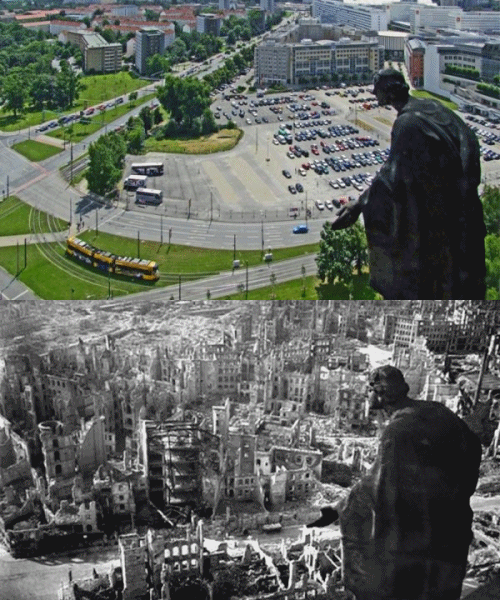
 The Committee to Nuke Elysium