Read moreThe idea that cultural change is driven by lines of flight helps us redress a common misconception about the sixties counterculture. The counterculture was not fundamentally oriented against mainstream society. It is true that the counterculture was defined by the rejection of the society that existed at the time. It is also true that, in the 1970s, the militant end of the counterculture positioned itself against the state in an effort to create a popular movement to overthrow it. But the counterculture itself was oriented away from mainstream society rather than against it. It was driven by the desire for another world and way of life, and inspired by the belief that this world and life was possible. Having a ‘countercultural’ attitude does not necessarily involve hostility towards mainstream society. It signals a desire to leave the society that exists, to leave it to its own devices, and to grow creative (with new devices) with other like-minded people.
Author: m1k3y
Read moreThe best expression of countercultural lines of flight, however, can be seen in the the back-to-land movement in the United States in the late 1960s. Drop City, in Colorado, was the first of many hippie communities that sought to create a new kind of society. Between 1965 and 1973, thousands of middle class kids, in flight from Mom and Dad, society, the draft, careers, and social conventions of all kinds, came to Drop City and other communes like it in search of freedom and alternative lifestyles. The culture got by with a minimum of rules. Everything was set up to enable free-wheeling, nomadic lifestyles, which could be recreated or escaped at a moment’s notice. Nomadism, as Deleuze and Guattari understand it, doesn’t require moving around. You can sit still and be a nomad. Nomadism is a way of being. It involves refusing to be tied down by set categories and definitions. It is driven by a desire to experiment and explore, to learn, grow, and boldly venture forth on creative lines of flight.
…
Nomadism is a cultural norm. While there are plenty of people who simply want to ‘fit in’, the best and the brightest want to break out and head for the horizon.
When we look into the future, we dream of a world that is radically different from the one we know today. We may be stuck in offices, trapped in traffic, tied down by debt or shacked to unhappy relationships. Inside, we are nomads. We are already in flight. The mainland awaits.

Rather than Bond’s private infrastructure expensive cars and toys, Bourne uses public infrastructure as a superpower.
A battered watch and an accurate U-Bahn time-table are all he needs for a perfectly-timed, death-defying evasion of the authorities.
As Rod has already pointed out:
“Jason Bourne is the man-as-weapon, never troubled by indecision or doubt, immediately responsive, unbalancing his enemies’ battlefield underneath them. He moves forward constantly, like a shark, and lives in a fast forward that’s the exact opposite of bullet-time – blurred fragments experienced at extraordinary speed – and his reactions are all reflex-fast”
But in addition, Bourne wraps cities, autobahns, ferries and train terminuses around him as the ultimate body-armour, in ways that Old Etonians could never even dream of.
Read more

 Goresome
The five panelists shared Moonraker clips, Pynchon quotes, and McLuhan-esque aphorisms: All our metaphors are broken. McNeil put the New Aesthetic in art-historical context. Bridle quoted Julian Assange: “We must think beyond those who have gone before us, and discover technological changes that embolden us with ways to act in which our forebears could not.” They took no questions. When it was over, they paraded the drone back to the bungalow they’d rented for the week and jumped into the pool with it.
The New Aesthetic: James Bridle’s Drones and Our Invisible, Networked World | Vanity Fair (via iamdanw)
Read more
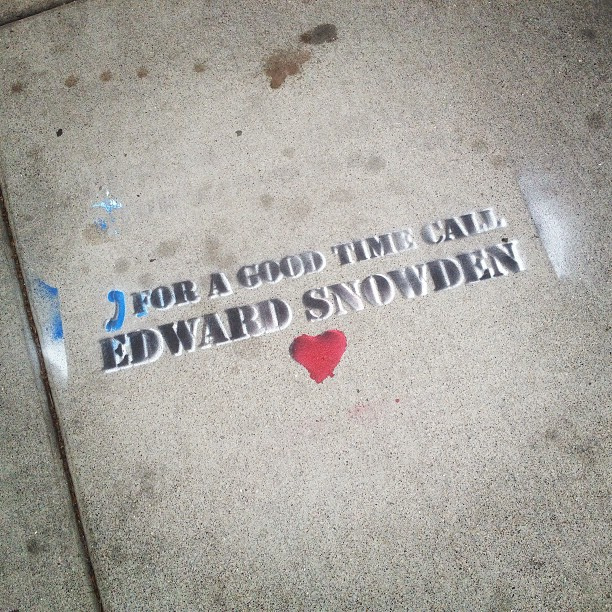
Read moreSo these showed up all over San Francisco last night… #EdwardSnowden by sfslim on Flickr.
For a good time call Edward Snowden
 The Committee to Nuke Elysium