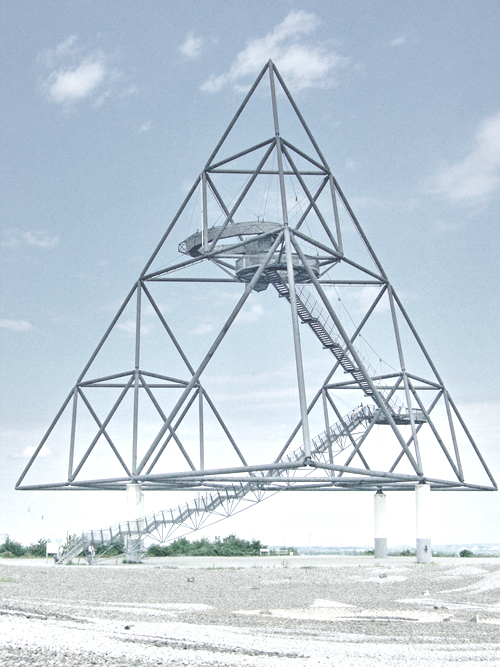
Read more(via (Image) – fasels Suppe)
I need to visit the universe where this is the truth of things. I NEED THIS NOW.
Read more(via (Image) – fasels Suppe)
I need to visit the universe where this is the truth of things. I NEED THIS NOW.

Read moreFurther reading via
Fukushima Disaster Caused Mutant Butterflies, Study | Asian Scientist Magazine | Science, Technology and Medicine News Updates From Asia
The Fukushima Disaster Produced Mutant Irradiated Butterflies.
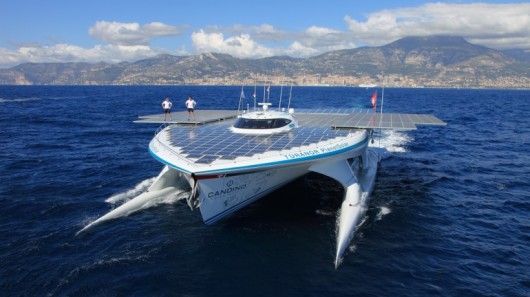
Read moreThe MS Tûranor PlanetSolar, the world’s largest solar-powered boat, took to the seas once more on Thursday – this time, in the name of science. Equipped with unique instruments, the Tûranor will carry a team of scientists who will monitor the air and water of the Atlantic Ocean’s Gulf Stream, a current which influences the climates of North America’s east coast and Europe’s west. The goal is to gain understanding of the processes which regulate climate. (via World’s largest solar-powered boat returns to the oceans in the name of science)
Read more "A Momentary Flow: Ice That Took 1,600 Years to Form in Peru’s Andes Melted in Only 25, Scientists Say"See on Scoop.it – Knowmads, Infocology of the future
Scientists say the rapid melting of the Quelccaya ice cap, the world’s largest tropical ice sheet, is the latest sign of global warming.
–
Glacial ice in the Peruvian Andes that took at least 1,600 years to form has melted in just…
NASA’s Transiting Exoplanet Survey Satellite (TESS), backed by Google and MIT, uses a set of onboard cameras to scan the skies for so-called exoplanets orbiting bright and nearby stars. Its objective is to discover terrestrial planets — ranging in size from Earth equivalents to gas giants — within habitable regions of space. TESS will deploy techniques similar to those used by the Kepler telescope, which has thus far identified more than 2,700 potential exoplanets, though its scope will be much broader.
“TESS will carry out the first space-borne all-sky transit survey, covering 400 times as much sky as any previous mission,” MIT’s George Ricker, TESS’ principle investigator, said in a statement. “It will identify thousands of new planets in the solar neighborhood, with a special focus on planets comparable in size to the Earth.”
NASA to launch planet-hunting mission with Google-backed satellite | The Verge
– can’t wait for Google Galaxy Maps