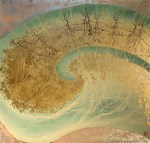
Read moreYou Wish Your Neurons Were This Pretty
When Greg Dunn finished his Ph.D. in neuroscience at Penn in 2011, he bought himself a sensory deprivation tank as a graduation present. The gift marked a major life transition, from the world of science to a life of meditation and art.
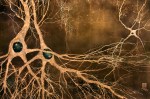
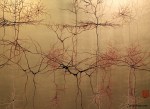
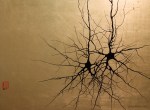
Now a full-time artist living in Philadelphia, Dunn says he was inspired in his grad-student days by the spare beauty of neurons treated with certain stains. The Golgi stain, for example, will turn one or two neurons black against a golden background. ”It has this Zen quality to it that really appealed to me,” Dunn said.
What he saw under the microscope reminded him of the uncluttered elegance of bamboo scroll paintings and other forms of Asian art, and he began to paint neurons in a similar style. He supplements traditional brush painting with methods he’s developed on his own, such as blowing a drop of ink across a surface. The ink spreads much as a neuron grows, Dunn says, propelled by a natural force, but forming random branches as it finds its way around microscopic obstacles. “I like the concept of drawing on similar forces to produce the art,” he said.
Dunn has sold commissioned works to research labs and hospitals, and he says his prints are popular with neuroscientists, neurologists, and others with a special interest in the brain, including people with neurodegenerative disorders. “I think it helps them come to terms or appreciate this thing they’ve been so vexed by,” Dunn said.
The images in this gallery are drawn from his imagination, but they’re informed by his knowledge of neuroanatomy. ”One of my frustrations with grad school was the necessity for absolute adherence to truth, and principles, and facts,” Dunn said. “I’m inspired by anatomy but not a slave to it.”

Author: m1k3y

Free Syrian Army fighters use the electronic compass of a smartphone to help them aim a locally made anti-aircraft weapon near the Menagh military airport in Aleppo’s countryside, on February 17, 2013
Read moreJared Diamondin row over claim tribal peoples live in ‘state of constant war’ | Books | The Observer
A fierce dispute has erupted between Pulitzer prize-winning author Jared Diamond and campaign group Survival International over Diamond’s recently published and highly acclaimed comparison of western and tribal societies, The World Until Yesterday: What Can We Learn from Traditional Societies? The controversy threatens to expose a deep rift in modern anthropology, with each claiming the other has fallen into a delusion that threatens to undermine the chances for survival of the world’s remaining tribal societies. On a book tour of the UK last week, Diamond, 75, was drawn into a dispute with the campaign group after its director, Stephen Corry, condemned Diamond’s book as “completely wrong – both factually and morally – and extremely dangerous” for portraying tribal societies as more violent than western ones. Survival accuses Diamond of applying studies of 39 societies, of which 10 are in his realm of direct experience in New Guinea and neighbouring islands, to advance a thesis that tribal peoples across the world live in a state of near-constant warfare. “It’s a profoundly damaging argument that tribal peoples are more violent than us,” said Survival’s Jonathan Mazower. “It simply isn’t true. If allowed to go unchallenged … it would do tremendous damage to the movement for tribal people’s rights. Diamond has constructed his argument using a small minority of anthropologists and using statistics in a way that is misleading and manipulative.”
Jared Diamondin row over claim tribal peoples live in ‘state of constant war’ | Books | The Observer
Read more "Jared Diamondin row over claim tribal peoples live in ‘state of constant war’ | Books | The Observer"