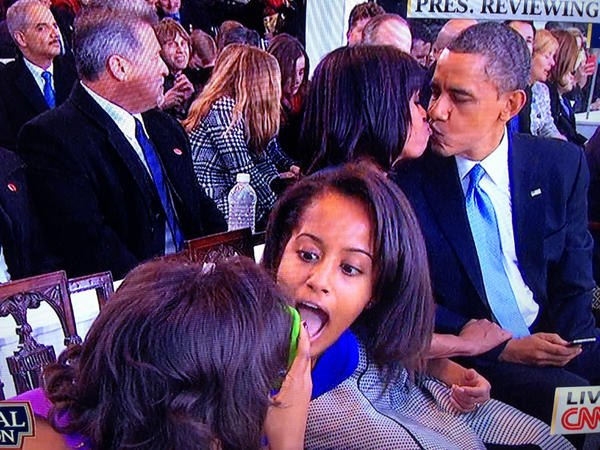
Read moreMalia Obama Photobombs Her Parents Kissing at the Inauguration
The critic Michael J. Arlen recognized the profound moral implications of this arrangement more than 40 years ago: the manner in which, for example, the propagandistic early coverage of Vietnam helped build public support for the war. Like Trow, Arlen regarded television not as a window onto the actual state of the world but a set of corporate-carved keyholes offering fragmented and often misleading visions.
It’s painful to read Trow or Arlen today because their intuitions about the effects of visual mass media have proved so eerily prescient. Our latest innovation, the Internet, was hailed as an information highway that would help us manage the world’s complexity. In theory, it grants all of us tremendous narrative power, by providing instant access to our assembled archive of human knowledge and endeavor.
In practice, the Internet functions more frequently as a hive of distraction, a simulated world through which most of us flit from one context to the next, from Facebook post to Tumblr feed to YouTube clip, from ego moment to snarky rant to carnal wormhole. The pleasures of surfing the Web — a retreat from sustained attention and self-reflection — are the opposite of those offered by a novel.
We haven’t lost the capacity to tell stories. Artists and journalists and academics still work heroically to make sense of the world. But theirs are niche products, operating on the margins of a popular culture dominated by glittering fantasies of violence and fame. On a grand scale, we’ve traded perspective for immediacy, depth for speed, emotion for sensation, the panoramic vision of a narrator for a series of bright beckoning keyholes.
Once Upon a Time, There Was a Person Who Said, ‘Once Upon a Time’ – NYTimes.com
“unsure how they arrived in such a precarious place, and uncertain even how to tell the story that might make sense of their journey.”
(via new-aesthetic)
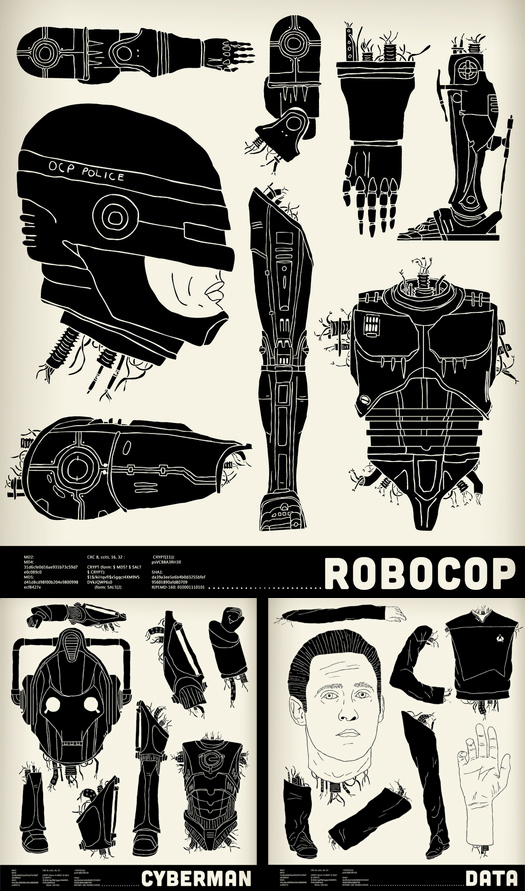
Read moreFrom the cat that brought us the Skeletal Spaceship Series , comes a new sweet series of prints for the nerd inside of each of us geeks. These busted n broken bots are available as prints, tees, etc…you know the drill. I suspect we’ll see more of these decommissioned prints as time passes…after all I can think of at least 3 he hasn’t chopped…can you?
By: Josh Ln
Coca-Cola’s new ‘Coming Together’ advert
January 2013“There’s an important conversation going on about obesity out there. We want to be a part of the conversation.”
I’m interested in this sentence – the positioning of the advert moreso than the actual content.
Now there’s a brand that’s bought into social media listening and the narrative that social has turned advertising on its head. No longer are brands able to broadcast what they mean at passive audiences – no! instead consumers are having conversations, and constructing webs of signification with each Like and Reblog, and all a brand can hope for is to humbly generate content in the hope that it might be used as currency in this attention economy.
“Consumers’ most valuable relationships are not with brands but with other consumers,” says Mark Earls – hell, I’ve even used that line myself…
“The Rise of the Empowered Consumer” – MediaCom, PWC, IBM.
It’s “The Real Thing”, right? Well. I’m less interested in this as a truth-statement or Big Idea that Coca-Cola are reorienting their entire marketing strategy around; instead it’s something we need to examine as ideology. This is the story that brands are choosing to tell us. Us as marketing professionals, us as consumers.
Is it a defensive strategy – as in, this IS the new reality and their only hope of survival is to acknowledge the new paradigm?
Or does capital’s capture of signification continue unabated, and we are now only being told that we are free and powerful in the hope that we might slip the bonds of regulatory guidance and indulge in that refreshing icy-cold beverage we have always wanted, but, since 1989, have been replacing with mineral water and sports drinks?
“The crisis consists precisely in the fact that the old is dying and the new cannot be born; in this interregnum a great variety of morbid symptoms appear.”
Antonio Gramsci, Selections from the Prison Notebooks, 1971.
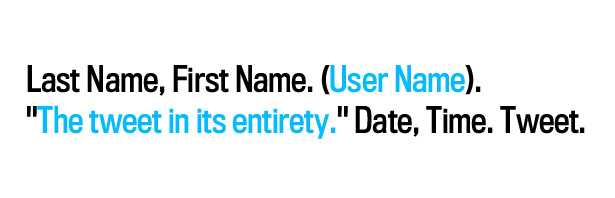
Read moreWhoa. The MLA has officially devised a standard format to cite tweets in an academic paper. Sign of the times.
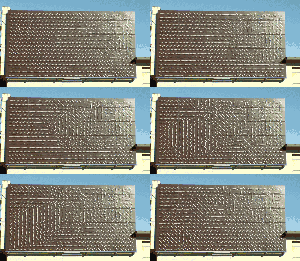

Read moreHundreds of spinning blades reveal the invisible patterns of the wind in American artist Charles Sowers’ kinetic installation on the facade of the Randall Museum in San Francisco.
via dezeen



 The Committee to Nuke Elysium