cozydark:

Earth-Size Planets Common in Galaxy: 17 Percent of Sun-Like Stars Have Planets Within the Orbit of Mercury |

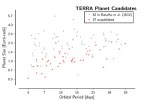
An analysis of the first three years of data from NASA’s Kepler mission, which already has discovered thousands of potential exoplanets, contains good news for those searching for habitable worlds outside our solar system.

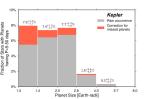
This estimate includes only planets that circle their stars within a distance of about one-quarter of Earth’s orbital radius – well within the orbit of Mercury – that is the current limit of Kepler’s detection capability. Further evidence suggests that the fraction of stars having planets the size of Earth or slightly bigger orbiting within Earth-like orbits may amount to 50 percent.

The team – UC Berkeley graduate student Erik Petigura, former UC Berkeley post-doctoral fellow Andrew Howard, now on the faculty of the Institute for Astronomy at the University of Hawaii, and UC Berkeley professor of astronomy Geoff Marcy – reported their findings today (Tuesday, Jan. 8) at a session on the Kepler mission during the American Astronomical Society meeting in Long Beach, Calif.

“Our key result is that the frequency of planets increases as you go to smaller sizes, but it doesn’t increase all the way to Earth-size planets – it stays at a constant level below twice the diameter of Earth,” Howard said.

Francois Fressin of the Harvard-Smithsonian Center for Astrophysics presented nearly identical results yesterday at the meeting, reporting that one in six stars, or at least 17 billion stars in the Milky Way Galaxy, have an Earth-size planet within an orbit like Mercury’s.

continue reading

Read more

new-aesthetic:

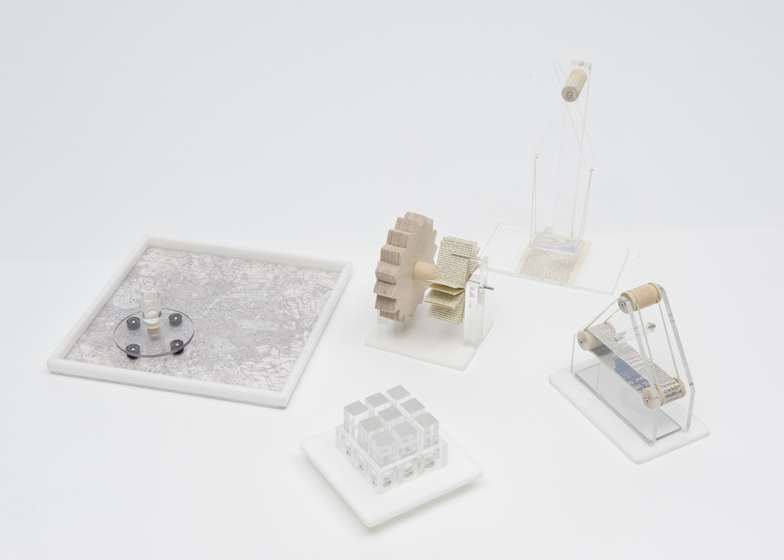
Royal College of Art student Gabriele Meldaikyte has designed a set of interactive exhibits for a museum of iPhone gestures. “I believe that in ten years or so these gestures will completely change, therefore my aim is to perpetuate them so they become accessible for future generations,” she explains.

Multi-Touch iPhone Gestures by Gabriele Meldaikyte, via Tom A.

Read more

trendd:

These flexible display prototypes are amazing.

“The flexible smartphone could soon be here. After years of teasing, Samsung finally unveiled flexible screens at CES. Called ‘Youm,’ the displays were shown on prototype devices including one where it stretched right to the edge.”

(via Samsung Debuts Flexible Screens – PSFK)

Read more

itsfullofstars:

cool iPad app celebrating the Cassini mission to Saturn

jtotheizzoe:

Cassini HD – Explore Saturn Via iPad

Our very own science/art Tumblrer stacythinx has been hard at work designing the Cassini HD iPad app, available Sept. 15 in the iTunes store (that’s tomorrow!). It will be free for the first day, by the way (I’ll add the link when it goes live).

I’ve had a chance to play with the app, and it’s really something special. NASA’s Cassini mission has provided us with what I think is the greatest catalogue of planetary images from our solar system. Saturn is such a visually striking celestial body, and exploring its moons and rings via photography gives us the ability to take a digital rocket tour with just a single click.

The Cassini HD app delivers more than just pretty pictures, of course. Tap an image to find out a little bit of the context behind each photo, and any of them can be shared on Tumblr, Twitter, Facebook, etc. right in the app. My only complaint about the app is that there isn’t more written, but the pictures are informative on their own, and still serve to inspire further study. The philosophy behind this project, and Stacey’s Tumblr, is making knowledge beautiful. Mission accomplished!

I give it a rating of 10 rings out of 10. Go get it tomorrow!

Read more