We Tribe-of-the-Strange ride in the bus marked “Further!” Where the only faith that is held is that things will change. That the only answer to questions is inevitably more questions.

Whose only beliefs are that what we see is just a glimpse afforded to us by cobbled together tool-kits that must be continually re-examined; questioning its contents… discarding, adapting, modifying…

Forever moving forwards.

This is the never-ending journey towards a horizon on which sits the glimmering, twin mirage cities of Truth & Knowledge. One cannot chose to make this grand expedition unless it has already been begun.

This is a true quest which can never be halted, but respite can be found in the discovery of fellow travelers. Join together, lighten the load for the whole party. Seek out one another! Share and swap partial maps of this infinite territory.

There are no dragons in this land, only the friendly ghosts of the departed that will aid in combating the invisible demons of Falsehood & Deception.

Leave the best trail possible! Light signal fires when able, that others may hasten to follow.

Good luck! May you forever be almost there.

The Unending Journey of the Tribe-of-the-Strange

(The edited and grossly expanded version of me riffing in the comments on Cat’s post Building Character, part 1 – Character Sheet)
Read more

The law, which is part of a complete restructuring of the Bolivian legal system following a change of constitution in 2009, has been heavily influenced by a resurgent indigenous Andean spiritual world view which places the environment and the earth deity known as the Pachamama at the centre of all life. Humans are considered equal to all other entities.

Ecuador, which also has powerful indigenous groups, has changed its constitution to give nature “the right to exist, persist, maintain and regenerate its vital cycles, structure, functions and its processes in evolution”. However, the abstract rights have not led to new laws or stopped oil companies from destroying some of the most biologically rich areas of the Amazon.

Bolivia is struggling to cope with rising temperatures, melting glaciers and more extreme weather events including more frequent floods, droughts, frosts and mudslides.

Research by glaciologist Edson Ramirez of San Andres University in the capital city, La Paz, suggests temperatures have been rising steadily for 60 years and started to accelerate in 1979. They are now on course to rise a further 3.5-4C over the next 100 years. This would turn much of Bolivia into a desert.

Most glaciers below 5,000m are expected to disappear completely within 20 years, leaving Bolivia with a much smaller ice cap. Scientists say this will lead to a crisis in farming and water shortages in cities such as La Paz and El Alto.

Evo Morales, Latin America’s first indigenous president, has become an outspoken critic in the UN of industrialised countries which are not prepared to hold temperatures to a 1C rise.

Read more

Frankly by far the biggest risk in a city like Cairo, Calcutta or Chongqing is being involved in a traffic accident, and this is an issue that is omnipresent every time you travel to an interview, cross the street. Cairo is still far safer for violent crime than Chicago, NYC or LA, comparable with many sleepy European cities.

Read on for more excellent advice on Managing Expectations in the Org
Read more

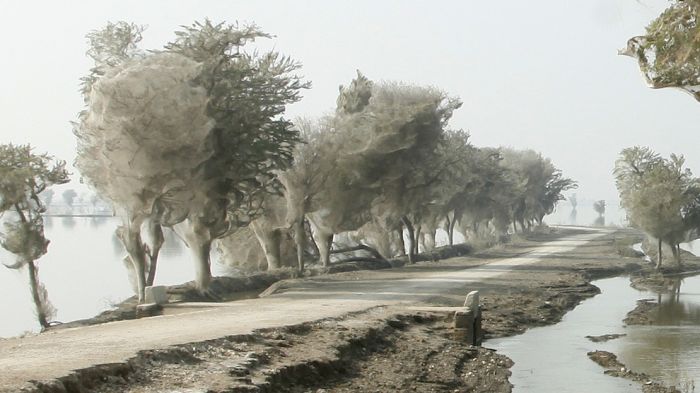
Massive webs created by spiders fleeing the floods in Pakistan (PIC)

epic webs are epic

From nejlon (Several more images there), via @liamosaur


Massive webs created by spiders fleeing the floods in Pakistan (PIC)

Read more "Massive webs created by spiders fleeing the floods in Pakistan (PIC)"

The debt was incurred when Britain and the Netherlands compensated their nationals who lost savings in online ‘Icesave’ accounts owned by Landsbanki, one of three Icelandic banks that collapsed in late 2008.

Icelandic lawmakers in February backed the repayment plan agreed with creditors in December but the president refused to sign the bill, triggering the vote.

Iceland rejected an earlier Icesave repayment blueprint in a referendum last year.

Many Icelanders say taxpayers should not have to bail out irresponsible banks.

Policymakers and economists have said solving the Icesave issue would help Iceland, whose economy fell into deep recession after its banks failed, get back into foreign credit markets to fund itself.

That is a condition for it to remove controls on capital flows it imposed in 2008 to stabilise a tumbling currency.

The controls have left an estimated equivalent to a quarter of Iceland’s gross domestic product in the hands of foreign investors, many of whom are expected to want to pull out when controls are lifted.

Ratings agencies follow the vote closely. Moody’s has said it may lower its credit rating on Iceland in case of a ‘no’.

Britain’s Chief Secretary to the Treasury Danny Alexander said he was disappointed that Icelanders had again rejected the debt deal, adding that the issue would now probably go to the courts.

‘It is obviously disappointing that it seems that the people of Iceland have rejected what was a negotiated settlement,’ Mr Alexander told BBC television.

‘Of course we respect the will of the Icelandic people in this matter and we are going to have to now go and talk to the international partners with whom we work, not least the government of the Netherlands. It now looks like this process will end up in the courts,’ he said.

Dutch Finance Minister Jan Kees de Jager said he was very disappointed that Icelanders had rejected the deal.

‘I am very disappointed that the Icesave agreement did not get through. This is not good for Iceland, nor for the Netherlands. The time for negotiations is over. Iceland remains obliged to repay. The issue is now for the courts to decide,’ Mr de Jager said in a statement.

He added that the Netherlands will consult with Britain about taking further steps.

Read more

Ericsson’s vision of the future-present smart home

Click here to view the embedded video.

Of course, in the Philip K. Dick version of this scenario the devices would probably conspire against him.

via @bruces


Ericsson’s vision of the future-present smart home

Read more "Ericsson’s vision of the future-present smart home"

Connie Hedegaard met with California’s governor, Jerry Brown, and Mary Nicholls, who chairs the Californian Air Resources Board, in Sacramento to discuss how future co-operation might work to join the world’s largest and second largest carbon markets.

EU plans to link emissions trading scheme with California | Environment | guardian.co.uk

– from the #ThingsYouCouldNeverPredict files, but seen from the viewpoint of Carbon Markets it makes perfect sense.

Read more

thoughts on the Transcendent Man

The Ray Kurzweil documentary, Transcendent Man, has been downloadable for a while now and is having selected screenings across the world. Prompted by Paul Raven’s review on Futurismic

thoughts on the Transcendent Man

Read more "thoughts on the Transcendent Man"

So if currents change with global warming, which is expected – and if regions such as the Arctic Ocean become less saline as ice sheets discharge their contents into the sea – the regional patterns of peaks and troughs will also change.

“Everybody will still have the impact, and in many places they will get the average rise,” said Roderik van der Wal from the University of Utrecht, one of the team presenting their regional projections at the European Geosciences Union (EGU) meeting in Vienna.

“But places like New York are going to have a larger contribution than the average – 20% more in this case – and Reykjavik will be better off.”

Of the 13 regions where the team makes specific projections, New York sees the biggest increase from the global average, although Vancouver, Tasmania and The Maldives are also forecast to see above-average impacts.

BBC News – New York set to be big loser as sea levels rise

– and weather systems will get *even crazier*

Read more

The Congressional Research Service found that during the Clinton-era shutdowns – which lasted 26 days – veterans’ services all but ceased, the National Park Service shuttered 368 sites, the Centers for Disease Control and Prevention stopped disease monitoring and toxic waste clean-up was suspended.

Over 30,000 applications for US visas were stalled each day and 200,000 passport applications sat unattended on desks.

Like all other departments, the State Department will have to determine which of the services it provides in foreign embassies are “essential”, but they would probably shut down or operate on skeleton staffing.

Customs and immigration at US airports and borders however would continue to function.

No new patients were enrolled in clinical research trials at the National Institute of Health, and its disease hotline went unanswered.

Alcohol, tobacco and firearms applications were affected, as were border patrol and law enforcement recruitment, delinquent child support case management and all of the national monuments in Washington DC.

Social security cheques were mailed, but administrators were unable to handle queries about address changes, lost cheques, new enrolees and the like.

This time around, government workers will likely have to shut off their Blackberries. Answering work emails is in contravention of the 1870 act which prohibits the government from receiving free labour.

Employees who try to sneak in some free work could land themselves a $5,000 (£3,118) fine or two years in prison.

Mostly a government shutdown works by furloughing nonessential government workers.

They are usually suspended without pay and later given back pay, even though they had not worked during that period.

That helps contribute to the irony: shutting down the government is expensive.

Fines and fees aren’t collected, the tourism industry suffers from the closure of national parks and employees are ultimately paid for not doing any work.

Read more