Operation Payback – Anonymous Message About ACTA Laws, Internet Censorship and Copyright (via AnonOfTheAbove)
(Source: https://www.youtube.com/)
Read more
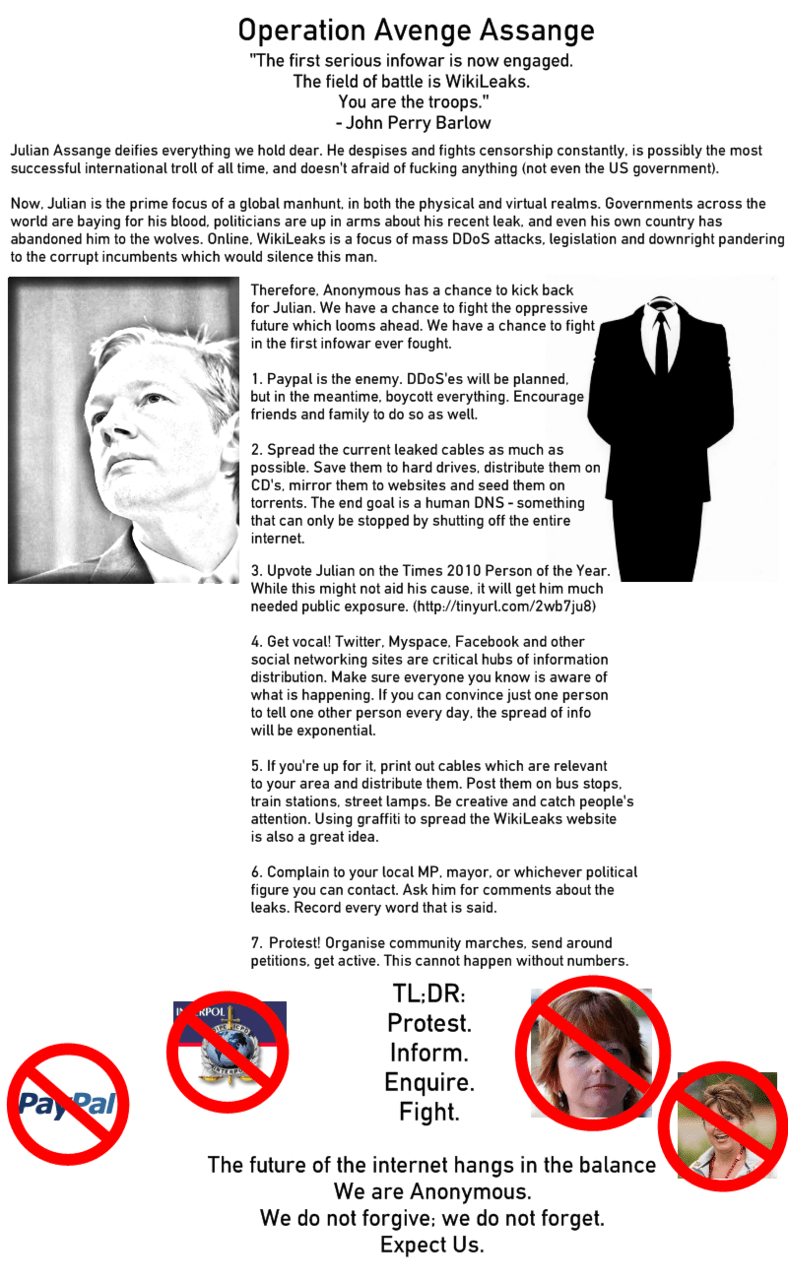
Read moreA few months ago I wrote about how confused I was by Julian Assange’s actions. Why would anyone taking on the state so directly become such a public figure? It made no sense to me. Now I see the plan. And it’s awesome.
You see, this is the first time anything like Wikileaks has been attempted. Yes, there have been leaks prior to this, but never before have hyperdistribution and cryptoanarchism come to the service of the whistleblower. This is a new thing, and as well thought out as Wikileaks might be, it isn’t perfect. How could it be? It’s untried, and untested. Or was. Now that contact with the enemy has been made – the state with all its powers – it has become clear where Wikileaks has been found wanting. Wikileaks needs a distributed network of servers that are too broad and too diffuse to be attacked. Wikileaks needs an alternative to the Domain Name Service. And Wikileaks needs a funding mechanism which can not be choked off by the actions of any other actor.
We’ve been here before. This is 1999, the company is Napster, and the angry party is the recording industry. It took them a while to strangle the beast, but they did finally manage to choke all the life out of it – for all the good it did them. Within days after the death of Napster, Gnutella came around, and righted all the wrongs of Napster: decentralized where Napster was centralized; pervasive and increasingly invisible. Gnutella created the ‘darknet’ for filesharing which has permanently crippled the recording and film industries. The failure of Napster was the blueprint for Gnutella.
In exactly the same way – note for note – the failures of Wikileaks provide the blueprint for the systems which will follow it, and which will permanently leave the state and its actors neutered. Assange must know this – a teenage hacker would understand the lesson of Napster. Assange knows that someone had to get out in front and fail, before others could come along and succeed. We’re learning now, and to learn means to try and fail and try again.
This failure comes with a high cost. It’s likely that the Americans will eventually get their hands on Assange – a compliant Australian government has already made it clear that it will do nothing to thwart or even slow that request – and he’ll be charged with espionage, likely convicted, and sent to a US Federal Prison for many, many years. Assange gets to be the scapegoat, the pinup boy for a new kind of anarchism. But what he’s done can not be undone; this tear in the body politic will never truly heal.
Everything is different now. Everything feels more authentic. We can choose to embrace this authenticity, and use it to construct a new system of relations, one which does not rely on secrets and lies. A week ago that would have sounded utopian, now it’s just facing facts. I’m hopeful. For the first time in my life I see the possibility for change on a scale beyond the personal. Assange has brought out the radical hiding inside me, the one always afraid to show his face. I think I’m not alone.
I know Kevin posted about this last month, but I just found this video interview by CNN and.. well, you’ve got to see it. (Just try and self-filter out the CNN lady)
CNN Video interview with Wafaa Bila, of the Third I project
Read moreIn the not-too-distant future, our relations to computers/the internet have grown more intimate. Our machines respond directly to our thoughts, courtesy of implants. Now: it’s very dangerous to be driving your computerized car and have it respond like lightning to every stray death wish that flits across your mental monitor. So our mind-machine links, in this future world, are insulated and buffered in prudent ways. But: Google (or whoever) has figured out that internet searching goes much better if the machine can read you raw at every level and log all that stuff. People go along with it. Of course, privacy is assured. But: Julian Assange (Assange’s envatted brain, or whoever) stages a massive, Wikileaks-style intelligence release: Psycheleaks. Everyone get up one morning and finds, to their horror, that in the night have sprung up public ‘Psykis’, consisting of everyone’s logged-and-now-leaked thoughts – down to every last little Underground Man-style private fantasy. And the New York Times, the Guardian, and Der Spiegel got to read the dreams earlier than everyone else, etc. Everyone pretty much knew what this stuff would be like, in broad outline. But it’s still embarrassing. And now no one can live without their implants. But Assange has cult followers everywhere, fanatically devoted to transparency …
Also, Twitter has become a meditative religion; syncretic amalgam of Buddhistic and Tantric notions and practices. The goal is to achieve complete mental-spiritual self-discipline. Some practitioners strive to post only the 140 characters of God’s true name, repeatedly – a variant of Amitabha (‘The Buddha of Infinite Tweet’) Buddhism. One guy almost sets the world record but accidentally tweets ‘world record!’ instead, breaking his streak. Twitric Buddhism maintains that the universe itself is the godhead’s twitter feed. The sexual side of Twitric ritual practice requires a Microsoft Kinect. In the wake of the Psycheleaks scandal, Twitter acquires many new devotees.




 The Committee to Nuke Elysium