
Author: m1k3y





Read morex-men origins: mystique
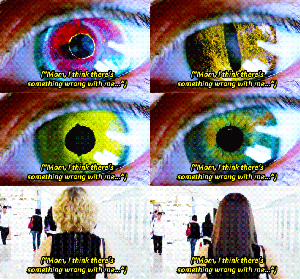
“You’re saying I look freakish? It’s better than looking like you!”



Read moreScience fiction has always built our culture powerful frameworks for thinking about the future. Computer sensors, “electronic paper,” digital newspapers, biological cloning, interactive television, robots, remote operation, and even the Walkman each appeared in fiction before they breached our physical reality. Has there been any major technological advancement that wasn’t dreamt up first in man’s imagination? Simon Lake – American mechanical engineer, naval architect, and perhaps the most important mind behind the development of the submarine – said of Twenty Thousand Leagues Under the Sea, “Jules Verne was in a sense the director-general of my life.” This was a man who created space travel in the pages of fiction decades before Sputnik, while Arthur C. Clarke imagined satellite communication into existence in 1945, a full 12 years before the Russians fired the first shots of the Space Race. Who invented the cell phone, Martin Cooper or Gene Roddenberry? Who invented the earliest iteration of the computer, Charles Babbage or Jonathan Swift? And the list goes on. Either art is imitating life, or science fiction writers have been pointing to the future for over a century.
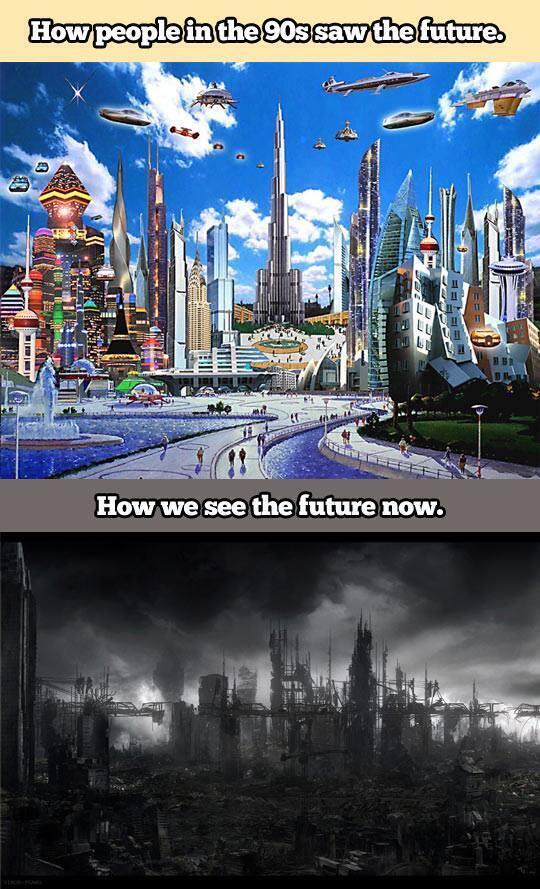
Read more*There’s something to this, but if you take the trouble to hang out with actual futurists you’ll see that they don’t really do much of this… On the contrary, they’d glance at that image on the bottom and go “Oh yeah, that’s the classic Detroit Rust Belt model. That scenario was big during the 1970s Energy Crisis.”
The 40 highest authority Twitter profiles in the network are:
@iftf – Institute for the Future
@WorldFutureSoc – World Future Society
@rossdawson – Ross Dawson
@gleonhard – Gerd Leonhard
@DefTechPat – Patrick Tucker
@Urbanverse – Cindy Frewen
@VenessaMiemis – Venessa Miemis
@cshirky – Clay Shirky
@cascio – Jamais Cascio
@bruces – Bruce Sterling
@mitchbetts – Mitch Betts
@frankspencer – Frank Spencer
@futuryst – Stuart Candy
@johnmsmart – John Smart
@Geofutures – Josh Calder
@ThomasFrey – Thomas Frey
@doctorow – Cory Doctorow
@heathervescent – Heather Schlegel
@psaffo – Paul Saffo
@MareeConway – Maree Conway
@dunagan23 – Jake Dunagan
@jenjarratt – Jennifer Jarratt
@kevin2kelly – Kevin Kelly
@wendyinfutures – Wendy L Schultz
@patrickdixon – Patrick Dixon
@Joi – Joi Ito
@GreatDismal – William Gibson
@futuristpaul – Paul Higgins
@futuramb – P A Martin Börjesson
@kristinalford – Kristin Alford
@nraford – Noah Raford
@avantgame – Jane McGonigal
@DavidBrin – David Brin
@jhagel – John Hagel
@fastfuture – Rohit Talwar
@singularityhub – Singularity Hub
@singularityu – SingularityU
@futureguru – Dr. James Canton
@timeguide – Ian Pearson
@FutureCon – Future Conscience
Read more: http://rossdawson.com/articles/futurists-twitter-analysis-network-centrality/#ixzz3BrJtP4IX


Read moreIn The Not So Distant Future, Glow-In-The-Dark Trees Could Replace Street Lights
Is that… is that even healthy?
There are sea organisms and fungi which glow in the dark and there’s fireflies and jellyfish which glow in the dark. It doesn’t do them any harm nor does it do the people around them any harm. I would say its pretty healthy, as well as it would mean more photosynthesis happening in cities which mean cleaner air.
I was just curious about how they were doing it and for some reason I didn’t think to click the link. But thanks! It makes more sense now. I was afraid it was some kind of chemical thing.
nah just genetic modification using existing bioluminescent genes. Genetics is really cool, and so is bioluminescence. I mean they’ve already made pigs glow using jellyfish genes and pigs are waaay more complicated than trees iirc. So they’re actually (i think) less likely to muck it up with trees.
In which case
GLOWY
FORESTS
GLOWY
TREES
GLOWY
EVERYTHING
(I like glowy things)
means more trees which is good
uses less electricity which is good (for both tax reasons and also just because reasons)
pretties everything up
just generally all good stuff
glowy trees 2k15 plz
*puts on science hat* This is basically an art project. Before anything like this could go live, there would have to be massive serious assessment of the ecological impact, and substantial harm reduction measures implemented. For instance, light pollution affects the behaviours of organisms in urban environments; obvious examples being diurnal birds singing well into the night, deciduous trees retaining leaves into winter, and so forth. Glowing trees can’t be switched off if needed, so the possible consequences of that must be measured. The effects of light pollution are thus far fairly mild but they are real. The thing about streetlamps is that they can’t reproduce and invade wild habitats. Glowing trees could potentially throw seeds into unlit areas such as forests, introducing light pollution where it hasn’t previously existed and affecting the ecosystems dramatically. GMO crops have already caused what could be termed genetic pollution; Glowing trees could cross-fertilise with unaltered rootstock and cause unexpected mutations, which may or may not negatively impact the survivability of the rootstock species, and in turn the other species that depend on the rootstock. Are glowing trees less or more appetising to insects and animals, would there be additional requirements of pesticides or further engineering, would glowing trees affect the reproductive behaviours of insect and animal species, and how would all this interact with the local and global ecosystems? Is there a more containable (thus safer) option, such as tanks/globes of functionally inert biolumiscent algae with a biological “deadman switch” that would prevent it from surviving unassisted if accidentally released? Genetic engineering is unfortunately a can of worms, and though it may provide solutions to many ecological threats, it may also create even more.
*takes off science hat* SO COOL WANT GIMME NOW





 The Committee to Nuke Elysium