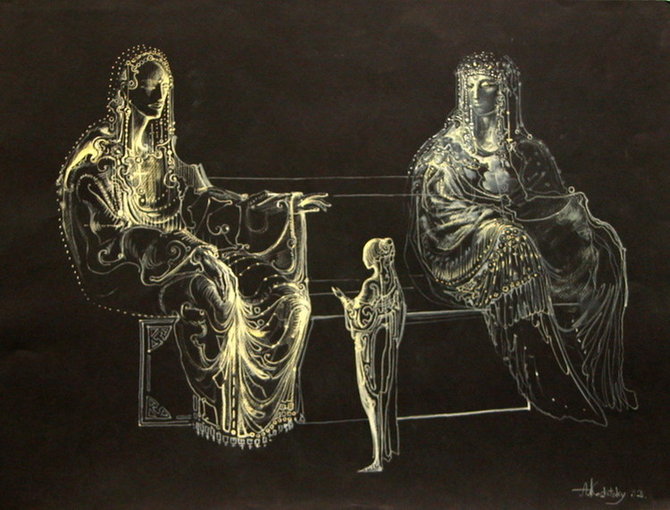
Read moreAleksandr Kosteckij. Conversation with the Gods.
Since a three-dimensional object casts a two-dimensional shadow, we should be able to imagine the unknown four-dimensional object whose shadow we are.



Read moreScene from S.H.I.E.L.D. #1 without text
Writer- Jonathan Hickman
Art- Dustin Weaver
Color- Christina Strain
This is not how the world ends.
All organizing is science fiction. What does a world without poverty look like? What does a world without prisons look like? What does a world with everyone having enough food and clothing look like? We don’t know. It’s science fiction, and it is as foreign to us as the Klingon homeworld (which is called Q’onos in case you were wondering). But being able to envision it and imagine it means we can begin seeing the steps it would take to move us there.
The discovery of electric bacteria shows that some very basic forms of life can do away with sugary middlemen and handle the energy in its purest form – electrons, harvested from the surface of minerals. “It is truly foreign, you know,” says Nealson. “In a sense, alien.”
Nealson’s team is one of a handful that is now growing these bacteria directly on electrodes, keeping them alive with electricity and nothing else – neither sugars nor any other kind of nutrient. The highly dangerous equivalent in humans, he says, would be for us to power up by shoving our fingers in a DC electrical socket.
To grow these bacteria, the team collects sediment from the seabed, brings it back to the lab, and inserts electrodes into it.
First they measure the natural voltage across the sediment, before applying a slightly different one. A slightly higher voltage offers an excess of electrons; a slightly lower voltage means the electrode will readily accept electrons from anything willing to pass them off. Bugs in the sediments can either “eat” electrons from the higher voltage, or “breathe” electrons on to the lower-voltage electrode, generating a current. That current is picked up by the researchers as a signal of the type of life they have captured.
“Basically, the idea is to take sediment, stick electrodes inside and then ask ‘OK, who likes this?’,” says Nealson.
At the Goldschmidt geoscience conference in Sacramento, California, last month, Shiue-lin Li of Nealson’s lab presented results of experiments growing electricity breathers in sediment collected from Santa Catalina harbour in California. Yamini Jangir, also from the University of Southern California, presented separate experiments which grew electricity breathers collected from a well in Death Valley in the Mojave Desert in California.
Over at the University of Minnesota in St Paul, Daniel Bond and his colleagues have published experiments showing that they could grow a type of bacteria that harvested electrons from an iron electrode (mBio, doi.org/tqg). That research, says Jangir’s supervisor Moh El-Naggar, may be the most convincing example we have so far of electricity eaters grown on a supply of electrons with no added food.
But Nealson says there is much more to come. His PhD student Annette Rowe has identified up to eight different kinds of bacteria that consume electricity. Those results are being submitted for publication.
Nealson is particularly excited that Rowe has found so many types of electric bacteria, all very different to one another, and none of them anything like Shewanella or Geobacter. “This is huge. What it means is that there’s a whole part of the microbial world that we don’t know about.”
Discovering this hidden biosphere is precisely why Jangir and El-Naggar want to cultivate electric bacteria. “We’re using electrodes to mimic their interactions,” says El-Naggar. “Culturing the ‘unculturables’, if you will.” The researchers plan to install a battery inside a gold mine in South Dakota to see what they can find living down there.
NASA is also interested in things that live deep underground because such organisms often survive on very little energy and they may suggest modes of life in other parts of the solar system.
Meet the electric life forms that live on pure energy
Read more "Meet the electric life forms that live on pure energy"Bill Nye: We May Discover Life on Europa
This plan does not involve landing on Europa and therefore meets the approval criteria from Posthuman Flight Club.
Start sending your empty coffee cups to NASA now, or something.
By 2100 A.D. as Kaku predicts we will approach a Type 1. We will capture all the solar energy that reaches Earth increasing our energy supply by a factor of 100-billion. We will have harnessed nanotechnology and warp drive propulsion and will be a civilization of this world and off this world.
By 2200 A.D., a mere century later we will approach Type 2, harnessing all the energy of our Sun, another 100-billion-fold increase. We will be extra-solar inhabiting planets on many nearby stars.
By 3000 A.D. we will have harnessed the energy of every star in the Milky Way, another 100-billion-fold energy increase. As a Type 3 we will traverse the galaxy and will, along the way, meet many other technologically advanced civilizations.
A Type 4 civilization will harness dark and extra-galactic energy. Such a civilization would be unrecognizable to us as such because it would be indistinguishable from the Universe itself. Would we evolve into pure energy? Would a Type 4 civilization be immortal and omnipotent.
…to attain Type 4 we will reach much further into the future, to 12000 A.D. At that point we will have transcended the physical reality of our Universe and may even have poked through to parallel universes in the multiverse.
Sounds delusional? Remember where human civilization’s technological achievements were in 1000 A.D. What would a person living in that time think of the world in which we live today? Magical? Incomprehensible? One thing we know for sure, technological breakthroughs that at one time took a century to achieve, now can happen in a year. It remains true that some technologies are harder to crack, like developing fusion energy. But today we are much closer to achieving that fusion breakthrough that alone will move us faster to becoming a Type 1 civilization. And after that will the rest unfold?
Will Humans Achieve a Type 1 Civilization by 2100? | h+ Magazine
Read more "Will Humans Achieve a Type 1 Civilization by 2100? | h+ Magazine "Read moreSince 1996, scientists have debated about whether the Martian meteorite ALH84001 contains evidence that life once existed on Mars. The rock holds some microscopic wormy-looking structures that some scientists have suggested could be fossilized remains of life on Mars, whereas others say the weird shapes derive from normal geochemical processes.
In a new study, physicists at University of Kent tested the hypothesis with a big gun. More specifically, they took powdered diatoms (a type of microscopic algae with a hard silica shell), packed them inside a nylon bullet, added water, and froze the sample. Then, they loaded the bullets inside a light gas gun and fired them at a sack of water at speeds ranging between 0.25 and 3.1 miles per second.
When they looked in the water afterwards, the researchers analyzed the whole and partial remains of the little diatom fossils. They concluded that small fossils could survive a meteorite impact, and that if they exist, then it’s possible to find them inside meteorites.
But there are a few important caveats. At impact speeds above 0.62 miles per second, none of the diatom fossils survived in one piece—they broke into tiny shards. And the faster they crashed into the water, the tinier the diatom bits became. That’s a problem for any potential fossils that would fall to Earth from other planets, because meteoroids enter the Earth’s atmosphere at speeds between 6.8 and 44.7 miles per second before they hit Earth, according to the American Meteor Society.
The other important limitation is that the diatoms were shot frozen in ice, meaning they potentially behave differently during impact than they would if they were encapsulated in rock.
So the jury is definitely still out on ALH84001, and it probably will be for many years. Even if tests provide stronger evidence that fossils can travel between planetary bodies, it doesn’t necessarily mean they did.
What is pretty neat is that, because meteorite impacts tend to be slower on the Moon, it looks like fossils that have been smashed off from Earth could survive a collision with our natural satellite. The authors conclude that the lunar surface could be a good place to scout for fossils, and those terrestrial transplants may be better preserved on the Moon than if they had remained on Earth.
mostlysignssomeportents: A bot that monitors Wikipedia for edits from Russian government IPs recorded a change to the MH17 entry, assigning blame to “Ukrainian soldiers” (a previous edit had blamed it on “terrorists of the self-proclaimed Donetsk People’s Republic with Buk system missiles, which the terrorists received from the Russian Federation.” Read more…
Read more "Twitterbot catches Russian State Media anonymously editing MH17 Wikipedia entry"

 The Committee to Nuke Elysium