Read moreMonuments 02 and 03 are in place. A long day of work. Time for some food and sleep. Stories recounting the interesting people we met later.
Awesome new experimental geography project:
“DELIMITATIONS is a collaborative project by Marcos Ramírez ERRE and David Taylor. During the month of July we will travel from the Pacific Coast to the Gulf of Mexico and mark the 1821 border between Mexico and the United States. That boundary was never surveyed and its brief, 27 year history exists mainly in the form of treaty documents and antique maps. We intend to make it visible for the first time…”
(Thanks to Pepe Rojo for the tip!)
Author: m1k3y
Ancient Lost Continent Discovered in Indian Ocean (2013)
Jamtveit and his colleagues estimate that the lost microcontinent, which they have dubbed Mauritia, was about a quarter of the size of Madagascar (map).
Furthermore, based on a recalculation of how the ancient continents drifted apart, the scientists concluded that Mauritia was once a tiny part of a much larger “supercontinent” that included India and Madagascar, called Rodinia.
The three landmasses “were tucked together in one big continent prior to the formation of the Indian Ocean,” Jamtveit said.
But like a prehistoric Atlantis, Mauritia was eventually drowned beneath the waves when India broke apart from Madagascar about 85 million years ago.
Based on the new findings, Mac Niocaill and others think other vanished microcontinents could be lurking beneath the Indian Ocean.
In fact, analyses of Earth’s gravitational field have revealed other areas in the world’s oceans where the rock appears to be thicker than normal and could be a sign of continental crusts.
“We know more about the topography of Mars than we do about the [topography] of the world’s ocean floor, so there may well be other dismembered continents out there waiting to be discovered.”
Ancient Lost Continent Discovered in Indian Ocean (2013)
Read more "Ancient Lost Continent Discovered in Indian Ocean (2013) "
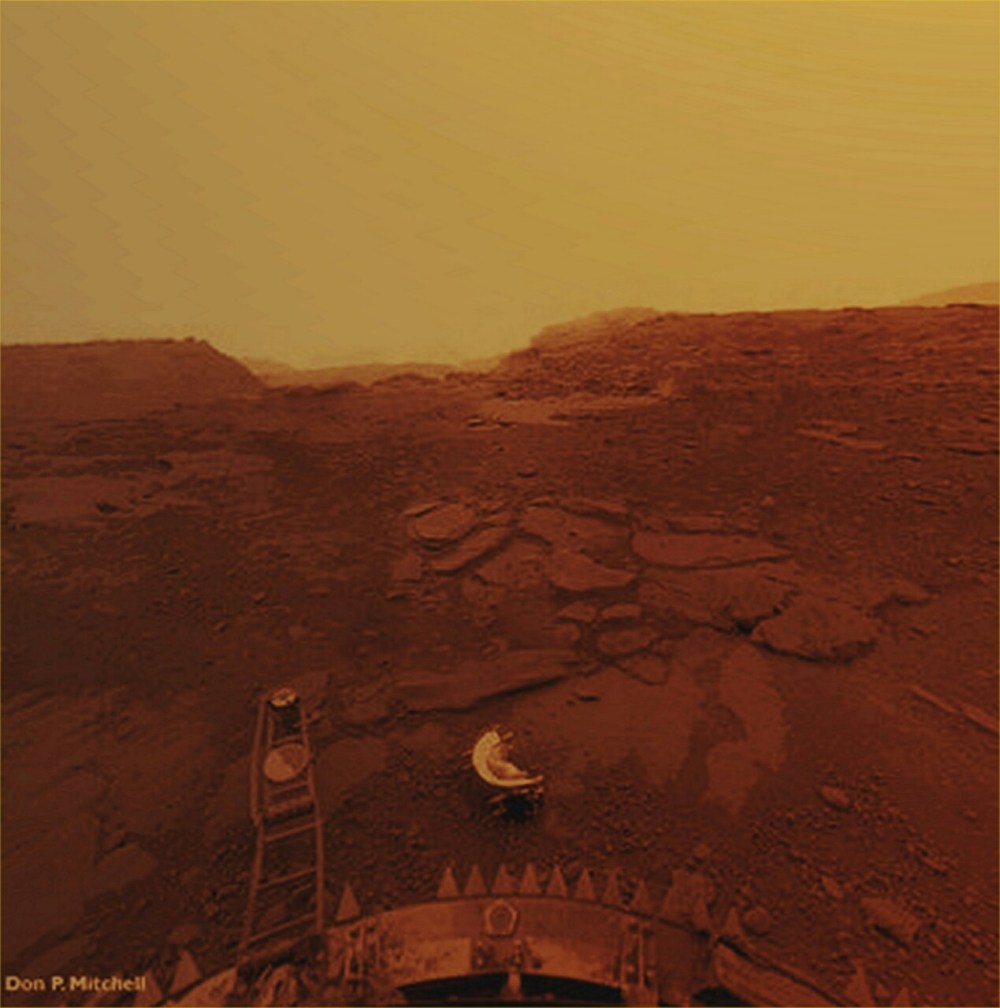
Venusian Surface and Sky, from Venera 13 (1982)
Credits: Soviet Space Agency – Credits for the additional process. and color.: Dr Don P. Mitchell and Dr Paolo C. Fienga/Lunar Explorer Italia/IPF
Read moreRead moreThe name Terasem comes from the Greek word for “Earthseed,” which is also the name for the futuristic religion found in the Octavia Butler sci-fi novel Parable of the Sower that helped inspire Gabriel’s parents, Bina and Martine Rothblatt, to start their new faith. Martine founded the successful satellite radio company Sirius XM in 1990. (Martine was originally known as Martin. She had sex reassignment surgery 20 years ago.)
Organized around four core tenets—“life is purposeful, death is optional, God is technological and love is essential”–Terasem is a “transreligion,” meaning that you don’t have to give up being Christian or Jewish or Muslim to join. In fact, many believers embrace traditional positions held by mainstream religions—including the omnipotence of God and the existence of an afterlife—but say these are made possible by increasing advancements in science and technology.
“Einstein said science without religion is lame. Religion without science is blind,” Martine Rothblatt tells TIME. “Bina and I were inspired to find a way for people to believe in God consistent with science and technology so people would have faith in the future.”
Some believers in Terasem are motivated by a longing similar to one shared by followers of more familiar faiths–a desire to be reunited with people who have passed. Linda Chamberlain, cofounder of the cryonics company Alcor Life Extension Foundation and an active Terasemian, anticipates that one day in the future she’ll be reanimated alongside her husband Fred, who passed away a few years ago, and they can explore space together. Giulio Prisco, an Italian physicist who practices Terasem, says he hopes he’ll finally be reunited with his mother.
Though from the outside Terasem might look a little kooky, some ideas at its center resonate with Silicon Valley’s mainstream where millions of dollars are being spent to research how technology can alter the end of life and beyond. People like Google’s Larry Page and PayPal cofounder Peter Thiel are investing in projects focused on life extension and rejuvenation.
Portraits on the wall of Terasem’s Florida headquarters show people who have attended the organization’s meetings in the past, some of whom are among the tech industry’s most radical thinkers. Marvin Minsky, who helped start MIT’s artificial intelligence lab, is there. So is Google engineer Ray Kurzweil, one of the world’s most prominent proponents of transhumanism, an intellectual movement that shaped Terasem and animates many avant garde ideas in Silicon Valley.
Born nearly a century ago with a spike in popularity in the 1990s, transhumanism advocates for the ethical use of technology to transcend biology and enhance humanity’s physical and intellectual abilities. Google Glass, artificial limbs—even birth control, as one transhumanist told me—are ways in which we can harness technology to upgrade our biology. And one day, if the mindfile system works the way it’s supposed to, we just might be able to leave our physical bodies behind and transmit our brains into computerized vessels.
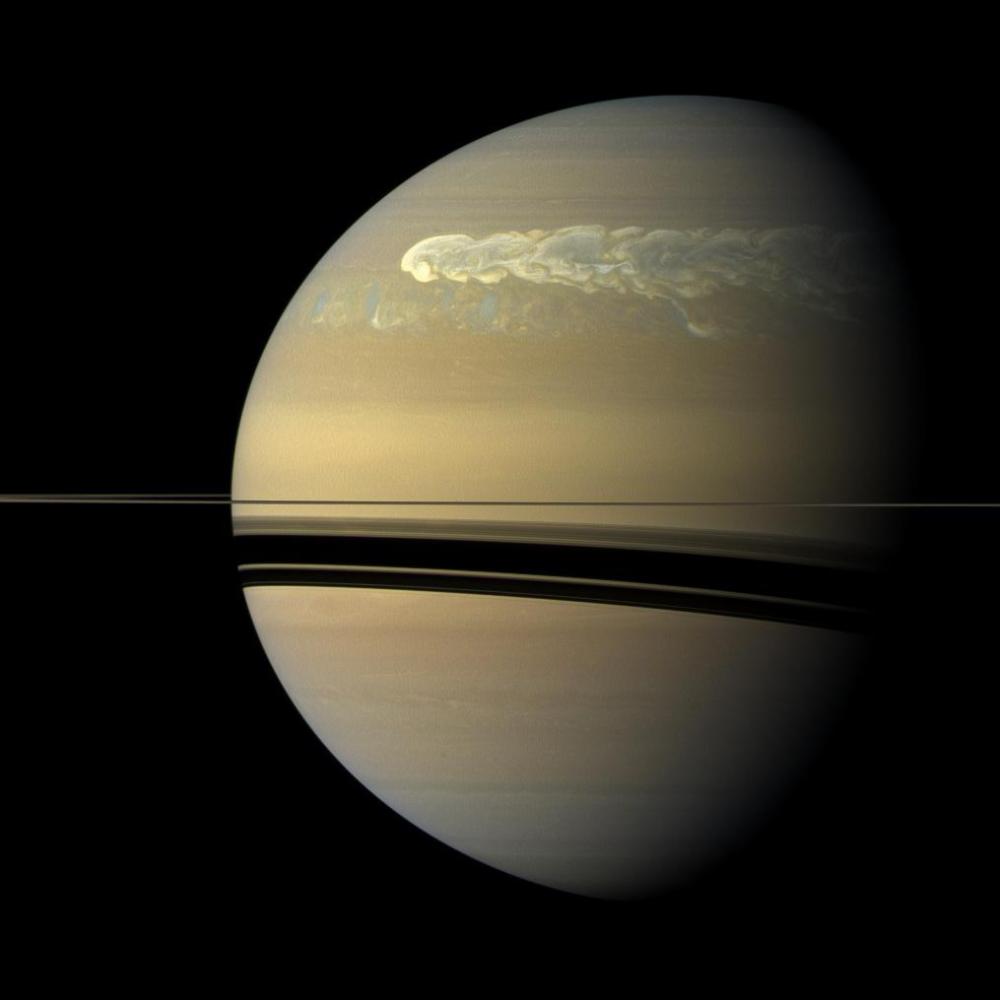
The huge storm churning through the atmosphere in Saturn’s northern hemisphere overtakes itself as it encircles the planet in this true-color view from NASA’s Cassini spacecraft.
This picture, captured on Feb. 25, 2011, was taken about 12 weeks after the storm began, and the clouds by this time had formed a tail that wrapped around the planet. Some of the clouds moved south and got caught up in a current that flows to the east (to the right) relative to the storm head. This tail, which appears as slightly blue clouds south and west (left) of the storm head, can be seen encountering the storm head in this view.
This storm is the largest, most intense storm observed on Saturn by NASA’s Voyager or Cassini spacecraft. It is still active today. As scientists have tracked this storm over several months, they have found it covers 500 times the area of the largest of the southern hemisphere storms observed earlier in the Cassini mission (see PIA06197). The shadow cast by Saturn’s rings has a strong seasonal effect, and it is possible that the switch to powerful storms now being located in the northern hemisphere is related to the change of seasons after the planet’s August 2009 equinox.
Read moreCycorp AI – Business Insider
Read more "Cycorp AI – Business Insider"“If computers were human,” Lenat told us, “they’d present themselves as autistic, schizophrenic, or otherwise brittle. It would be unwise or dangerous for that person to take care of children and cook meals, but it’s on the horizon for home robots. That’s like saying, ‘We have an important job to do, but we’re going to hire dogs and cats to do it.’”
And this is why I empathize more with theoretical AGIs than some people.
hyper real, meta fictional, future present life Show notes: http://m1k3y.tumblr.com/tagged/multiverse%20tv http://www.antipope.org/charlie/blog-static/2007/05/shaping_the_future.html http://qz.com/229852/googles-street-view-cameras-are-touring-museums-and-taking-weird-selfies-by-accident/ http://www.google.com/killer-robots.txt http://time.com/66536/terasem-trascendence-religion-technology/ Intro music from: http://www.radiosky.com/rjcentral.html
Read moreBlue Ants | MORNING, COMPUTER
Why would you not want to be Blue Ant? Being aware that others may read this, I don’t want to spoil the ending of William Gibson’s “Blue Ant” trilogy, as some now call it. But Bill gives the mysterious (or, perhaps, too shallow to be knowable, like screwing fog, therefore “mysterious”) Hubertus Bigend a very, very good reason for doing what he does. Which is knowing things, as completely as possible, before other people do. Again, fog:
he leaks into the leading edge of the civilisational substrate without being detected, and causes sample molecules to be scraped off the cutting blade of the future-facing plane.
Read more "Blue Ants | MORNING, COMPUTER"Read moreThe first time I heard sounds from space was in 2001. I was in western Latvia working with a 32-metre parabolic dish called RT32. It had been used by the Soviets to intercept communications between Europe and America during the cold war. The Russians wanted to blow the site up after the collapse of the Soviet Union but the scientific community was able to convert it into a radio telescope, to focus on celestial, rather than earthly, signals.
While our project uses what we describe as “sounds from space”, stars and planets are not directly audible. Sound waves cannot propagate in the vacuum of space. However, radio waves emitted from celestial bodies, such as Jupiter and the sun, can be converted into sound waves that we can hear, using radios and amplifiers.
In our galaxy, the sun is the strongest source of radio waves – the most powerful transmitter in our radio sky. Jupiter also sends us strong radio signals. What we hear – unsurprisingly, given the technology – is similar to our experience of radio here on Earth. The sounds are a bit like the sound of static between the stations.
Contemporary radio telescopes let you listen to all kinds of weird and wonderful phenomena. You can tune in to solar flares on the surface of the sun, listen to the regular beat of a pulsar in deep space, or the sizzling radio noise storms that occur between Jupiter and its volcanic moon Io. At the moment, the sounds that excite me most are Nasa’s Voyager 1’s plasma waves. The spacecraft was launched in 1977 and it has a plasma receiver designed by Don Gurnett and his team at the University of Iowa. What it detects is transmitted back to Earth, and Gurnett’s team turn these plasma waves into beautiful sounds using a process called sonification. There is a magical and somewhat spooky quality to these sounds that I find mesmerising. Perhaps it is what we should expect from the first man-made object to reach interstellar space, billions of miles away.
Of all the sounds I’ve encountered, the one that stays with me is the oldest and most significant – the “cosmic microwave background” radiation that survives from the birth of the universe 13.8 billion years ago. That we can still actually listen to the very beginning of all things – the Big Bang – is something I find extraordinary.
Read moreIn personal journals Butler admits Olamina is an idealized self, her “best self” — and the poetry that drives the Earthseed religion actually mirrors the style of the daily affirmations, self-help sloganeering, and even self-hypnosis techniques Butler used to keep herself focused and on-task.
The ultimate expression of “shaping God,” the culmination of human historical achievement Olamina calls “the Destiny,” likewise seems to parallel Butler’s deep-rooted psychological investment in science fictional speculation, which dates back to her childhood:
“The destiny of Earthseed,” Olamina prophesies, “is to take root among the stars.”
The two published Earthseed books trace the tribulations of Olamina’s early life and her efforts to find some safe space for her nascent utopian community in the desperate and increasingly fascistic America of the coming decades. But the last chapter of Talents skips ahead to the end of the story: jumping forward six decades, the epilogue sees a very aged Olamina, now world-famous, witnessing the launch of the first Earthseed ship carrying interstellar colonists off the planet as she’d dreamed.
Only the name of the spaceship gives us pause: against Olamina’s wishes the ship has been named the Christopher Columbus, suggesting that perhaps the Earthseeders aren’t escaping the nightmare of history at all, but bringing it with them instead.