Mars-crossers that are also Earth-crossers or grazers

These objects are not catalogued as Mars-crossers in databases such as the Jet Propulsion Laboratory’s online Small-body Database Browser. Instead, they are categorized as Near Earth Objects (NEOs).

Read more

The mammoth asteroid set to fly by Earth last night just disappeared

The most likely explanation is that its orbit was miscalculated. Even with its current whereabouts unknown, the near earth asteroid poses no present danger to Earth — in fact, if anything, its loss indicates that 2000 EM26 is probably further out in space that was originally thought.

The mammoth asteroid set to fly by Earth last night just disappeared

Read more "The mammoth asteroid set to fly by Earth last night just disappeared"

*** Warning: non plot spoilers to True Detective follows. Also: high metaphysical content ***

“You ever heard of something called membrane theory, detectives?” Cohle asks.

“No,” Papania says. “That’s over my head." 

And so Professor Cohle begins to hold forth. "It’s like, in this universe, we process time linearly,” he says. “Forward. But outside of our space-time, from what would be a fourth-dimensional perspective, time wouldn’t exist. And from that vantage, could we attain it, we’d see"—he crushes a can of Lone Star between his palms—"our space-time look flattened, like a seamless sculpture. Matter in a super-position—every place it ever occupied. Our sentience just cycling through our lives like carts on a track. See, everything outside our dimension—that’s eternity. Eternity looking down on us. Now, to us, it’s a sphere. But to them, it’s a circle.”

Needless to say, Papania and Gilbough are utterly baffled by Cohle’s lecture, and I would have been, too—if Pizzolatto hadn’t already told me what he was up to.  

“You could see Cohle as Job crying out to an unhearing God,” he explained. “Or you could see him as something else." 

"Like what?” I asked.

“Cohle describes the possibility of other dimensions existing, and he says that’s what eternity is,” Pizzolatto continued. “He says that if somehow you existed outside of time, you’d be able to see the whole of our dimension as one superstructure with matter superimposed at every position it had ever occupied. He says that the nature of the universe is your consciousness, and it just keeps cycling along the same point in that superstructure: when you die, you’re reborn into yourself again, and you just keep living the same life over and over. He also explains that from a higher mathematical vantage point, our dimension would seem less dimensional. It would look flattened, almost.”

Pizzolatto took a bite of his branzino. “Now, think about all the things Cohle is talking about,” he said as he finished chewing. “Is he a man railing against an uncaring god? Or is he a character in a TV show railing against his audience? Aren’t we the creatures of that higher dimension? The creatures who can see the totality of his world? After all, we get to see all eight episodes of his life. On a flat screen. And we can watch him live that same life over and over again, the exact same way." 

The thought was dizzying. Sure, True Detective is a page-turning crime yarn. But at least according to its creator, it’s also a meta-page-turning crime yarn—a story about storytelling. Pizzolatto had transformed m-theory into a metaphor for television—and television, perhaps, into a metaphor for existence itself.

The more I think about it, the more I think this might be the ultimate "meaning” of the series: that at some indivisible level, life is story. Much ado has been made online about all the references on True Detective to the Yellow King and Carcosa, as if they were aspects of a coherent satanic theology to which Ledoux & Co. subscribed—a puzzle to be unraveled eventually. But it’s telling that the Yellow King is a reference to The King in Yellow, an 1895 collection of horror stories by Robert W. Chambers that itself references a forbidden play called “The King in Yellow"—a play that in turn "induces despair or madness in those who read it.” It’s also telling that Chambers borrowed the name “Carcosa” from Ambrose Bierce, and that H.P. Lovecraft later borrowed it from Chambers. 

In other words, the important thing about the Yellow King and Carcosa isn’t what they signify to Reggie Ledoux. It’s what they signify to us. They call attention to the story-ness of the story we’re watching. They tell us, as Pizzolatto put it to me, that Dora Lange is “meant to stand in for the universal victim for this type of show”; that Ledoux, with his comically archetypal 666, pentagram, and swastika tattoos, is the universal serial killer; and that True Detective is a form of metafiction. 

Read more

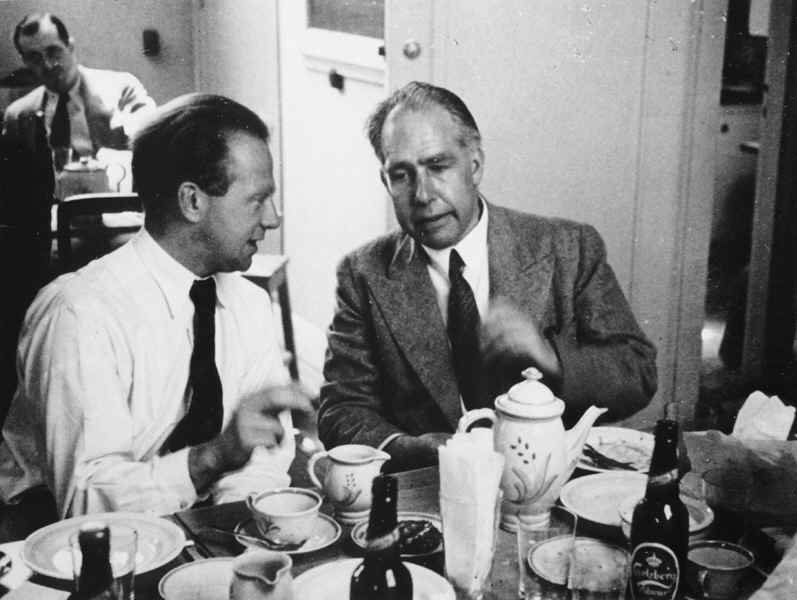
I remember discussions with Bohr which went through many hours till very late at night and ended almost in despair…

Can nature possibly be so absurd as it seemed to us in these atomic experiments?

Read more

Autonomous sensory meridian response (ASMR) is a neologism for a perceptual phenomenon characterized as a distinct, pleasurable tingling sensation in the head, scalp, back, or peripheral regions of the body in response to visual, auditory, olfactory, and/or cognitive stimuli.

Many role-playing videos and audio recordings also aim to stimulate ASMR. Examples include descriptive sessions, in a style similar to guided imagery, for experiences such as haircuts, visits to a doctor’s office, and ear-cleaning. While these make-believe situations are acted out by the creator, viewers and listeners report an ASMR effect that relieves insomnia,[2] anxiety or panic attacks.

Read more

To continue its investigation, the car-sized rover is on an expedition to roll up Mt. Sharp, the central peak of the large crater in which it landed. Life might have shown preference for water that once ran down the Martian mountain. Two weeks ago, to avoid more dangerous and rocky terrain, Curiosity was directed to roll across a one-meter high sand dune that blocked a useful entrance to Mt. Sharp. Just after the short trip over Dingo Gap was successful, the robotic rover took the above image showing the now-traversed sand mound covered with its wheel tracks.

Read more