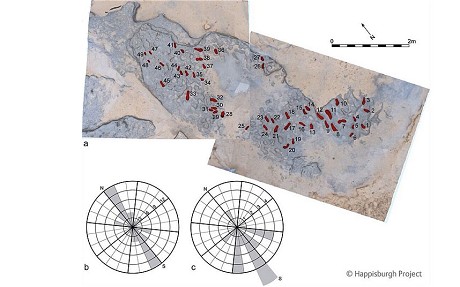
Footprints left behind by what may be one our first human ancestors to arrive in Britain have been discovered on a beach in Norfolk.

The preserved tracks, which consisted of 49 imprints in a soft sedimentary rock, are believed to be around 900,000 years old and could transform scientists understanding of how early humans moved around the world.

Anthropologists and evolutionary biologists from around the UK have been studying the tracks, and believe they may have been related to an extinct form of human ancestor known as Homo antecessor, or “Pioneer Man”.

The tracks include up to five different prints, indicating a group of both adults and children walked across the ancient wet estuary silt.

They are the earliest direct evidence of human ancestors in the area and may belong to some of the first ever Britons.

From their analysis of the prints, researchers believe the group were probably heading in a southerly direction over what would at the time have been an estuary surrounded by salt marsh and coniferous forest.

At the time Britain was connected to continental Europe by land and the site at Happisburgh would have been on the banks of a wide estuary several miles from the coast.

The estuary itself would have provided a rich array of plants, seaweed and shellfish. Fossils of mammoth, an extinct kind of horse and early forms of voles have also been found at the site Happisburgh.

The early humans could also have hunted or scavenged the grazing herds for meat.

The discovery of the footprints is particularly significant as there are few surviving tracks of human ancestors elsewhere in the world.

Scientists can glean large amounts of information about our ancestors, including the size of the groups they travelled in, how they walked, their size and weight.

The prints were discovered in deposits that have also revealed stone tools and fossilised bones dating to between 800,000 and one million years ago.

It is thought that the footprints may have belonged to a relative of a Homo antecessor – an extinct hominid species that may have been a common ancestor to both modern humans and Neanderthals, although such theories are still highly disputed.

Remains from Homo antecessor were discovered in the Atapuerca Mountains in Spain.

Professor Chris Stringer, an eminent anthropologist at the Natural History Museum in London who worked with the team, said: “The humans who made the Happisburgh footprints may well have been related to the people of similar antiquity fromi Atapuerca in Spain, assigned to the species Homo antecessor.

“These people were of a similar height to ourselves and were fully bipedal. They seem to have become extinct in Europe by 600,000 years ago and were perhaps replaced by the species Homo heidelbergensis.

“Neanderthals followed from about 400,000 years ago and eventually modern humans some 40,000 years ago.”

http://www.telegraph.co.uk/science/science-news/10623660/900000-year-old-footprints-of-earliest-northern-Europeans-discovered.html

Read more

Qiandao Lake is a man-made lake located in Chun’an County, China, where archeologists have discovered in 2001 ruins of an underwater city. The city is at a depth of 26-40 meters and was named “Lion City”. There would have been 290 000 people living in this city during more than 1300 years. Touristic expeditions are projected.

Read more

The Overton window is a political theory that describes as a narrow “window” the range of ideas the public will accept. On this theory, an idea’s political viability depends mainly on whether it falls within that window rather than on politicians’ individual preferences

Read more

The complete inability to have a mature discussion about the woeful shortcomings of the official Egyptological story as espoused by notorious Anti-Semites, without someone assuming you’re about to say “aliens” is so fucking convenient for mainstream academics that you would be forgiven for thinking it was a deliberate conspiracy.

It’s like someone labelling you a truther because you dare to suspect that a bloodthirsty shadow state with a seventy year history of lying may have lied to you in its thirst for blood. This is known as ‘shaping’ or ‘framing’ and it is the last resort of morons who know they are in the wrong and hope you’ll just go away.

Read more

For a long time, scientists had assumed a gradual expansion of African people through Sinai into both Europe and Asia. Then, bizarrely, it became clear from both genetics and archaeology that Europe was peopled later (after 40,000 years ago) than Australia (before 50,000 years ago).

Meanwhile, the geneticists were beginning to insist that many Africans and all non-Africans shared closely related DNA sequences that originated only after about 70,000-60,000 years ago in Africa. So a new idea was born, sometimes called the “beachcomber express,” in which the first ex-Africans were seashore dwellers who spread rapidly around the coast of the Indian Ocean, showing an unexpected skill at seafaring to reach Australia across a strait that was at least 40 miles wide. The fact that the long-isolated Andaman islanders have genes that diverged from other Asians about 60,000 years ago fits this notion of sudden seaside peopling.

Sea levels were 150 feet lower then, because the cold had locked up so much moisture in northern ice-caps, so not only were most Indonesian islands linked by land, but the Persian Gulf was dry and, crucially, the southern end of the Red Sea was a narrow strait. Recent work by Prof. Geoffrey Bailey and colleagues from York University in Britain has shown that the gap was often less than 2½ miles wide for up to 60 miles. People would not have needed to move through Sinai and the inhospitable Arabian desert to reach the Indian Ocean shoreline. They could raft or swim across a narrow marine canal.

The story grew more complicated last year when a team led by Hans Peter Uerpmann of the University of Tübingen in Germany described a set of stone tools found under a rock overhang in eastern Arabia, dating from 125,000 years ago. The tools were comparable to those made by east Africans around the same time. This was when Arabia was wetter than today, but the Red Sea crossing was wider.

So maybe Arabia was colonized early and there was a long pause before the Beachcomber Express set off for southeast Asia? If so, the genetics of Arabians should show convergence on an ancient ancestor of more than 125,000 years ago. They don’t: Recent research suggests a common ancestor only 60,000 years ago.

Two ways out of the impasse come to mind. One is that the Arabian settlers of 125,000 years ago died out and were replaced by a new exodus from Africa. The second is that there may have been back-migration into Africa to muddy the genetic water. Complicating the issue is the volcanic eruption of Toba, in Sumatra, around 74,000 years ago, which injected so much sulfurous dust into the high atmosphere that it caused prolonged droughts that might have come close to wiping out many human populations.

Prof. Bailey reckons the answer to these riddles lies beneath the waters of the Red Sea, where ancient coastlines, teeming with undisturbed archaeology, remain to be explored. (via Matt Ridley on Early Humans Leaving Africa | Mind & Matter – WSJ.com)

Read more

Until recently most researchers would have dismissed such talk of Ice Age mariners and coastal migrations. Nobody, after all, has ever unearthed an Ice Age boat or happened upon a single clear depiction of an Ice Age dugout or canoe. Nor have archaeologists found many coastal campsites dating back more than 15,000 years. So most scientists believed that Homo sapiens evolved as terrestrial hunters and gatherers and stubbornly remained so, trekking out of their African homeland by foot and spreading around the world by now-vanished land bridges. Only when the Ice Age ended 12,000 to 13,000 years ago and mammoths and other large prey vanished, archaeologists theorized, did humans systematically take up seashore living—eating shellfish, devising fishing gear, and venturing offshore in small boats.

But that picture, Erlandson and others say, is badly flawed, due to something researchers once rarely considered: the changes in sea level over time. Some 20,000 years ago, for example, ice sheets locked up much of the world’s water, lowering the oceans and laying bare vast coastal plains—attractive hunting grounds and harbors for maritime people. Today these plains lie beneath almost 400 feet of water, out of reach of all but a handful of underwater archaeologists. “So this shines a spotlight on a huge area of ignorance: what people were doing when sea level was lower than at present,” says Geoff Bailey, a coastal archaeologist at the University of York in England. “And that is especially problematic, given that sea level was low for most of prehistory.”

Concerned that evidence of human settlement and migration may be lost under the sea, researchers are finding new ways of tracking ancient mariners. By combining archaeological studies on remote islands with computer simulations of founding populations and detailed examinations of seafloor topography and ancient sea level, they are amassing crucial new data on voyages from northeast Asia to the Americas 15,000 years ago, from Japan to the remote island of Okinawa 30,000 years ago, and from Southeast Asia to Australia 50,000 years ago. New evidence even raises the possibility that our modern human ancestors may have journeyed by raft or simple boat out of Africa 60,000 to 70,000 years ago, crossing the mouth of the Red Sea. “If they could travel from Southeast Asia to Australia 50,000 years ago, the question now is, how much farther back in time could they have been doing it?” Bailey asks. “Why not the Red Sea?”

Read more

The salvation of CNSA’s [Chinese National Space Agency] public image is likely thanks to the insights of a group of young people with a Weibo account, whoever they may be. On Dec. 2, 2013, the account started to report the Yutu lunar mission in the first person, anthropomorphic voice of a brave rabbit explorer, who often interacted with ordinary Internet users using the latest web slang. As a result, while Chinese taikonauts – likely heavily coached by members of state-run media – have come off as robotic, the purported Weibo voice of what’s assuredly a robot has paradoxically seemed deeply human. En route skyward, the Yutu avatar wrote that it stole one last look at Earth: It was “really blue,” which made him “a bit sad.” The account lamented forgetting to “strike a pose” when the United States’ Lunar Reconnaissance Orbiter flew by to take a picture. Occasionally, Yutu’s account retweeted images of actual rabbits.

One possible explanation for Yutu’s unusually savvy campaign is that its architects are not in fact employed by Chinese authorities. The identity of Yutu’s Weibo handlers remains a mystery; although U.S. outlets including CNN and news satire The Daily Show have referredto Yutu’s Weibo comments as if they hail directly from state media, the account generating the quotes is not actually verified as the official account of CNSA’s mission control, although it seems to have inside knowledge of Yutu’s latest comings and goings. Internet users have speculated that the account is actually managed by Guokr, an online community site dedicated to explaining popular science. (Guokr is one of only three accounts that Yutu follows and there are frequent interactions between them.) In other words, if the government is behind this social media success, many can’t believe it.

Regardless of the identity of its ultimate mastermind, the successful effort to personalize China’s Yutu mission shows a path to PR success for a Chinese space program that has been searching for one for more than a decade.

Read more

Private companies are building their own spy agencies

technoccult:

Klint Finley

Here’s the description of a talk that happened at Belfer Center for Science and International Affairs:

In today’s world, businesses are facing increasingly complex threatspto infrastructure, finances, and information. The government is sometimes unable to share classified…

Essential Breakaway Republic services in the post cyberpunk present.

Private companies are building their own spy agencies

Read more "Private companies are building their own spy agencies"

Finding a comet: the backstory | Rocket Science


The comet was actually discovered by my computer here under my desk!

Our human-volunteer TOTAS clickers review all the ‘movers’ found by the software and either confirm or reject them. That task can’t be done by software – but the software can combine the single detections and extract the moving objects.

Just one of the ways we’re forming a team with machines and exploring the cosmos.

Finding a comet: the backstory | Rocket Science

Read more "Finding a comet: the backstory | Rocket Science"
