Toward a Drone Sexuality – Part 1: Knowledge and consent » Cyborgology

warrenellis:

“We—the dronesexual, the recently defined, though we only call ourselves this name to ourselves and only ever with the deepest irony—we’re never sure whether the humming is pleasure or whether it’s a form of transmission, but we also don’t really care…There are no dronesexual support groups. We don’t have conferences. There is no established discourse around who we are and what we do. No one writes about us but us, not yet.”

Toward a Drone Sexuality – Part 1: Knowledge and consent » Cyborgology

Read more "Toward a Drone Sexuality – Part 1: Knowledge and consent » Cyborgology"

futurist-foresight:

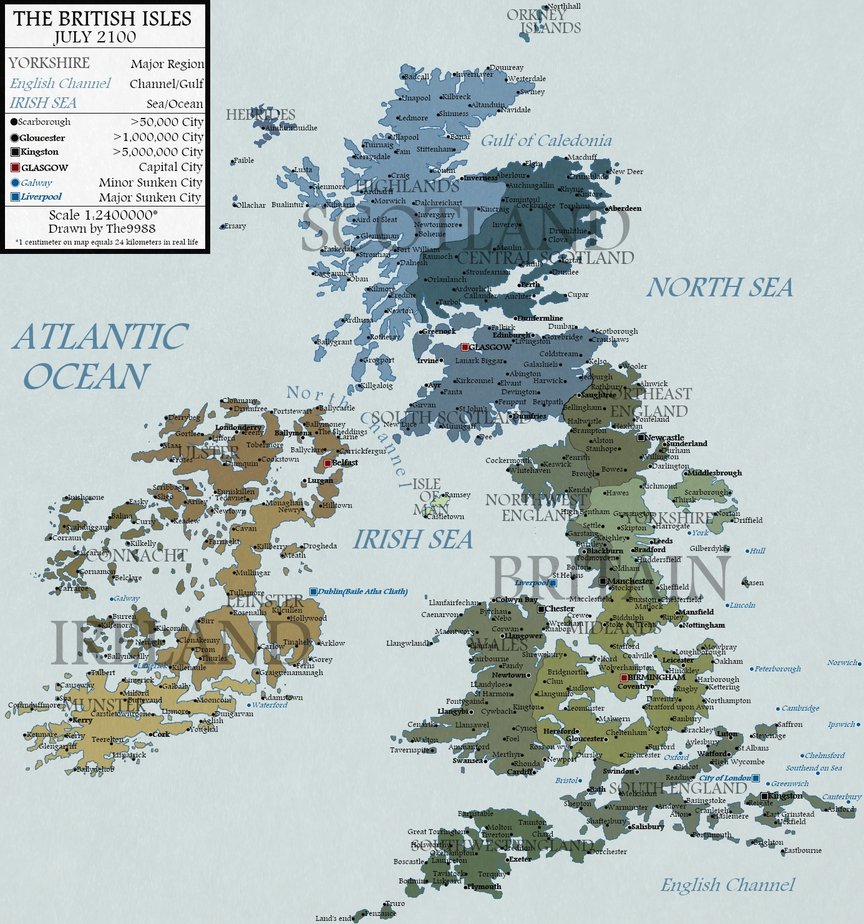
A look at the UK in 2100 with a 100m rise in sea level.

mapsontheweb:

The British Isles after a 100 m rise in sea levels

Related: Europe in 2100

More sea level rise maps

Read more

We are now living in a history glut; the Internet has muddled the line between past and present.

The transformation was slow at first, and hardly anyone besides librarians noticed. Project Gutenberg, founded in 1971, was a cheerfully radical effort to turn old books into text files. When the web came along, the Online Books Page appeared and began listing links to thousands of digitized titles. Then, after the turn of the millennium, the pace rapidly accelerated: Google set up Google Books, Amazon launched Kindle, and Archive.org started scanning public-domain works from libraries. Meanwhile, shifts in the economics of music, film, and video set off an explosion in the digitization of back catalogs, until then the furtive territory of file-sharing pirates. Spotify and Netflix, Apple and YouTube have all now built enormous businesses based on organizing the past for commercial exploitation. Suddenly we find ourselves living in an online realm where the old is just as easy to consume as the new. We’re approaching an odd sort of asymptote, as our past gets closer and closer to the present and the line separating our now from our then dissolves.

There’s an irony here: All of the data we’re collecting, all of the data points and metadata, is history itself. Much as we marvel at Babylonian clay tablets listing measures of grain, future generations will find just as much meaning in our log files as they will in the media we consume. Sure, Frank Sinatra sang a bunch of songs; sure, Jennifer Lawrence was a big star in 2014. But the log files tell you who listened, and when, and where they were on the planet. It’s these massive digital archives—and the records that show how we used them—that will be the defining historical objects of our era.

Netflix and Google Books Are Blurring the Line Between Past and Present

BY PAUL FORD – http://www.wired.com/underwire/2014/02/history/

Read more

For over a thousand years before the appearance of the Yoga Sūtras (YS) and Bhagavad Gītā (BhG), yoga was a practice of yoking the physical body. Yet today, even when scholars, teachers, and commentators say they are talking about the “ancient tradition” of yoga they are (often knowingly) suppressing its actual history.

The result of denying the roots and realities of yoga, says White, is that “nearly every history of “yoga” written to date has in fact been the history of meditation.”

Erasing a meaningful understanding of yogic yokingin order to give a hyperbolic importance to the practices of contemplation turns out to be a switch not unlike that accomplished by yogis who stole the bodies of kings and went on to live as royal impostors.

White argues against academic colleagues who play down villainous yogis. Given the ubiquitous occurrence of “yoking of another” animal or human body “with one’s own self (ātman)” as the chief mode of operation of yogis in more than a thousand years of Indian texts, White maintains sinister yogis are not mere “literary fixtures.” Through copious (quite captivating) examples, White demonstrates in the entire period of literature, no other representation of yogis even exists.

Why is it that not a single yogi in these narratives is ever seen assuming a yogic posture (āsana); controlling his breath, senses, and mind; engaging in meditation (dhyāna); or realizing transcendent states of consciousness (samādhi) – all of the practices of what has been deemed “classical yoga”?

White, like other scholars, is keen to dismantle the hagiography of contemporary yoga. The idea that yoga is an ahistorical, unbroken transmission is a perfection White holds as pure fabrication, a recent and fantastical construction based on singling out specific passages of just two texts.

The reef upon which many of these modernist constructions have stranded themselves is the notion that the BhG and YS were capstone works, literary culmination of an unbroken and unchanging tradition of yogic theory and practice extending back to, if not beyond, the Vedas of the second millennium BCE.

In fact, these are works that were compiled toward the end of a five-hundred-year period in which a new synthesis of theory and practice, sometimes referred to as “yoga,” was very much in vogue throughout South Asia.

It’s easy to appreciate this by checking out the commentary of almost any copy of the Yoga Sūtraswhich often obviate the significance of the vibhūti, in spite of the fact this pada on attainment of extraordinary powers comprises over a quarter of the YS.

Read more

Expanding Mind – The New Animism – 02/02/14 at Expanding Mind   

Animist practice, sacred sites, and cultivating a relationship to significant otherness: a talk with Robert Wallis, professor of Visual Culture at Richmond University and a scholar of paganism, shamanism, and rock art.

Expanding Mind – The New Animism – 02/02/14 at Expanding Mind   

Read more "Expanding Mind – The New Animism – 02/02/14 at Expanding Mind   "