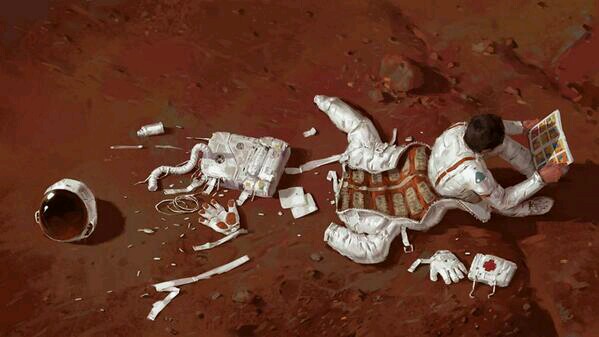
Source http://mikelisowski.com/
Read more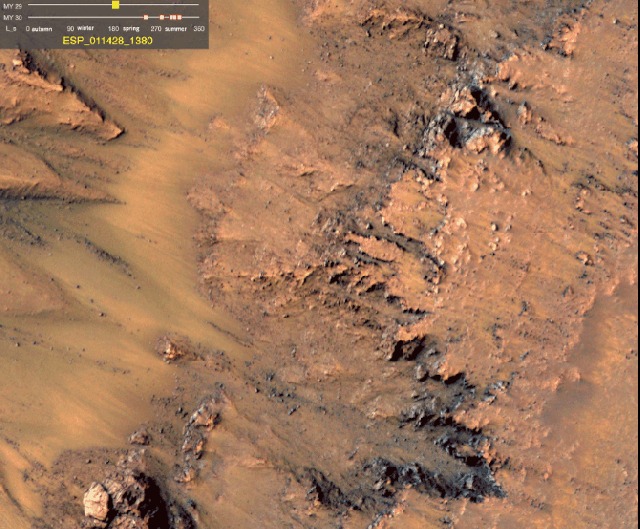
Researchers have long theorized that Mars had at one point held flowing water, and probably even held frozen water still. But, the presence of darkening lines moving downwards along a slope as the temperatures rise in the warmer months, suggests that there could be water flowing even now — and also suggests a mechanism for how it might be able to do it.
So, how does water flow in the frigid Martian temperatures that are present, even in the summer months? Researchers think that there may be a naturally-occurring anti-freeze in the water, caused by the high-iron content…
More details and pix http://io9.com/are-these-pictures-of-water-flowing-on-mars-right-now-1520115138
Read moreThe iron level of the universe increases with time as successive generations of stars form and die. We can use the iron abundance of a star as a qualitative “clock” telling us when the star was formed.
In the case of the star we have announced, the amount of iron present is less than one millionth that of the Sun, and a factor of at least 60 times less than any other star. This indicates that our star is the most ancient yet found.
Stars are like time capsules, they lock away a sample of gas from which they form. In the case of the star we have discovered, this has enabled us to study in detail a sample of gas from approximately 13.6 billion years ago.
This is so long ago that the star predates the formation of the Milky Way. It likely formed in a small cloud of gas and eventually many of such clouds fell together under gravity to form the grand spiral galaxy we call home.
This star has born silent witness to 99% of the life of the universe – it has spun impervious, slowly converting hydrogen into helium as demanded by gravity.
I would say that one of the ethical problems we face today is how to return to silence. And one of the semiotic problems we might consider is the closer study of the function of silence in various aspects of communication, to examine a semiotics of silence: it may be a semiotics of reticence, a semiotics of silence in theater, a semiotics of silence in politics, a semiotics of silence in political debate—in other words, the long pause, silence as creation of suspense, silence as threat, silence as agreement, silence as denial, silence in music.

Shops and small stores are opening three months after Typhoon Haiyan. In a badly-hit part of Tacloban, a shop offering phone credit has already been built and is well stocked. Photograph: Eleanor Farmer/Oxfam
Read moreEnvironmental management requires long-term strategy which may not be profit-maximising; it requires outward-looking international co-operation; it requires taxation and state intervention. Such attitudes are anathema to a neoliberal. They refuse to believe there is a problem because the ideology to which they are devoted could not possibly begin to deal with it.
Or, how the west was destroyed from within by barbarians in bespoke suits.
From the comments: “ To my mind, this library should be one that could jumpstart a human civilization founded by the passengers of a generational starship.”
Like, say, Spaceship Earth.
» The Manual For Civilization Begins – Blog of the Long Now
Read more "» The Manual For Civilization Begins – Blog of the Long Now"Read moreOne of the main technical challenges the ISEE-3/ICE project has faced is determining whether we can speak, listen, and understand the spacecraft and whether the spacecraft can do the same for us. Several months of digging through old technical documents has led a group of NASA engineers to believe they will indeed be able to understand the stream of data coming from the spacecraft. NASA’s Deep Space Network (DSN) can listen to the spacecraft, a test in 2008 proved that it was possible to pick up the transmitter carrier signal, but can we speak to the spacecraft? Can we tell the spacecraft to turn back on its thrusters and science instruments after decades of silence and perform the intricate ballet needed to send it back to where it can again monitor the Sun? The answer to that question appears to be no.
The transmitters of the Deep Space Network, the hardware to send signals out to the fleet of NASA spacecraft in deep space, no longer includes the equipment needed to talk to ISEE-3. These old-fashioned transmitters were removed in 1999. Could new transmitters be built? Yes, but it would be at a price no one is willing to spend. And we need to use the DSN because no other network of antennas in the US has the sensitivity to detect and transmit signals to the spacecraft at such a distance.
This effort has always been risky with a low probability of success and a near-zero budget. It is thanks to a small and dedicated group of scientists and engineers that we were able to get as far as we have.

Sure, obviously you go hang out at a Lagrange point on the way back to Earth, after rendezvousing with a Type C Asteroid.
Read more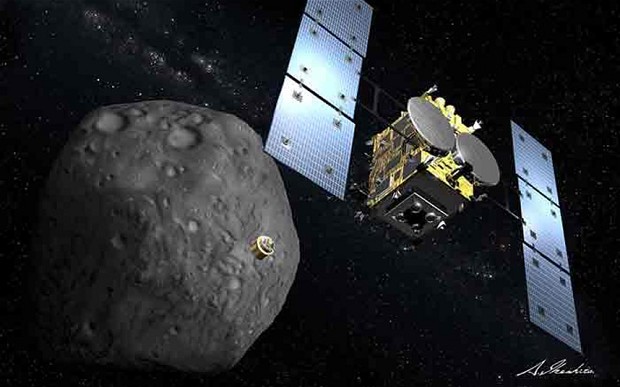
Read more‘Space Cannon’ To Be Fired Into Asteroid
Japanese craft to fire “space cannon” into asteroid in search for origins of the universe
Japan’s space agency has successfully test-fired a “space cannon” designed to launch a projectile into an asteroid as part of the search for the origins of the universe.
The device will be aboard the Hayabusa-2 space probe that is scheduled to take off in 2014 and rendezvous with an asteroid identified as 1999JU3 that orbits between Earth and Mars in 2018.
Once in position close to the asteroid, the space cannon will detach itself and remotely fire a 4lb metal projectile into the surface of the miniature planet.
“An artificial crater that can be created by the device is expected to be a small one, a few meters in diameter, but … by acquiring samples from the surface that is exposed by the collision, we can get fresh samples that are less weathered by the space environment or heat,” the Japan Aerospace Exploration Agency said in a statement.
The mother craft will then land close to the crater and use a small rover to collect samples that would have otherwise been below the surface of the asteroid and return to Earth in late 2020. In all, JAXA scientists say the craft will shadow the 2,950-foot-diameter asteroid for around 18 months.
The project has “the potential to revolutionise our understanding of pristine materials essential to understanding the conditions for planet formation and the emergence of life,” JAXA said.
“It can provide important information needed to develop strategies to protect the Earth from potential hazards,” the agency added.
“Moreover, robotic sampling missions to primitive bodies will be pathfinders for … human missions that might use asteroid resources to facilitate human exploration and the development of space.”
Hayabusa-2 is the second project to recover particles from deep space and will build on the success of Hayabusa, which in 2010 gathered surface dust from an asteroid and returned to Earth.
Source: telegraph UK
 The Committee to Nuke Elysium