


Read moreMesoamerican Mosaic Skulls

Read moreFrom the space of the interwebs: this sleeve illustration for The Heliocentric Worlds of Sun Ra (1965) is stellar in all senses of the word.
As certain writing deadlines loom and I start thinking towards moderating this very exciting event in a couple of months, I’ll try posting relevant thoughts, sounds, visuals and otherwise up here, more so than I usually do. Next stop, Jupiter…
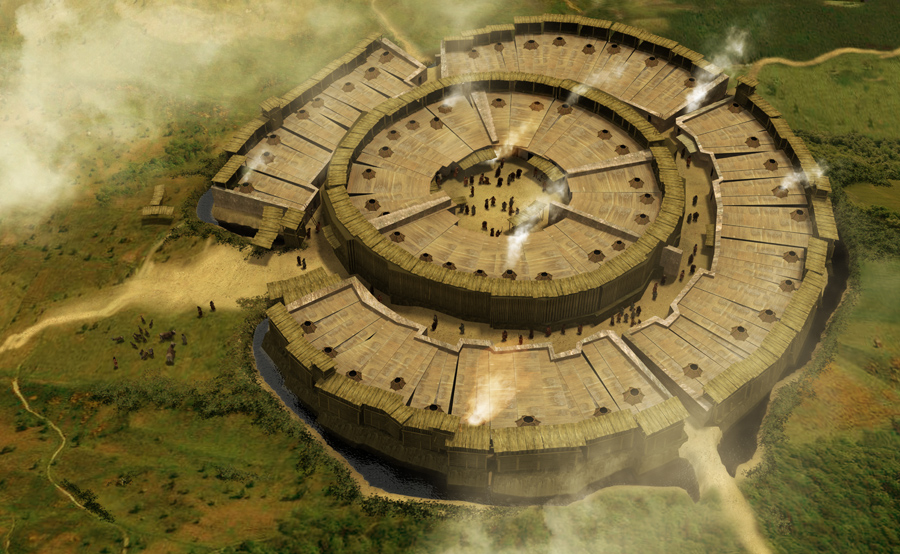
Arkaim is the remnants of an ancient settlement, which is basically a village that was fortified by two large stone circular walls. The settlement covers an area of some 220,000sq-ft and consists of two circles of dwellings separated by a street, with a central community square in the center. The site was discovered (rediscovered?) in 1987 by a team of Russian archaeologists, and a wave of excitement washed through the world of archaeology. The site and associated artefacts have been dated to the 17th century BCE and it’s generally agreed that it was built somewhere between 4000-5000 years ago, which puts it in the same age bracket as Stonehenge.
…
It has been of great interest to archaeoastronomers, and therein lies the reason for its association with Stonehenge. It’s long been known that Stonehenge has and was built with astronomical observation in mind. In fact it’s technically called an observatory. Stonehenge allowed for, and possibly may still allow for observations of 10 astronomical phenomena using 22 elements, whereas some archaeoastronomers claim that Arkaim allows for observations of 18 phenomena using 30 elements. This essentially means that certain events in the sky could be observed and tracked by using the site in particular ways and from different positions, and that Arkaim offered more observable events than Stonehenge.
…
It may seem obvious to some, but the fact that these sites were apparently constructed, deliberately, to act as astronomical observatories and even calendars of a sort, before the same expertise was achieved in the great foundational empires of antiquity, like the Egyptians and the Greeks, is seemingly strong evidence for attributing greater development and sophistication to these pre-historic cultures. The more conspiratorial among us might even say that these sites offer clues to the existence of an unknown or lost civilization in our distant past.
Read moreJulien Cuny and Louis-Pierre Pharand, former producers and creative directors at Ubisoft on Assassin’s Creed and FarCry, have formed a new development studio named PIXYUL. Their goal: to map our planet at 1:1 scale using drones, and use the resulting 3D recreation as the setting for a survival RPG called ReRoll.
Survival RPG ReRoll Wants To Map (Most Of) The World
Read more "Survival RPG ReRoll Wants To Map (Most Of) The World"
Read moreIn the Martian winter, carbon dioxide freezes out of the air (and you thought it was cold where you are). In the summer, that CO2 sublimates; that is, turns directly from a solid to a gas. When that happens the sand gets disturbed, and falls down the slopes in little channels, which spreads out when it hits the bottom. But this disturbs the red dust, too, which flows with the sand. When it’s all done, you get those feathery tendrils. Note that at the tendril tips, you see blotches of red; that’s probably from the lighter dust billowing a bit before settling down.
Now, you might think I’m making this all up. How do we know this stuff is flowing downhill like that? Ah, because in this picture we’ve caught it in the act! In this image, a closeup of a region just to the left of center of the big image, you can actually see the cloud of dust from an avalanche as it occurs.
Oh, baby. The cloud is only a few dozen meters across, and can’t be more than a few seconds old.
spaceexp: The Opportunity rover recently celebrated 10 years on Mars, even though the mission was only planned for three months. Engineers thought the rover would conk out much sooner, in part because they believed its solar panels would quickly become caked with dust and cut off the robot’s power supply. Instead, they found that wind […]
Read more "The Opportunity Rover Looks Nearly Unrecognizable After 10 Years On Mars"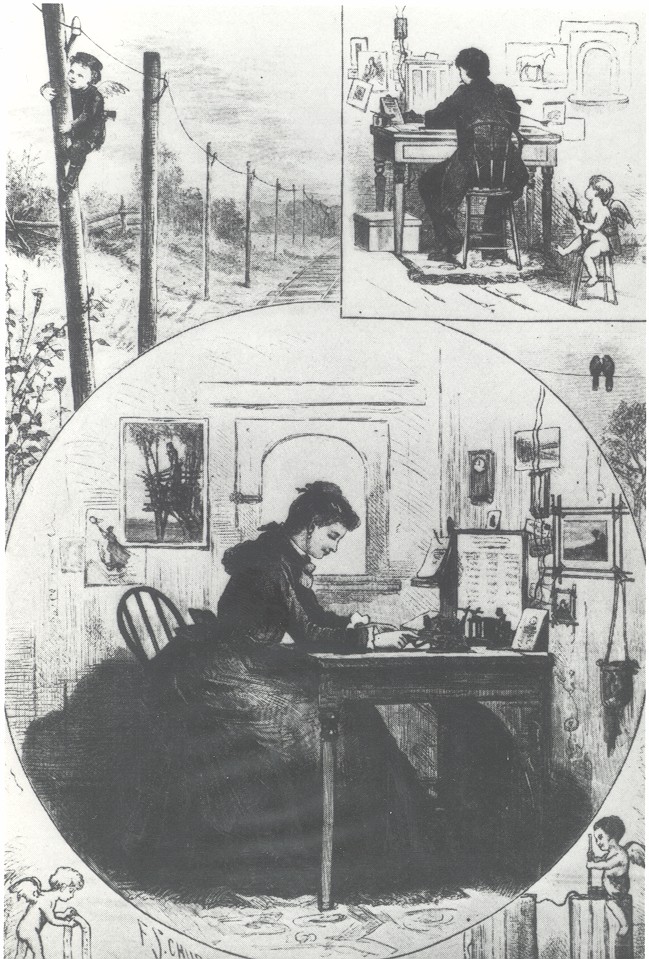
Read moreUsing the telegraph, circa 1900
*Oh come on, that couple are not merely “using” the telegraph, they’re carrying out a telegraphic romance complete with electric cupids


 The Committee to Nuke Elysium