The House of Rumour by Jake Arnott – review

The book could almost work as a compendious excuse to exhume neglected figures from the past, because Arnott assembles a fascinating cast of misfits who have been consigned to the margins of history. There is Jack Parsons, the rocket scientist and Crowley devotee who set up a hedonistic commune in California in the 1940s, before accidentally blowing himself up. And Katharine Burdekin, the British feminist who in 1937 wrote Swastika Night, a work of visionary dystopia that has been compared to Nineteen Eighty-Four. But this novel is more than a collection of obscure biographies; it’s also about timing and dislocation, and how life and history rest on what sci-fi readers may know as a “Jonbar Hinge”, a point at which the future could have taken a different path.

The House of Rumour by Jake Arnott – review

Read more "The House of Rumour by Jake Arnott – review"

Asteroid 2014 AA: Harmless impact over Atlantic Ocean last night.

It’s only the second time in history that an asteroid was seen before it hit us; the first was 2008 TC3, which burned up over Sudan in Africa in 2008. That one was also discovered just a day before atmospheric entry. Other rocks have been discovered in the past that gave us a very close shave, and usually small asteroids that actually hit us go undetected until someone looks up and sees them! That’s because they are so small: That makes them faint and hard to detect. Because they are close by they also tend to move very rapidly across the sky, making them harder to find. The 19-meter wide asteroid that blew up over Russia last year was undetected until it hit, for example.

It’s possible some satellites may have observed the entry of 2014 AA, and hopefully we’ll get an image or two. Stay tuned.

And of course this underscores how seriously we need to take asteroid impacts. While 2014 AA wasn’t a threat, there are a million bigger rocks out there that cross Earth’s orbit, big enough to cause real damage should they hit us. And given enough time, they will.

That’s why we need to keep scanning the skies, locating and characterizing these asteroids. Both NASA and the B612 Foundation are working on better detection methods, but that’s only the first step; we also need a plan in place should we find one with our number on it. B612 is working on that, but we’re a long way from being able to implement it.

Asteroid 2014 AA: Harmless impact over Atlantic Ocean last night.

Read more "Asteroid 2014 AA: Harmless impact over Atlantic Ocean last night."

Today, Alexei Sharov at the National Institute on Ageing in Baltimore and his mate Richard Gordon at the Gulf Specimen Marine Laboratory in Florida, have taken a similar to complexity and life.

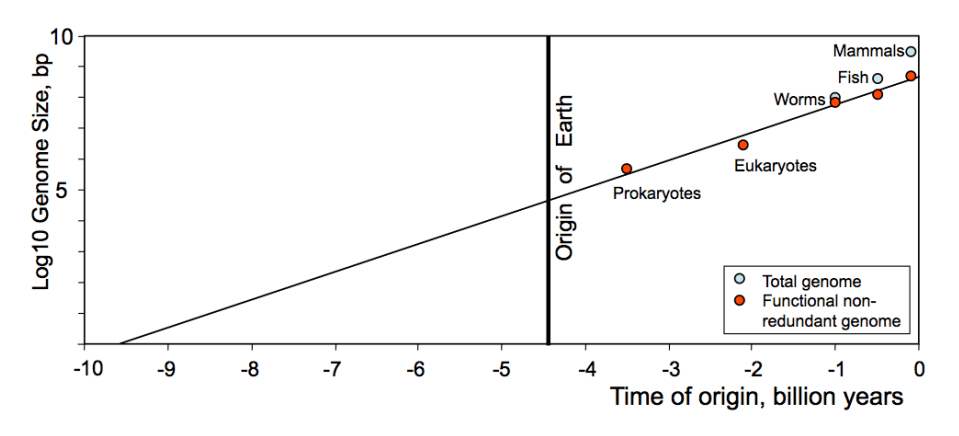
These guys argue that it’s possible to measure the complexity of life and the rate at which it has increased from prokaryotes to eukaryotes to more complex creatures such as worms, fish and finally mammals. That produces a clear exponential increase identical to that behind Moore’s Law although in this case the doubling time is 376 million years rather than two years.

That raises an interesting question. What happens if you extrapolate backwards to the point of no complexity–the origin of life?

Sharov and Gordon say that the evidence by this measure is clear. “Linear regression of genetic complexity (on a log scale) extrapolated back to just one base pair suggests the time of the origin of life = 9.7 ± 2.5 billion years ago,” they say.

And since the Earth is only 4.5 billion years old, that raises a whole series of other questions. Not least of these is how and where did life begin.

Of course, there are many points to debate in this analysis. The nature of evolution is filled with subtleties that most biologists would agree we do not yet fully understand.

For example, is it reasonable to think that the complexity of life has increased at the same rate throughout Earth’s history? Perhaps the early steps in the origin of life created complexity much more quickly than evolution does now, which will allow the timescale to be squeezed into the lifespan of the Earth.

Sharov and Gorden reject this argument saying that it is suspiciously similar to arguments that squeeze the origin of life into the timespan outlined in the biblical Book of Genesis.

Let’s suppose for a minute that these guys are correct and ask about the implications of the idea. They say there is good evidence that bacterial spores can be rejuvenated after many millions of years, perhaps stored in ice.

They also point out that astronomers believe that the Sun formed from the remnants of an earlier star, so it would be no surprise that life from this period might be preserved in the gas, dust and ice clouds that remained. By this way of thinking, life on Earth is a continuation of a process that began many billions of years earlier around our star’s forerunner.

Sharov and Gordon say their interpretation also explains the Fermi paradox, which raises the question that if the universe is filled with intelligent life, why can’t we see evidence of it.

However, if life takes 10 billion years to evolve to the level of complexity associated with humans, then we may be among the first, if not the first, intelligent civilisation in our galaxy. And this is the reason why when we gaze into space, we do not yet see signs of other intelligent species.

Ref: arxiv.org/abs/1304.3381: Life Before Earth

Read more

In 1986, the military’s psychic friends were asked to locate Muammar Gadhafi before the US bombing raid on Libya. The next year, the DIA requested some of the purported psychics to divine the purpose of a Soviet facility at Dushanbe, and in 1989 the Joint Staff asked for help in determining the exact function of a suspected terrorist training facility in Libya. In 1993, the DIA asked the psychics to locate tunnels that the agency suspected the North Koreans were digging under the demilitarized zone separating their country from South Korea. In 1994, some of the alleged psychics were tasked to find plutonium in North Korea. In 1995, despite its claim that the program produced some successes—including the 1979 prediction that a new Soviet submarine would be launched within 100 days and the identification of a building where Lt. Col. William Higgins was being held in Lebanon—DIA was planning on terminating its STARGATE program.

The Wizards of Langley, by Jeffery T. Richelson

[Don’t be fooled by the title… the book is a general history of the CIA, and this bit about remote viewing programs is just an (albeit true) aside.]

(via wolvensnothere)

Read more

theremina:

american-whoreror-story:

lightspeedsound:

manybodies:

lightspeedsound:

lunapics:

theshells:

I can’t stop laughing at Harry running the fuck awaythe boy who lived ladies and gentlemen.

….You realize, of course, that Hermione Granger lit a teacher on fire when she was eleven, and kept a person alive in a jar for a year when she was fourteen, and studies dark and forbidden magics for kicks, and is one of the brightest and strongest witches of her era. If she came at me, even wandless, I would aparate to Neptune to get away from her.

Hermione Granger also: 

  • punched Draco Malfoy in the nose for being an idiot 
  • purposefully performed a confundus charm on whatshsface WHILE HE WAS FLYING just so Ron would win (omfg that is so fucking dangerous) 
  • literally pulled a fucking Bourne Identity on her parents and managed to set them up in fucking Australia (jesus christ she literally made it so that she NEVER EXISTED wtf that’s so fucking 007)
  • Convinced the Ministry of Magic to give her an incredibly dangerous and volatile device that allowed her to ALTER TIMELINES COMPLETELY (just because she was so smart, literally, that is the reason, her “potential”) 
  • Has enough basic survival skills and badass magic to literally disappear to the middle of nowhere and flourish AND figure out Voldemort’s plot with Harry 
  • Hermione also figures out not only what Voldemort’s plan is, but generally how to beat it, WAY BEFORE VOLDEMORT EVER DOES. Why? because she is just that much smarter and better at magic than everybody else

in conclusion: Voldemort wishes he could be as awesome as Hermione, that’s why he wants to kill her so bad. 

Can we rehave this series with hermione as the protagonist. 

Hermione Granger and “That Time I Used the Power of Research and Deductive Reasoning to Make Sure Harry Didn’t Die”

Hermione Granger and “That time I figured shit out and literally ended up petrified for the cause and it took my friends weeks to figure out that I had the research on me”

Hermione Granger and “That Time I Was a Time Lord”

Hermione Granger and “That Time I Realized I was Hot and Smart and Saved Harry’s Ass with Research. Again. All the Time. Really, He Would Have Died Without Me.” 

Hermione Granger and “That time Harry was too emo to actually do shit so I did shit in his name because I am the power behind the throne clearly also PS fought evil deatheaters and won”

Hermione Granger and “That Time I told Harry about the Dangers of Copying off Somebody’s else’s work that wasn’t mine and OH LOOK I WAS RIGHT”

Hermione Granger and “That Time I let Harry Decide Where to Go and What To do and we ended up wandering the forests of dean for like 5 months before saving his ass at Hogwarts” 

Reblogging for comment^

FOREVER REBLOG

HERMIONE 4 PREZ

Read more