climateadaptation:

Video of a glacier literally exploding. It’s called a “jökulhlaup,” a type of glacial flood caused by volcanic or geothermal pressure. An extremely rare event, it’s rarely caught on camera. The above catastrophic jökulhlaup occurred in 2010 when the Eyjafjallajökull erupted.

A jökulhlaup (Icelandic pronunciation: [ˈjœːkʏl̥ˌl̥øip]) is a glacial outburst flood. It is an Icelandic term that has been adopted by the English language. It originally referred to the well-known subglacial outburst floods from Vatnajökull, Iceland which are triggered by geothermal heating and occasionally by a volcanic subglacial eruption, but it is now used to describe any large and abrupt release of water from a subglacial or proglacial lake/reservoir. 

Since jökulhlaups emerge from hydrostatically-sealed lakes with floating levels far above the threshold, their peak discharge can be much larger than that of a marginal or extra-marginal lake burst. The hydrograph of a jökulhlaup from Vatnajökull typically either climbs over a period of weeks with the largest flow near the end, or it climbs much faster during the course of some hours. These patterns are suggested to reflect channel melting, and sheet flow under the front, respectively.

Similar processes on a very large scale occurred during the deglaciation of North America after the last ice age (e.g. Lake Agassiz), and presumably at earlier times, although the geological record is not well preserved. Via Wikipedia (great entry!)

Read more

8bitfuture:

Update on Google Glasses.

Babak Parviz, head of Project Glass at Google has given an interview updating some of the progress since they were first shown off Mid-2012.

Among other information, he describes how the glasses are currently controlled:

Right now, we have a touch pad on the device that allows people to change things on the device if they wish to do so. We have also experimented a lot with using voice commands. We have full audio in and audio out, which is a nice, natural way of interacting with something that you’d wear and always have with you. We have also experimented with some head gestures.

Check out the full interview here.

Read more

Tim O’Reilly on The Endarkment

smarterplanet:

Tim O’Reilly is a very smart guy, and even though he is a dyed-in-the-wool technophile, he hasn’t let that blind him:

Tim O’Reilly, The Rise Of Anti-Intellectualism And The End Of Progress

For so many in the techno-elite, even those who don’t entirely subscribe to the unlimited optimism of the Singularity, the notion of perpetual progress and economic growth is somehow taken for granted. As a former classicist turned technologist, I’ve always lived with the shadow of the fall of Rome, the failure of its intellectual culture, and the stasis that gripped the Western world for the better part of a thousand years. What I fear most is that we will lack the will and the foresight to face the world’s problems squarely, but will instead retreat from them into superstition and ignorance.

[…]

Yes, we may find technological solutions that propel us into a new golden age of robots, collective intelligence, and an economy built around “the creative class.” But it’s at least as probable that as we fail to find those solutions quickly enough, the world falls into apathy, disbelief in science and progress, and after a melancholy decline, a new dark age.

Civilizations do fail. We have never yet seen one that hasn’t. The difference is that the torch of progress has in the past always passed to another region of the world. But we’ve now, for the first time, got a single global civilization. If it fails, we all fail together. 

Yes, we’ve become entangled, and our fate will be shared. To avoid the endarkment will require a great deal of hard work, and the hardest part might be the necessary first step: realizing that we are at a pivotal moment, and that just about everything must change.

He’s as right as he is wrong: There’s still plenty of edges left to rebuild from.

Tim O’Reilly on The Endarkment

Read more "Tim O’Reilly on The Endarkment"

cozydark:

Earth-Size Planets Common in Galaxy: 17 Percent of Sun-Like Stars Have Planets Within the Orbit of Mercury |

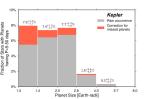
An analysis of the first three years of data from NASA’s Kepler mission, which already has discovered thousands of potential exoplanets, contains good news for those searching for habitable worlds outside our solar system.

This estimate includes only planets that circle their stars within a distance of about one-quarter of Earth’s orbital radius – well within the orbit of Mercury – that is the current limit of Kepler’s detection capability. Further evidence suggests that the fraction of stars having planets the size of Earth or slightly bigger orbiting within Earth-like orbits may amount to 50 percent.

The team – UC Berkeley graduate student Erik Petigura, former UC Berkeley post-doctoral fellow Andrew Howard, now on the faculty of the Institute for Astronomy at the University of Hawaii, and UC Berkeley professor of astronomy Geoff Marcy – reported their findings today (Tuesday, Jan. 8) at a session on the Kepler mission during the American Astronomical Society meeting in Long Beach, Calif.

“Our key result is that the frequency of planets increases as you go to smaller sizes, but it doesn’t increase all the way to Earth-size planets – it stays at a constant level below twice the diameter of Earth,” Howard said.

Francois Fressin of the Harvard-Smithsonian Center for Astrophysics presented nearly identical results yesterday at the meeting, reporting that one in six stars, or at least 17 billion stars in the Milky Way Galaxy, have an Earth-size planet within an orbit like Mercury’s.

continue reading

Read more

new-aesthetic:

Royal College of Art student Gabriele Meldaikyte has designed a set of interactive exhibits for a museum of iPhone gestures. “I believe that in ten years or so these gestures will completely change, therefore my aim is to perpetuate them so they become accessible for future generations,” she explains.

Multi-Touch iPhone Gestures by Gabriele Meldaikyte, via Tom A.

Read more

trendd:

These flexible display prototypes are amazing.

“The flexible smartphone could soon be here. After years of teasing, Samsung finally unveiled flexible screens at CES. Called ‘Youm,’ the displays were shown on prototype devices including one where it stretched right to the edge.”

(via Samsung Debuts Flexible Screens – PSFK)

Read more