Read moreJuan Yin at the University of Science and Technology of China in Shanghai, and a bunch of mates say they have teleported entangled photons over a distance of 97 kilometres across a lake in China. That’s an impressive feat for several reasons. The trick these guys have perfected is to find a way to use a 1.3 Watt laser and some fancy optics to beam the light and receive it. Inevitably photons get lost and entanglement is destroyed in such a process. Imperfections in the optics and air turbulence account for some of these losses but the biggest problem is beam widening (they did the experiment at an altitude of about 4000 metres). Since the beam spreads out as it travels, many of the photons simply miss the target altogether. So the most important advance these guys have made is to develop a steering mechanism using a guide laser that keeps the beam precisely on target. As a result, they were able to teleport more than 1100 photons in 4 hours over a distance of 97 kilometres. That’s interesting because it’s the same channel attenuation that you’d have to cope with when beaming photons to a satellite with, say, 20 centimetre optics orbiting at about 500 kilometres. “The successful quantum teleportation over such channel losses in combination with our high-frequency and high-accuracy [aiming] technique show the feasibility of satellite-based ultra-long-distance quantum teleportation,” say Juan and co. So these guys clearly have their eye on the possibility of satellite-based quantum cryptography which would provide ultra secure communications around the world.
Uncategorized
HOW WE LOST THE FUTURE – Leila Johnston (by lighthouse296) (Transcript http://finalbullet.com/2012/09/07/how-we-lost-the-future/)
(Source: http://www.youtube.com/)
Read more
#SON12: Julian Oliver – If the air we breathe is considered Public, why not that which passes through it? (by newthinking) MORE http://open-strategies.de/sessions/the-air-we-breathe
(Source: http://player.vimeo.com/)
Read more
Jacob Appelbaum 29C3 Keynote: Not My Department (by thisdayinwikileaks)
(Source: https://www.youtube.com/)
Read more
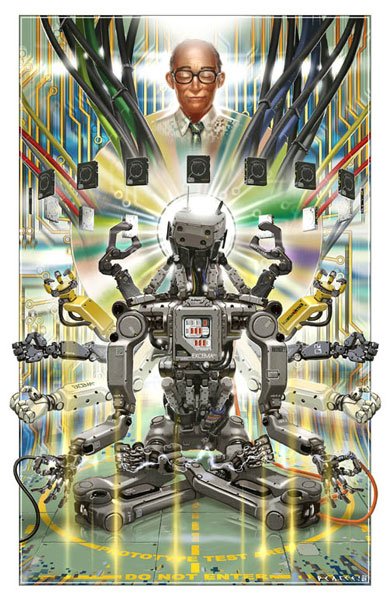
Read moreBefore we invented automobiles, air-conditioning, flatscreen video displays, and animated cartoons, no one living in ancient Rome wished they could watch cartoons while riding to Athens in climate-controlled comfort. Two hundred years ago not a single citizen of Shanghai would have told you that they would buy a tiny slab that allowed them to talk to faraway friends before they would buy indoor plumbing. Crafty AIs embedded in first-person-shooter games have given millions of teenage boys the urge, the need, to become professional game designers—a dream that no boy in Victorian times ever had. In a very real way our inventions assign us our jobs. Each successful bit of automation generates new occupations—occupations we would not have fantasized about without the prompting of the automation.
Alan Moore circa 2010 telling some very real and personal experiences of practicing magic(k).
(Source: https://player.vimeo.com/)
Read more
Times are bad. Children no longer obey their parents and everyone is writing a book.
Cicero, circa 43 BC (via tsar-bomba)
Read more