Solar Mamas | Trailer | Independent Lens | PBS (by IndependentLens)
(Source: https://www.youtube.com/)
Read more
Solar Mamas | Trailer | Independent Lens | PBS (by IndependentLens)
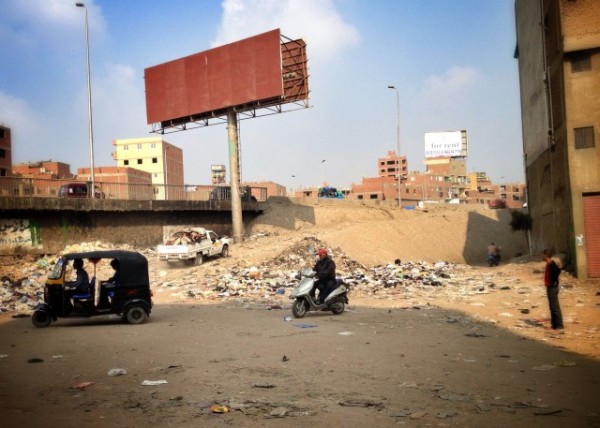
Cairo has always been a city of informal, unsanctioned construction, and this practice is only increasing. Take what’s going on in the neglected neighborhood that runs next to Cairo’s main highway. With no paved streets and flocks of sheep clogging busy thoroughfares, 20th Street seems like an unlikely place for urbanist revolution. But with no assistance from government or any other authority, this year the working-class residents of this area built their own informal highway exit.
Nondescript mounds of dirt and sand mixed with trash, roughly 10 feet high, sit comfortably next to the highway overpass, forming entrance and exit ramps. Stray cats and dogs rummage through these homemade ramps as cars and large trucks fly by. Once the dirt highway exits were in place, residents simply moved the concrete safety barriers to create their new entry point.
from In the Traffic of Cairo’s DIY Highway Exit, an Urbanist Movement Grows – Next American City
Read more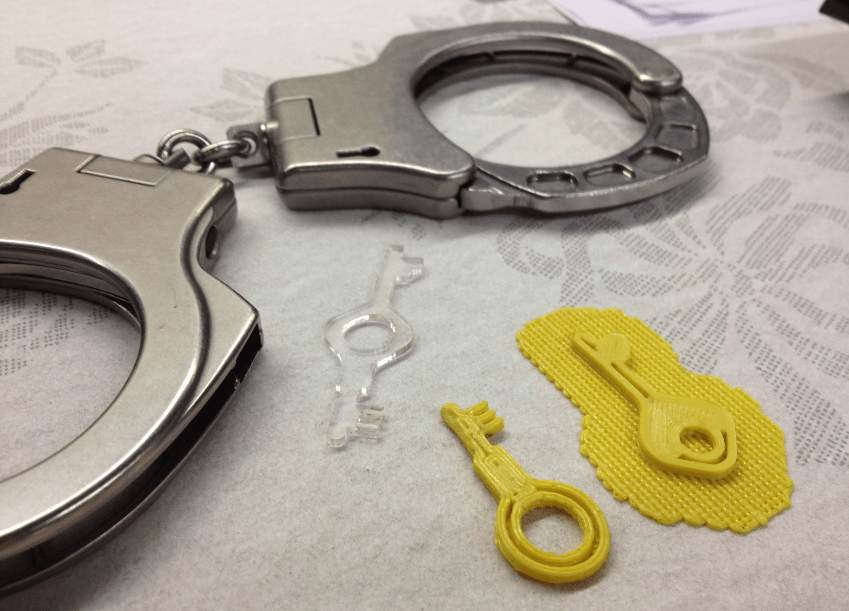
In a workshop Friday at the Hackers On Planet Earth conference in New York, a German hacker and security consultant who goes by the name “Ray” demonstrated a looming problem for handcuff makers hoping to restrict the distribution of the keys that open their cuffs: With plastic copies he cheaply produced with a laser-cutter and a 3D printer, he was able to open handcuffs built by the German firm Bonowi and the English manufacturer Chubb, both of which attempt to control the distribution of their keys to keep them exclusively in the hands of authorized buyers such as law enforcement.
Over the weekend, a lockpick vendor at the HOPE conference was already selling dozens of the plexiglass Chubb keys for a mere $4 each. Ray says he plans to upload the CAD files for the Chubb key to the 3D-printing Web platform Thingiverse after the annual lockpicking conference LockCon later this week.
from Hacker Opens High Security Handcuffs With 3D-Printed And Laser-Cut Keys – Forbes
Read moreRead moreThe New Aesthetic is an act of noticing, as much as anything: we are already in a machine-vision world, we are already in a world where the digital is erupting into the physical, and we just didn’t really notice it, in the entire breadth of its creeping wave, until now.
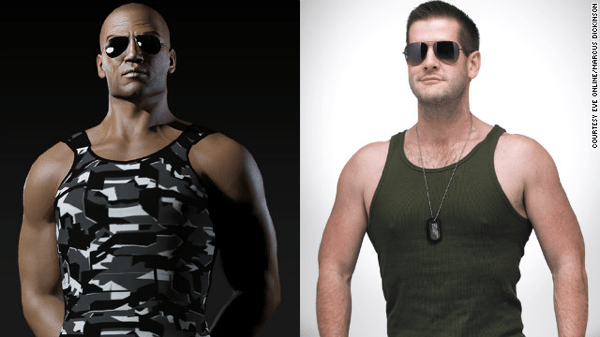
Marcus Dickinson, 40, was very overweight and unhealthy when he created his EVE Online character Roc Wieler, the tough guy seen above left. Eventually, Dickinson became so inspired by Roc that he hit the gym to be more like him. Above right is Dickinson now. “I’m a role player inherently,” Dickinson says. “I take it seriously.” Virtual reality: Avatar inspires gamer to hit the gym (CNN) (via Man cultivates healthy lifestyle to be more like his avatar – Boing Boing)
Read moreConsensus in a liberal-democratic society is — and all will always be — the expression of a hegemony and the crystallization of power relations.
Read moreWikipedia is a privately owned public space. Its articles are managed and manicured as carefully as the flora of Zuccotti Park. Just as Wikipedia is groomed for smooth and sensible data retrieval, the privately owned public park is a place for white-collar workers to savor a moment of relaxation so they can return to the bustle of the office feeling refreshed. Zuccotti Park and Wikipedia both make sense in the framework of a neoliberal worldview that understands public spaces—in the city and online—as sites of discrete actions and transactions, as links in logical chains of cause and effect. They are not places so much as they are conduits of productive movement. Ersatz urban environments are built along this principle: the Silicon Valley offices of Google and Facebook eschew cubicles for plazas and promenades, in the belief that shared spaces of locomotion generate productivity and innovation.
Read moreThis is the political side of the New Aesthetic, which the discourse of the New Aesthetic has been dancing around since it became a topic of discussion. The New Aesthetic isn’t so much a thing of itself, as the combined sense of oddness that we feel when we discover technology warping or mutating the shape of the world. The New Aesthetic is an aesthetic tag, which James Bridle began attaching to clipped photos and text blocks that demonstrated this warp. The difficulty of confronting the political side of the New Aesthetic is that there is no ideology of it, no state flag or political line to toe. The political side of the New Aesthetic is that politics is everywhere, and anything can be equally political if deployed correctly, depending on who deploys it, and what their next-stage goals are. There is no rubric to assess this politics, no official spokesperson. There is only the vast multitude of instances of links between nodes, whether they are flying missiles, retweeted propaganda, philosophy texts, or the faces of self-Instagrammed soldiers.
And of course, James Bridle is on top of this, only just this past week launching Dronestagram, a Tumblr/Twitter/New Aesthetic/New Politic something, which posts aerial photos of the locations of US drone strikes from throughout the post-national terrain of that war-machine. So very similar to the IDF’s Youtube videos, the effect is entirely different, as it seeks not to brag or threaten, but to document and exhibit.
But could Dronestagram be co-opted by the State? What would be the effect of the IDF’s Twitter account retweeting Dronestagram? What if the president retweeted it? What if Al-Qaeda did? Who does the uncanniness of the New Aesthetic/New Politic work for? Who owns these aspects of the war-machine?

Not happy with building mysterious gigantic structures in the desert, the Chinese are now building inter-dimensional portals in the middle of their cities. I mean, come on, what the hell is this 157m high metal structure in the the city of Fushun, in northeast China’s Liaoning province?
It’s made of an astounding 3000 tons of steel and it will glow at night — decorated with 12,000 LED lights. According to Fushun Municipal Government’s officials, this titanic structure does absolutely nothing except serve as an elevated sighting position. They claim it is pretty “landscape architecture” — like the Eiffel Tower. It uses four elevators to take people to the top.
Source: http://www.gizmodo.com.au/2012/11/what-the-hell-is-china-building-here/
Read more