I ask myself what it must have been like to be a politician in the boom years, a period of senseless intoxication and time without measure. To be re-elected, many politicians had to have something to show for themselves, a project, and preferably one built of stone and concrete. Playing fields, theaters, swimming pools and streetcars were popping up everywhere. The economy had gone mad, and so had politicians. But the democracy was fully functional. Spaniards could have asked where all the money was coming from, and why roads were improving and trains were getting faster, while their children were doing worse in school. They could have elected different politicians, more level-headed ones. I firmly believe that every village, every town and every province got exactly the politician it deserved.

A Visit To Absurdistan
What Happened to the Spain Where I Was Born?
By Juan Moreno
Read more

The city can be seen as a machine for living in, and one of its mechanisms is this: if I live in the city, an ambulance is fifteen minutes away, but if I live in the country, it’s fifty minutes away. Corrections to those numbers, like traffic density and stresses on the health provider, apply to both, but the simple fact is that the hospitals are in the big towns and cities, and the closer you are to the hospitals the better your chances are. Until the weather drowns the comms system or the land you’re on starts to slip due to a year’s worth of saturation or your town just ends up underwater. I paraphrased Bruce Sterling’s bit, while I was on my feet at the gig: the cities will be filled with old people who are afraid of the sky. But I recalled something else. Since the 1960s, Russia has been guaranteeing good weather for its Red Square parades and state holidays by controlling the weather. Here in England, in fact, it’s long been held that the Russians have pushed their rain this way. No-one ever called them on it, of course, because they were entirely capable of sending things larger and harder than rain through the air towards us instead. Also, obviously, we’re paranoid about rain. What is the international legality of that? I mean, if you could exert serious control over weather. Is there a legal framework for saving your cities from destructive weather by pushing that weather somewhere else? What’s the right of response if you find yourself suddenly deluged by the rainfall that nature had originally aimed at a city that couldn’t take it? Saving Wales by chucking eight feet of water at Ireland?

Read more

zoetica:

It’s here! The Haute Macabre giveaway for The Secret Guide to Alternative Beijing is now live. The winner will receive one of my limited edition SpaceFriends sticker set, a Cephalotus iZozzi iPhone case, and a Cumulous Confection fine art print.

Click here to find out on how to enter, and good luck!

Read more

 University of British Columbia professor Suzanne Simard, who explains how “trees in a forest ecosystem are interconnected with the largest, oldest ‘mother trees’ serving as hubs.

(Source: http://blip.tv/)
Read more

Techno Occult: Hypersigils Reconsidered

invisicollege:

Three important things:

1. Wearing masks alters our perceptions, especially of ourselves. Masks can be used to embody ideal personas or create anonymity. They also affect our self awareness, encourage less limited behaviors and reduce reliance on a singular self-narrative.

3. Putting on a mask, especially one deliberately constructed for a specific purpose, is a very powerful tool for self-transformation work/magic.

2. The Internet allows us to create and change masks very quickly. It also provides far more anonymity than most physical masks, heightening both effects.

Techno Occult: Hypersigils Reconsidered

Read more "Techno Occult: Hypersigils Reconsidered"

heterochronia:

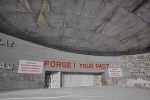
Buzludha is Bulgaria’s largest ideological monument to Communism. Designed by architect Guéorguy Stoilov, more than 6000 workers were involved in its 7 year construction including 20 leading Bulgarian artists who worked for 18 months on the interior decoration. A small, universally expected donation from every citizen in the country formed a large portion of the funds required to build this impressive structure that was finally unveiled in 1981 on what was the 1300th anniversary of the foundation of the Bulgarian state.

Buried in the monument’s concrete structure, is a time capsule containing a message for future generations explaining the significance of the building.

In September 2011, the Bulgarian cabinet transferred ownership of the monument to the Bulgarian Socialist party.

Bulgaria’s Prime Minister Boyko Borisov declared, “We shall let them take care of it because here it also holds true that a party which does not respect its past and its symbols has no future”.

Read more