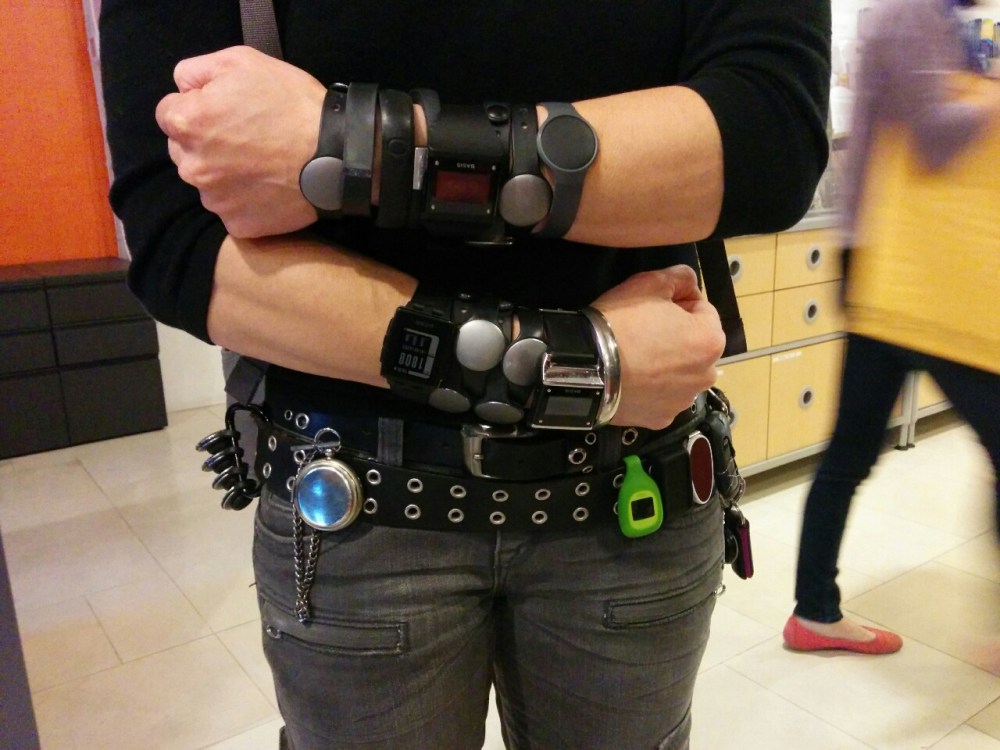
Datapunk sensorpunk quantified self
atemporal tech post irony punk
Read moreI was talking to a friend who was feeling down about human-caused global climate change. “It may be,” I told a friend in London as we walked across Tower Bridge, “that our ticket was punched before we ever got started.” While there is no doubt we’re cutting our time on earth shorter through carbon emissions and the destruction of the ecology, it might be that our species was never going to make it past the end of the womb of our ice-age birth. I explained this, about how fragile an organism we are, and how the ice ages cycle. She laughed, she was used to my strange form of hope.
“You have to choose to have hope, or just jump out of a window,” a person I was interviewing once told me, a person who’d been accused of techno-utopianism. We were walking along the California coast hills at sunset, talking about all the ways our technological lives could go wrong, and the many ways it is going wrong. He wasn’t utopian, it turned out, he’d thought of the worst long before his detractors had. He’d decided to try to head it off, instead of jumping out of a window.
We are diseased and angry and we kill each other and ourselves and all the world. We are killing off life on Earth like a slow moving asteroid. I try to look at this, and my own part in it. Sometimes it is overwhelming. I feel so powerless trying to comprehend all the terrible things we face, much less get past them into our future, with our humanity and our inconceivably beautiful little blue-green planet preserved.
…
All these grown-up monsters for my grown-up mind, they are there in the nights I wake up terrified and taunted by death. When I feel so small and broken, when despair and terror take me, I have a secret tool, a talisman against the night. I don’t use it too often so that it doesn’t lose its power. I learned it on airplanes, which are strange and thrilling and full of fear and boredom and discomfort. When I am very frightened, I look out the window on airplanes and say very quietly:
I have seen the tops of clouds
And I have. In all the history of humanity, I am one of the few that has seen the tops of clouds. Many would have died to do so, and some did. I have seen them many times. I have seen the Earth from space, and spun it around like a god to see what’s on the other side. We are the only consciousness we’ve ever found that has looked deep into the infinite dark, and instead of dark, we saw galaxies. Galaxies! Suns and worlds beyond number. We have looked into our world and found atoms, atomic forces, systems that dance to the glorious music of the universe. We have seen actual wonders that verge on the ineffable. We have coined a word for the ineffable. We have coined thousands of words for the ineffable. In our pain we find a kind of magic, in our worst and meanest specimens we find the flesh of a common human story. We are red with it.
I know mysteries that great philosophers would have died for, just to have them whispered in their dying ears. I can look them up on my smartphone. I live in the middle of miracles, conceptions and magics easily worth many lifetimes to learn, from which I can pick and choose. I have wisdom and knowledge poured around me like a river, more than I could learn in a thousand lifetimes, and I am still alive. It is good that I am alive, it is good that we are alive. Even if we kill ourselves off with nuclear fire, or gray goo, or drown ourselves in stinking acid oceans, it is good that we have lived, that we did all of this, and that we grew into what we are, and learned to dream of what we could be. The only thing we can say for sure is that we will die, but we will die having gone so far above our primordial ponds and primate forests that we saw the tops of clouds.
I Have Seen The Tops of Clouds — Quinn Norton (via fuckyeahdarkextropian)
with bonus link in the post to my now public again ello.
JOIN MY ASTEROID DEATH CULT
Read moreGenetic data on 27 Easter Island natives indicated that interbreeding between the Rapa Nui and native people in South America occurred roughly between 1300 and 1500.
“We found evidence of gene flow between this population and Native American populations, suggesting an ancient ocean migration route between Polynesia and the Americas,” said geneticist Anna-Sapfo Malaspinas of the Centre for GeoGenetics at the University of Copenhagen, who led the study.
The genetic evidence indicates either that Rapa Nui people traveled to South America or that Native Americans journeyed to Easter Island. The researchers said it probably was the Rapa Nui people making the arduous ocean round trips.
“It seems most likely that they voyaged from Rapa Nui to South America and brought South Americans back to Rapa Nui and admixed with them,” said Mark Stoneking, a geneticist with Germany’s Max Planck Institute for Evolutionary Anthropology who collaborated on a related study of Brazil’s indigenous Botocudo people. “So it will be interesting to see if in further studies any signal of Polynesian, Rapa Nui ancestry can be found in South Americans.”
In making their way to South America and back, the Rapa Nui people may have spent perilous weeks in wooden outrigger canoes.
The researchers concluded that the intermixing occurred 19 to 23 generations ago. They said Rapa Nui people are not believed to have started mixing with Europeans until much later, the 19th century. Malaspinas said the genetic ancestry of today’s Rapa Nui people is roughly 75 percent Polynesian, 15 percent European and 10 percent Native American.
A second study, also published in Thursday’s issue of Current Biology, illustrates another case of Polynesians venturing into South America. Two ancient human skulls from Brazil’s indigenous Botocudo people, known for the large wooden disks they wore in their lips and ears, belonged to people who were genetically Polynesian, with no detectable Native American ancestry.
“How the two Polynesian individuals belonging to the Botocudos came into Brazil is the million-dollar question,” said University of Copenhagen geneticist Eske Willerslev of the Centre for GeoGenetics, who led the study on the Botocudos.
The findings suggest these Polynesians reached South America and made their way to Brazil, either landing on the western coast of the continent and crossing the interior or voyaging around Tierra del Fuego and up the east coast, Stoneking said.
Read moreThe irony being, of course, that the world normcore wants to escape from is the very world co-opted by trend forecasters and their ilk, a world where everything we own is imagined to be a prop, where our clothes are costumes and the places we live are stage sets. In other words, any authentic cultural expression has been rendered impossible by the kind of industry that K-Hole represents. Normcore is the sound of that world collapsing from the inside even as it smirks.
Read moreIn 2012, Dr. Paabo and his colleagues took samples from the bone to search for DNA. To their surprise, it held a number of genetic fragments.
“This is an amazing and shocking and unique sample,” said David Reich, a geneticist at Harvard Medical School and co-author of the new study.
The researchers used the DNA fragments to recreate a high-resolution copy of the man’s complete genome. A Y chromosome revealed that the thighbone belonged to a man.
The scientists then compared the genome of the so-called Ust’-Ishim man to those of ancient and living people.
They found that his DNA was more like that of non-Africans than that of Africans. But the Ust’-Ishim man was no more closely related to ancient Europeans than he was to East Asians.
He was part of an earlier lineage, the scientists concluded — a group that eventually gave rise to all non-African humans.
Homo sapiens, our own species, appeared in Africa around 200,000 years ago. Previous studies — both on genes and fossils — have suggested that they then expanded through the Near East to the rest of the Old World.
The Ust’-Ishim man’s genome suggests he belonged to a group of people who lived after the African exodus, but before the split between Europeans and Asians.
Dr. Paabo and his colleagues also found that the Ust’-Ishim man had pieces of Neanderthal DNA in his genome, just as living non-Africans do. But his Neanderthal DNA has some important differences.
Fossils indicate that Neanderthals spread across Europe and Asia before becoming extinct an estimated 40,000 years ago. Today, the Neanderthal DNA in each living non-African human is broken up into short segments sprinkled throughout the genome.
Dr. Paabo and his colleagues have hypothesized that this arrangement is the result of how cells divide.
During the development of eggs and sperm, each pair of chromosomes swaps pieces of their DNA. Over the generations, long stretches of DNA get broken into smaller ones, like a deck of cards repeatedly shuffled.
Over thousands of generations, the Neanderthal DNA became more fragmented. Dr. Paabo and his colleagues predicted, however, that Neanderthal DNA in the Ust’-Ishim man’s genome would form longer stretches.
And that’s exactly what they found. “It was very satisfying to see that,” Dr. Paabo said.
By comparing the Ust’-Ishim man’s long stretches of Neanderthal DNA to shorter stretches in living humans, Dr. Paabo and his colleagues estimated the rate at which they fragmented. They used that information to determine how long ago Neanderthals and humans interbred.
Previous studies — based on only living humans — had yielded an estimate between 37,000 and 86,000 years. Dr. Paabo and his colleagues have now narrowed down that estimate dramatically: Humans and Neanderthals interbred between 50,000 and 60,000 years ago, according to the new data.
WORLD ORDER "MACHINE CIVILIZATION"
/emerges from YouTube hole an hour later…
“The vision was simple – let anyone on Earth experience the Moon live through the eyes of a robot,” explained team leader Daniel Shafrir.
“We weren’t just going to go to the Moon. We are going to bring the Moon back,” he added.
The telepresence robot, nicknamed Andy after university founder Andrew Carnegie, can be controlled by an operator’s head.
Using an Oculus Rift headset, the movements of the user’s head are tracked and sent back to Andy’s camera so that it will match where the user is looking.
“Imagine the feeling of looking out and seeing rocks and craters billions of years old. Turn your head to the right and you see the dark expanse of space. Turn your head to the left and you see home, Earth,” said Mr Shafrir.
First we virtually take the Moon…
Get on this Google. Every planet. Every moon. Every near earth asteroid.
Whoop… Deploy probe.
While we build the infrastructure to get our meat bodies out there afk.
Students build Oculus Moon robot
Read more "Students build Oculus Moon robot"
 The Committee to Nuke Elysium