There may actually be a “demographic bonus” in a dwindling population, according to experts. “As the size of the actual labor force grows, fewer people depend on it. This is not yet the case in Japan, which faces an increasingly onerous demographic debt,” says Toru Suzuki of the National Institute of Population and Social Security Research.
The population patterns in most countries in the region are such that, in a matter of years, the size of the labor forces in those places will shrink and the number of people depending on them such as retirees and children will balloon.
Suzuki, however, adds that the demographic factor doesn’t have an immediate effect on an economy. “Demography works in the background of the economic trajectory,” he says.
In China the family-planning policy that encourages most families to have a single child has been successful but created other problems, the most significant being a relatively older population. Almost half of its people are over the age of 40. This means that at some point in the near future the workforce may be too small to support everybody.
Analysts and forecasters fear dangers will arise if the trend continues. For now, however, there appears to be progress in a number of areas – if progress is defined as healthier populations who are living longer.
…
“Nobody is really prepared for these demographic shifts. One challenge created by an older population is the cost of healthcare. As you become older you are less able to look after yourself,” says Thomas Abraham, director of the public health communication program at Hong Kong University. “In terms of public health, the question is whether increases in population are met with greater access to health services,” he adds.
In the next 15 years, global fertility may drop to the replacement rate – the point at which populations stay flat. Workforces across the continent will likely begin to drop, and, as a result, people in Asia may work longer.
This will lead to a higher retirement age. Working to the age of 70 is a likely prospect for the current labor force, according to Deutsche Bank.
…
According to WHO statistics, people now earn more and have easier access to healthcare, education, clean drinking water and vaccinations. More people across Asia now receive vaccines. Measles vaccination rates are 95 percent in the Western Pacific region and 76 percent in Southeast Asia, up from 85 percent and 58 percent in 2000 respectively.
These developments have a direct effect on the lifestyles of people in the region who are living longer and healthier lives. And in turn, these also have a positive effect on economies because healthier and more educated people are more productive.The irony, however, lies in the fact that healthy and longer lifespans presage a potential disaster. The indications are quite clear, even from affluent Asian countries such as Japan, South Korea and Singapore.
Uncategorized
William Gibson famously observed that the future is already here, it’s just unevenly distributed. The flip side of that observation is that the near future is just like the present, with added nuggets of weirdness embedded in it. About 90% of the near future (10-20 years out) *is* here today: the buildings, the cars, the clothing. This is because we don’t junk our entire fleet of automobiles every time a new model appears — change is incremental, and old stuff hangs around. In addition to the 90% that’s familiar, there will be another 9% that is new but not unexpected — cheaper, flatter TV screens, better cancer treatments, bigger airliners, cars with extra cup-holders. These are the things that are trivially predictable. Finally, if you go more than 5 years out, about 1% of the world will be utterly, incomprehensibly alien and unexpected. To a time traveller from 1994 to 2004, that would have been the internet (which suddenly detonated, and went from being a techie/academic/corporate nerd thing into a ubiquitous communications medium), or mobile phones (expensive yuppie business tool to ubiquitous pocket lint).
PBS piece on advances in prosthetics
Great overview on Better Living Through Upgrades:
Watch the full episode.
via Wolven
PBS piece on advances in prosthetics
http://www-tc.pbs.org/video/media/swf/PBSPlayer.swf
Watch the full episode. See more PBS NewsHour.
A wildfire is raging for a third day in the hills of northern New Mexico near the nuclear laboratory where the atomic bomb was first developed.
The blaze came within a few kilometers of a dump site where around 20,000 barrels of plutonium-contaminated waste is stored at the Los Alamos National Laboratory.
However, officials said that the fire is being kept at a safe distance and there is no danger of it reaching the low-level radioactive materials.
The Los Alamos laboratory, which was established during World War Two as part of the top-secret Manhattan Project that developed the first atomic bomb, remains one of the top nuclear arms manufacturing facilities in the US.
The cause of the fire is believed to be a fallen power line.
Whosoever lays their hands on another to govern them is a tyrant and a usurper, and I declare them my enemy.
Read moreIn fact, the real profanity is that almost a million properties are standing empty in England and Wales, while millions of impoverished people have nowhere safe to live. Britain has a housing crisis, and the scale of that crisis makes squatting a practical, sensible option for many desperate people. There are currently half a million homeless people in this country, and another 500,000 who are “precariously housed” – sleeping on friends’ sofas, living in temporary accommodation. Meanwhile, hundreds of thousands of properties are standing entirely empty in London alone, patrolled by security guards, waiting for their value to increase when the market picks up again.
In these circumstances, squatting is starting to look like a principled response to the moral bankruptcy of contemporary housing inequality, as well as the smart option for homeless people with nowhere else to go. There are currently 15,000 squatters in England and Wales – the law is different in Scotland – and as the cuts come in, that number is likely to rise.
The prospect of a wave of squats and occupations poses two problems for this Government. When thousands of people squatted in London after the Second World War, they were lauded as heroes, bravely responding to the housing shortages created by the Blitz. But when housing shortages are the direct result of bungled forward planning and ideological austerity measures, the presence of squatters is an embarrassment. More importantly, Britain has a long tradition of occupation and squatting as a form of political resistance, dating back to the Diggers and Levellers of the 1640s, and continuing through contemporary university and workplace occupations.
If it comes into force, the new law will make criminals of students who occupy their universities, of outraged citizens who occupy their council buildings, of striking employees who occupy their places of work. Taking over an empty building and using it to set up a family home or a community garden is itself a political statement, but it is the more overtly political occupations which the Government is keen to do away with. Occupations like the Deptford anti-cuts space, where activists took over a disused Job Centre and used it to train locals to fight the cuts.
The occupation of private property by the poor and outraged is a matter of principle, as well as a practical response to hardship. If we believe that it is unfair for the wealthy to buy up empty buildings while millions of people squeeze through their lives in narrow, crumbling council blocks, in hostels or on the streets; if we believe that ordinary people should not be criminalised for protesting peacefully against Government-imposed austerity, then it is up to all of us to stop this spiteful new law in its tracks.

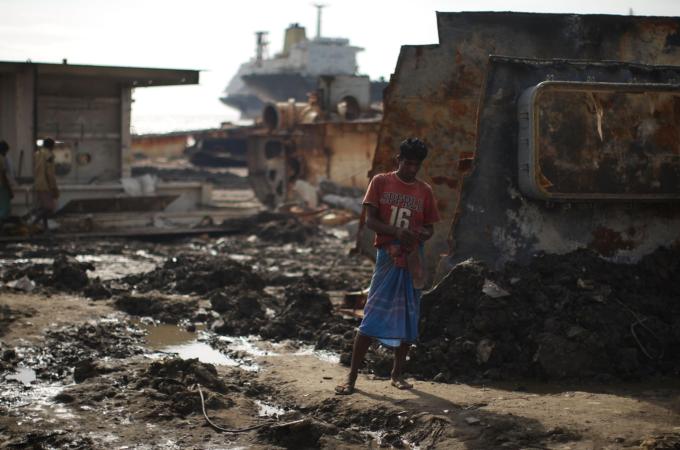
Bangladesh tops the list of countries having the greatest number of ships scrapped every year, with India and Pakistan trailing far behind. Some 200 Bangladeshi companies pay a combined $100 million in taxes each year. The metal scrapping business is so lucrative it supplies about 1.5 million tonnes out of the nation’s total steel consumption of about five million tonnes, the World Bank study said.
Most of the ship breaking companies are located on a roughly 20km stretch of beach in Chittagong district, situated on the Bay of Bengal in southeastern Bangladesh. Some 18,000 unskilled and unprotected workers manually handle poisonous chemicals and are also exposed to the risk of explosion.
Between 2005 and 2007, a total of 270 ocean-going vessels, categorised as end-of-life-ships, were dismantled there. This year alone, some 70 such vessels have been cleared for scrapping, a majority of which failed to obtain either prior clearance to use the yards or no-objection certificates to continue scrapping operations.
On June 1, the US Maritime Administration cleared the cargo vessel Harriette for scrapping on the beaches of Chittagong, with support from the US Environmental Protection Agency. Earlier, the ship Probo Koala, which figured in a controversial toxic waste dumping off the Ivory Coast in August 2006, was also sold for scrapping and docked on the ship breaking beaches of Chittagong. The ship has since been renamed the Gulf Jash.
The soil and waters in ship breaking areas are showing high levels of toxicity, with environmental protection limited and virtually no proper management of deadly chemicals – among them asbestos, polychlorinated biphenyls (PCBs), and other ozone-depleting substances (ODS) and heavy metals. According to the World Bank report, soil contamination tests showed concentrations of cadmium, chromium, lead, mercury and oil. The same report predicts the accumulation of substantial amounts of poisonous chemicals including asbestos, PCBs, ODS (mainly polyurethane foam) and paints during the next 20 years if safety measures are not put in place immediately.
According to an investigation conducted by the Department of Explosives, Greenpeace, the International Federation of Human Rights Leagues, and BELA, 123 workers have died while dismantling ships on the beaches of Shitakunda in Chittagong from 1998 to March this year. “The figures are those which are actually reported. We have no knowledge on workers whose bodies are simply thrown into the sea. So, we assume deaths could be much higher,” said Taslima Islam, senior lawyer at BELA.
Since 1998, a total of 72 incidents of violent explosions and chemical spillage have taken place in ship breaking yards. Hundreds of workers who have survived with chemical burns and life-long physical disabilities have never been compensated properly, the lawyers said.
On top of this, vast areas of mangrove trees – the lifeline of the local ecosystem – have been cleared to accommodate dismantling operations.
From Bangladeshi ship breakers defy court ruling – Features – Al Jazeera English
Read more“The Truth About the Economy in 2 Minutes and 15 Seconds”