zzkt:
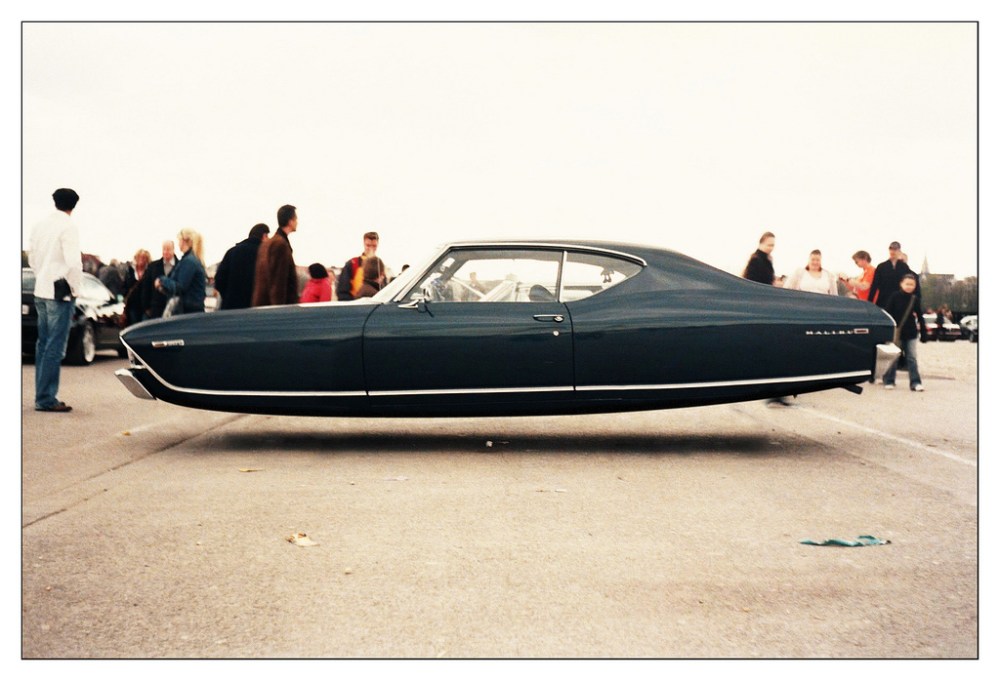
Read moreFlying Malibu by hannes.trapp (via http://flic.kr/p/7Yf6id )
In conlusion, there is no conclusion. Things will go on as they always have, getting weirder all the time.
Archive recreation for The Great Martian War documentary by impossible factual for History Canada. Directed by Christian Johnson, (Plazma). and Steve Maher (impossible factual). Music: “88” by Working for a Nuclear Free City. http://ift.tt/LliWGt Great martian war PLAZMA
Read moreSo are we alone? Well, there is one other possibility, at this point. I’ve lately been trumpeting my revision of Clarke’s Law (which originally said ‘any sufficiently advanced technology is indistinguishable from magic’). My revision says that any sufficiently advanced technology is indistinguishable from Nature. (Astute readers will recognize this as a refinement and further advancement of my argument in Permanence.) Basically, either advanced alien civilizations don’t exist, or we can’t see them because they are indistinguishable from natural systems. I vote for the latter. This vote has consequences. If the Fermi Paradox is a profound question, then this answer is equally profound. It amounts to saying that the universe provides us with a picture of the ultimate end-point of technological development. In the Great Silence, we see the future of technology, and it lies in achieving greater and greater efficiencies, until our machines approach the thermodynamic equilibria of their environment, and our economics is replaced by an ecology where nothing is wasted. After all, SETI is essentially a search for technological waste products: waste heat, waste light, waste electromagnetic signals. We merely have to posit that successful civilizations don’t produce such waste, and the failure of SETI is explained. And as to why we haven’t found any alien artifacts in our solar system, well, maybe we don’t know what to look for. Wiley cites Freitas as having come up with this basic idea; I’m prepared to take it much further, however. Elsewhere I’ve talked about this particular long-term scenario for the future, an idea I call The Rewilding. Now normally one can’t look into the future; in the case of the long-term evolution of technological civilization, however, that is precisely what astronomy allows us to do. And here’s the thing: the Rewilding model predicts a universe that looks like ours–one that appears empty. The datum that we tend to refer to as ‘the Great Silence’ also provides the falsification of certain other models of technological development. For instance, products of traditionally ‘advanced’ technological civilizations, such as Dyson spheres, should be visible to us from Earth. No comprehensive search has been done, to my knowledge, but no candidate objects have been stumbled upon in the course of normal astronomy. The Matrioshka brains, the vast computronium complexes that harvest all the resources of a stellar system… we’re just not seeing them. The evidence for that model of the future is lacking. If we learn how life came to exist on Earth, and if it turns out to be a common or likely development, then the evidence for a future in which artificial and natural systems are indistinguishable is provided by the Great Silence itself.
Claiming there is no other life in the universe is like scooping up some water, looking at the cup and claiming there are no whales in the ocean.
Read moreTen years after the introduction of Google’s self-driving car, it still shows ads for businesses in other cities. Everyone complains, but we’d be terrified if the ads were too good. There’s a mutual interest to retard the platform. You want a dumb ad network so you can believe Google doesn’t know too much. Google wants it to seem dumb so they can keep some knowledge for themselves. After watching a 15-second YouTube ad for bail bonds, the car starts driving you to the Google grocery store without you telling it you needed milk. When you arrive, the car makes you sing the grocery store’s jingle to unlock the doors.
When explorer and surveyor Major Thomas Mitchell ventured into Australia’s inland in the early 1800s, he recorded in his journals his impressions of the landscape. Around him he noted expanses of bright yellow herbs, nine miles of grain-like grass, cut and stooped, and earthen clods that had been turned up, resembling ‘ground broken by the […]
Read more
*Knock it off with those unlikely start-up schemes, and sell us the candy made from all-natural ground-up crickets
http://www.buzzfeed.com/mikespohr/startups-that-will-change-your-life#3ftlm3y
the future of food
Read moreNATS – Guardians Of The Sky
From the gigantic white woman in heels roleplaying ‘Attack of The 50ft Woman’ on an airport to the assurances that she holds millions of lives in her hands, this Omnipotent Air Traffic Being clearly has our best interests at heart and yet she insists on remaining ‘unseesn and invisible.’ If infrastructure fiction did dream sequences, this would be it.
Our invisible flight controller waxes lyrical on ‘big data’ and robot planes. What exactly is the difference between ‘air traffic control’ and ‘dynamic air traffic management?’ No one knows. Doesn’t matter, it’s the future baby, which is essentially the same thing with the names changed.
The future is also ‘quieter and more efficient.’ Presumably this is because the overlord has reduced the other former populace of planet Earth to white silhouettes aimlessly milling about the code/space of airports. I guess if you’re just the blasted silhouette of a former human you don’t actually need to eat or consume or do anything at all really except pose for design fictions.
Of course, later we see the reason for the silhouettes as she boards the Hypersonic Jet Of The Future; no-one else is on it. Those silhouettes can’t recognise each-other, all familial relationships have broken down, they don’t know who they are or what to do and so they just wait, ghost-like in the airport wondering what happened to the cries of their children.
–
At NATS we believe we’re a little different. We’re best known for providing air traffic control in the UK, particularly at London’s Gatwick and Heathrow airports, the busiest single and dual runway airports in the world. But that’s not all we do.
We support airport and airline customers in over 30 countries globally to aid in achieving their objectives. Growth. Efficiency. Safety enhancements. Using big data to transform how air traffic control affects economies, affects people.
We’ve created a short film that asks you to consider us differently and to wonder with us what the future might hold.
“If infrastructure fiction did dream sequences, this would be it.” YES

 The Committee to Nuke Elysium