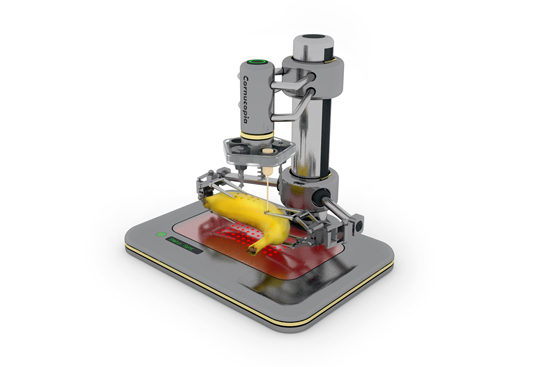
The Robotic Chef is a mechanical arm designed to physically and chemically transform a single solid food object, such as a steak, fish or a fruit. It allows for two types of transformations: localized and precise manipulations performed with an array of tools located in the toolhead; and global transformations performed through the underlying bed and two 5-degree of freedom robotic arms.

The toolhead holds an array of interchangeable manipulation devices, such as a drill bits, mineral and spices injection syringes, and a lower power laser diode, which can programmatically cut, cook and spice the food held by the arm. The underlying bed houses a heating plate which can heat and cook the food while the arm can apply mechanical transformations, such as compressions, elongations, and torsion, as well as control the location of the food underneath the toolhead. These transformation processes allow cooks to exert highly localized and repeatable food manipulations that would be impossible to achieve through traditional cooking methods.

Read more

The pioneering technology could also create a seamless wireless network and eliminate internet ‘black spots’

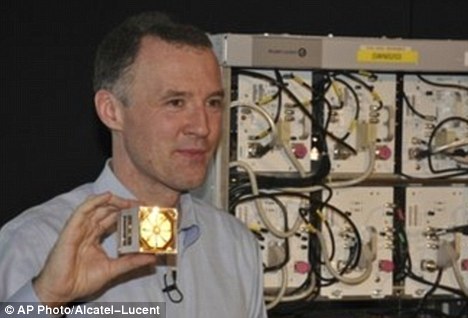
The ‘lightRadio cube’ is the size of a Rubik’s cube.. These tiny devices could be attached to lampposts, buildings or telephone poles as single cubes or in clusters, connected to the mobile phone network with optical fibres

Rather than connecting all phones within a mile or two to the same mast, mobile phone companies could instead divide traffic between several smaller cells.

This would allow for a far greater capacity for calls and data – crucial at a time when smartphone users are saturating the network with data requests.

AT&T has already started creating a network of outdoor Wi-Fi hotspots in New York to cope with the number of iPhone users who are using the mobile network to access the internet.

Read more

On Google’s vision of an ‘augmented humanity’

The following video is Google’s soon to be ex-CEO, Eric Schmidt, presenting to IFA 2010 a vision to create an ‘age of Augmented Humanity’; it also features demos of then new GoogleTV and various new…

On Google’s vision of an ‘augmented humanity’

Read more "On Google’s vision of an ‘augmented humanity’"

bashford:

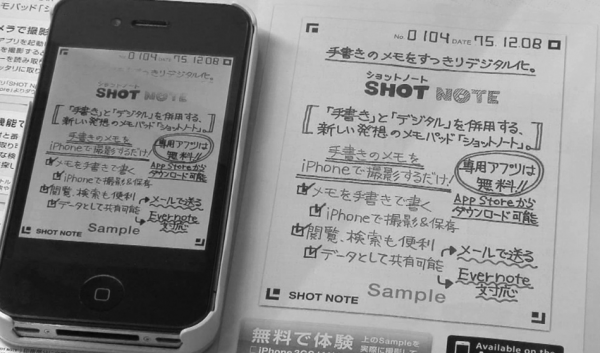
Shot Note from Japanese stationary company King Jim is a notepad for storing hand written notes in a digital format. The iPhone app recognises the fiduciary markers on the corner of the pad and corrects the perspective, colour and scale to fit the iPhone screen perfectly.

“Handwritten text can be imported as-is from the photo, and if you write in the No. and DATE boxes, on the top right of the notes, they get read using OCR. You can use the number and date to search your data and re-arrange your notes.”

Website (JP)

Read more

Instead of focusing on building a better shield, engineers should design spaceships that can hop in and out of passing asteroids, argues study author Gregory Matloff, an adjunct professor of physics at the New York City College of Technology.

The asteroid itself could then block cosmic rays during the voyage—astronauts could pull a Millennium Falcon and park their ship in a crater, or they could use on-board mining tools to tunnel into the rock. (Related: “Obama’s New Plan for NASA: Why Go to an Asteroid?”)

According to Matloff’s calculations, to be published in the March-April 2011 issue of the journal Acta Astronautica, the asteroid “taxi” would need to be about 33 feet (10 meters) wide to provide enough shielding. It would also need to pass close enough to both planets—within a couple million miles—to make the trip feasible.

Already there are five known asteroids that fit the criteria and will pass from Earth to Mars before the year 2100, based on a database of 5,500 near-Earth objects (NEOs), or comets and asteroids whose orbits take them near our planet.

The asteroids 1999YR14 and 2007EE26, for example, will both pass Earth in 2086, and they’ll make the journey to Mars in less than a year. The trouble would be getting home: Because of their wide orbits, it’d be five years before either asteroid would swing around Mars as it heads back toward Earth.

Matloff did find a third space rock that will travel from Mars to Earth—but it makes the journey too early, in 2037. For now it seems a space taxi to Mars would be a one-way ride.

However, the number of NEOs has increased since the database was compiled, Matloff said. There are now more than 7,000 known NEOs, so more potential rock taxis could exist.

Ideally, astronauts would divert an asteroid so that it cycles permanently between Earth and Mars on a well-timed orbit. Humans could nudge an asteroid into the desired path using a solar sail or gentle propulsion. (See “Solar Sail Hybrid Launches From Japan.”)

Once the asteroid is in a stable orbit, Matloff said, “you’d just jump on it. You could store provisions and spare parts on it and use it for shielding. … ”
Read more

The most surreal moment came as I watched the unyielding female activists attacked by a group of young policewomen in pants and boots – their own career paths only imaginable thanks to the hard work of some of the very women activists they hit and shoved. A young policewoman, the age of one of the students I teach, slapped me for taking a picture as this occurred. The women protesters’ only “crime” had been to stand peacefully on the sidewalk of their own capital city singing the national anthem and calling for democracy.

Read more

https://cdn.livestream.com./embed/liftconference?layout=4&clip=pla_bb4adf80-4b21-44dc-924b-2d5456ff7f83

Ben Hammersley at LIFT11 on Post-Digital Geopolitics

Read more