TAKRIZ asks its members, friends, followers and readers to stop relying on Facebook and to disperse and follow TAKRIZ Twitter account twitter.com/takriz and check http://degage.tv publishing the latest videos.

A voice press conference will be given on Tuesday January 25th 9PM GMT+1 on our encrypted voice server accessible with a “mumble” software client. Details of the server will be given to press, NGO and diplomatic contacts only and by email.

Facebook Suspended All TAKRIZ Accounts With Admin 
                 Privileges on the Page TAKRIZO

http://takriz.com/press/24-1-2011-english.txt

Read more

In contrast to the medical, electrochemical, and pharmaceutical enhancements first envisioned for cyborgs, the effects of our consumer appurtenances thus far remain superficial and reversible—stranded on an island without an iPhone, your problems are no different from those faced by Robinson Crusoe. If our helplessness in such an environment is due to our being cyborgs, than we humans have been cyborgs for a very long time.

Lepht Anonym’s cyborg erotics harken back to Donna Haraway’s Cyborg Manifesto, in which a political impatience with the biological conditions of human life urged a radical break with biological limits and the cultural baggage that comes with them. “The cyborg would not recognize the Garden of Eden,” Haraway writes; “it is not made of mud and cannot dream of returning to dust.” Where the retail cyborgs that Amber Case describes seem to be seeking that Edenic reunion, a numbing togetherness of family and community, made possible by tools that promise to make us “more human.” Troubling and total, Lepht Anonym’s cybernetic commitments remind us that we co-opted pseudocyborgs are domesticated version of the true cyborg: angry, damaged, and feral.

Read more

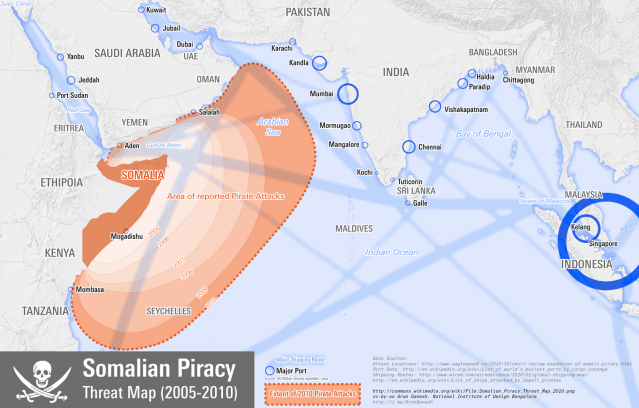
Ransoms paid to Somali pirates averaged $5.4 million last year, compared with $150,000 in 2005, according to One Earth Future, a non-governmental organization based in Louisville, Colorado. A total of $238 million was paid out in 2010, the group said in a report, estimating the annual cost of piracy at $7 billion to $12 billion. That includes ransoms, insurance premiums, re-routing ships, security equipment and naval forces.

Somali pirates still held 28 ships and 638 hostages as of Dec. 31, the IMB said. Pirate attacks also took place in Nigeria and Bangladesh and Indonesia reported its highest level of attacks on ships since 2007, the IMB said. (via Pirates Hijacked a Record Number of Ships and Crew Last Year, IMB Reports – Bloomberg)

Read more

The case against WikiLeaks is absolutely this decade’s version of the Saddam/WMD campaign. It’s complete with frivolous invocations of Terrorism, grave public warnings about National Security negated by concealed information, endlessly repeated falsehoods, a competition among political and media elites to advocate the harshest measures possible, a cowardly Congress that (with a few noble exceptions) acquiesces to it all on a bipartisan basis and is eager to enable it, and a media that not only fails to subject these fictions to critical scrutiny, but does the opposite: it takes the lead in propagating them. One might express bewilderment that most American journalists never learn their lesson about placing their blind faith in government claims, but that assumes – falsely – that their objective is to report truthfully.

Read more

** Underlying Causes **

This 21st century digital revolution is not driven by irreconcilable tribalism, religion, abuse of human rights or gender.

This is about corruption, extremely high unemployment, out-of-control food and fuel prices and the disruption of the daily lives of ordinary people.

Read more

There’s a special irony when Google CEO Eric Schmidt suggests—as he did in a speech to the Council on Foreign Relations last November—that China’s government will find it impossible to censor “a billion phones that are trying to express themselves.” Schmidt is rich because his company sells precisely targeted ads against hundreds of millions of search requests per day. If Google can zero in like that, so can China’s censors.

Calling China’s online censorship system a “Great Firewall” is increasingly trendy, but misleading. All walls, being the creation of engineers, can be breached with the right tools. But modern authoritarian governments control the web in ways more sophisticated than guard towers.

This isn’t just theory. The Kremlin is allegedly soliciting proposals for data-mining social networking sites. The police in Iran and Belarus reportedly browse such sites in order to find connections between opposition figures and dissidents. China tried to launch Green Dam, a technology that studies the browsing habits of its users before deciding to block access. And contrary to what Eric Schmidt believes, authorities do have the ability to locate and monitor mobile phone users, as well as censor their messages.

Why all the tricky techniques? Superpowers like China have to engage with the global economy. So for them, the best censorship system is the one that censors the least. Millions of people already disclose intimate social data on Facebook, LinkedIn, Delicious, and their Russian and Chinese alternatives—and that’s all the data governments need to pick the right target. Online friends with an antigovernment blogger? No access for you! Spend most of your day surfing Yahoo Finance? Browse whatever you want. Satisfied Chinese investment bankers will have access to an uncensored web; subversive democracy activists get added to the government watch list.

Can the Internet empower dissidents and pro-democracy activists? Yes. But it can also strengthen existing dictatorships and facilitate the control of their populations. Washington’s utopian plan to liberate the world one tweet at a time could also turn American innovation into a tool for the world’s subjugation.

Read more

Make no mistake: what is at stake here is the infrastructure for our national conversation—the very lifeblood of American democracy. We should be moving in precisely the opposite direction of what this Commission approves today

Read more