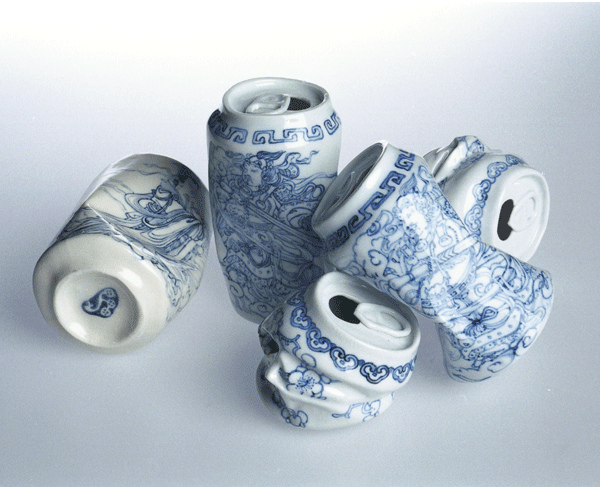
Ming Dynasty Beer cans… « How to be a Retronaut
Read moreI think if Space Opera was invented now, it would be spacepunk. Maybe astropunk. Asimov would have invented robopunk. But I guess we couldn’t have punk before punk, in the late 1970s. I’ve seen some “fairy punk” costumes.
If hard science fiction was relabeled “Science Punk” do you think it would become more popular? Or would it just be a dark, gritty type of hard science fiction???
I love this new ecology of bio-mimiced robots.
From Wired UK:
The gecko’s toe hairs interact with the wall in a molecular attraction called “van der Waals force“. Using this force, a…
Stanford University engineers mimic geckos to create StickyBot
Read more "Stanford University engineers mimic geckos to create StickyBot"Some might say it’s a bit late, but MIT’s SENSEable have at least got a solution for the next big horrible oil spill. Seaswarm is a cutting-edge, 21C design; just the sort of thing we need…
Read more "Seaswarm"Read moreBinary systems comprise two stars that orbit closely around one another.
The erratic behaviour of these twin suns can fling orbiting planets into devastating head-on collisions.
In the new study, the pulverised remains of former worlds have been spotted around four different binary stars using Nasa’s Spitzer Space Telescope.
The double stars that are the subject of present attention orbit only 3.2 million km apart (two million miles). This is a mere 2% of the distance between the Earth and our own Sun.
As they twirl around one another every few days, their powerful magnetic fields cause them to move closer together. This results in gravitational changes that disrupt the trajectory of orbiting planets.
These changes can send planets smashing into one another.
Read moreSince the 2001 discovery of a stone point in the Iceman’s left shoulder, many scientists have assumed that someone shot and killed Ötzi with an arrow as he attempted to flee through a mountain pass after a disastrous fight. From this perspective, the Iceman preserves a brutal prehistoric moment in time.
But a new analysis of the distribution of Ötzi’s belongings around his body, published in the September issue of Antiquity, raises the possibility that he perished near kin living at low altitudes, who took him to the mountains for a final send-off as soon as the weather permitted.
…
Archaeobotanist Klaus Oeggl of the University of Innsbruck, Austria, reported in 2000 that high concentrations of a binding material used in Ötzi’s equipment appeared not just near his body but on a nearby ridge that includes the burial platform proposed by Vanzetti’s team.
Oeggl agrees that warming and freezing cycles caused the Iceman’s body to move from an initial resting place on the ridge to the gully. But no compelling evidence demonstrates that stones on the ridge were placed there to form a burial platform, he says.
…The Iceman’s joints and spine display no dislocations that would have resulted from a downhill slide. Intact blood clots in his arrow wound would show damage if the body had been carted up the mountain, Zink adds.
If Zink is correct, warming and freezing cycles should have randomly spread out his belongings, Bondioli counters. Instead, a mathematical analysis of the position of artifacts recovered around Ötzi reveals two main clumps of items, one at the proposed stone platform and another in the gully where his body lay.
A backpack frame rested on the platform, trapped by a protruding rock. Clumps of human and animal hair, plant fragments, splinters of arrow shafts and an ax lay nearby.
Remains of a grass mat, regarded as an overcoat by many investigators, were found near Ötzi’s body. Vanzetti’s group suspects the mat was part of a funeral shroud.
Ötzi’s belongings include an unfinished wooden bow and arrow shafts lacking points, which make sense as burial offerings because a hunter could not have used them, the researchers add.
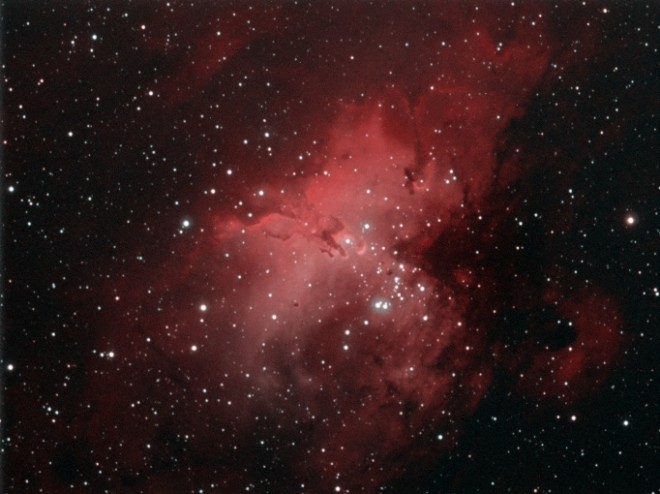
This stunning shot of the Eagle Nebula […] was captured by Iain Melville with a Williams Optics FLT 110 telescope and a SXV-H9 Starlight Express camera. Melville took a total of eight 10-minute exposures, four in a hydrogen alpha filter and four in color. (via Reader Photo Gallery: DIY Astrophotos From Star-Geek Campout | Wired Science | Wired.com)
Read more