In depth: Destiny beckons for Bungie’s next big shooter

Destiny is set after the cataclysmic end of a future golden age for humanity. The survivors shelter within Earth’s last surviving city. Players venture out to explore and reclaim their legacy – from the abandoned ships of a Baikonur-like Cosmodrome to lost colonies on other planets.

In depth: Destiny beckons for Bungie’s next big shooter

Read more "In depth: Destiny beckons for Bungie’s next big shooter"

Science fiction has always built our culture powerful frameworks for thinking about the future. Computer sensors, “electronic paper,” digital newspapers, biological cloning, interactive television, robots, remote operation, and even the Walkman each appeared in fiction before they breached our physical reality. Has there been any major technological advancement that wasn’t dreamt up first in man’s imagination? Simon Lake – American mechanical engineer, naval architect, and perhaps the most important mind behind the development of the submarine – said of Twenty Thousand Leagues Under the Sea, “Jules Verne was in a sense the director-general of my life.”  This was a man who created space travel in the pages of fiction decades before Sputnik, while Arthur C. Clarke imagined satellite communication into existence in 1945, a full 12 years before the Russians fired the first shots of the Space Race. Who invented the cell phone, Martin Cooper or Gene Roddenberry? Who invented the earliest iteration of the computer, Charles Babbage or Jonathan Swift? And the list goes on. Either art is imitating life, or science fiction writers have been pointing to the future for over a century.

Read more

brucesterling:

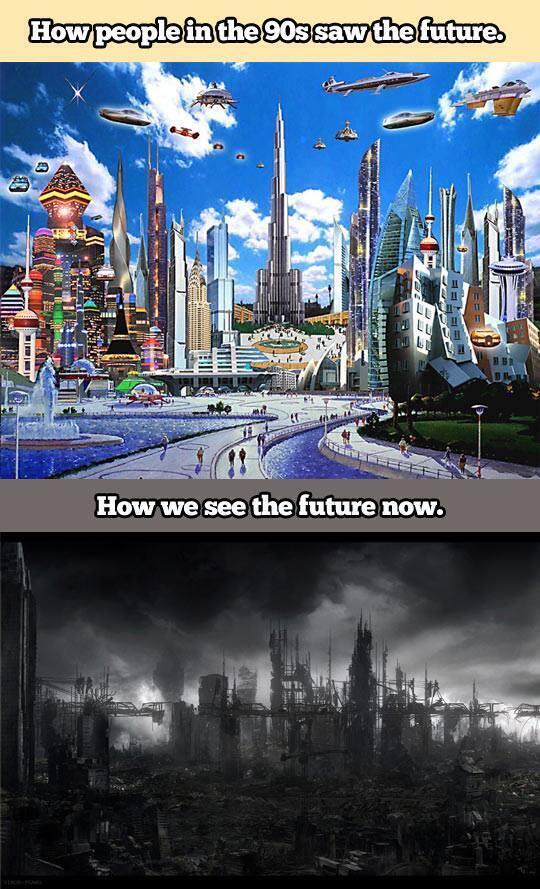
*There’s something to this, but if you take the trouble to hang out with actual futurists you’ll see that they don’t really do much of this…  On the contrary, they’d glance at that image on the bottom and go “Oh yeah, that’s the classic Detroit Rust Belt model.  That scenario was big during the 1970s Energy Crisis.”

The 40 highest authority Twitter profiles in the network are:

@iftf – Institute for the Future
@WorldFutureSoc – World Future Society
@rossdawson – Ross Dawson
@gleonhard – Gerd Leonhard
@DefTechPat – Patrick Tucker
@Urbanverse – Cindy Frewen
@VenessaMiemis – Venessa Miemis
@cshirky – Clay Shirky
@cascio – Jamais Cascio
@bruces – Bruce Sterling
@mitchbetts – Mitch Betts
@frankspencer – Frank Spencer
@futuryst – Stuart Candy
@johnmsmart – John Smart
@Geofutures – Josh Calder
@ThomasFrey – Thomas Frey
@doctorow – Cory Doctorow
@heathervescent – Heather Schlegel
@psaffo – Paul Saffo
@MareeConway – Maree Conway
@dunagan23 – Jake Dunagan
@jenjarratt – Jennifer Jarratt
@kevin2kelly – Kevin Kelly
@wendyinfutures – Wendy L Schultz
@patrickdixon – Patrick Dixon
@Joi – Joi Ito
@GreatDismal – William Gibson
@futuristpaul – Paul Higgins
@futuramb – P A Martin Börjesson
@kristinalford – Kristin Alford
@nraford – Noah Raford
@avantgame – Jane McGonigal
@DavidBrin – David Brin
@jhagel – John Hagel
@fastfuture – Rohit Talwar
@singularityhub – Singularity Hub
@singularityu – SingularityU
@futureguru – Dr. James Canton
@timeguide – Ian Pearson
@FutureCon – Future Conscience

Read more: http://rossdawson.com/articles/futurists-twitter-analysis-network-centrality/#ixzz3BrJtP4IX

Read more