Uncategorized
Read moreAs thinking and communicating have come to eclipse physical strength and stamina as the keys to economic success, those societies that take advantage of the talents of all their adults, not just half of them, have pulled away from the rest. And because geopolitics and global culture are, ultimately, Darwinian, other societies either follow suit or end up marginalized. In 2006, the Organization for Economic Cooperation and Development devised the Gender, Institutions and Development Database, which measures the economic and political power of women in 162 countries. With few exceptions, the greater the power of women, the greater the country’s economic success. Aid agencies have started to recognize this relationship and have pushed to institute political quotas in about 100 countries, essentially forcing women into power in an effort to improve those countries’ fortunes. In some war-torn states, women are stepping in as a sort of maternal rescue team. Liberia’s president, Ellen Johnson Sirleaf, portrayed her country as a sick child in need of her care during her campaign five years ago. Postgenocide Rwanda elected to heal itself by becoming the first country with a majority of women in parliament.
…
The postindustrial economy is indifferent to men’s size and strength. The attributes that are most valuable today—social intelligence, open communication, the ability to sit still and focus—are, at a minimum, not predominantly male. In fact, the opposite may be true. Women in poor parts of India are learning English faster than men to meet the demands of new global call centers. Women own more than 40 percent of private businesses in China, where a red Ferrari is the new status symbol for female entrepreneurs. Last year, Iceland elected Prime Minister Johanna Sigurdardottir, the world’s first openly lesbian head of state, who campaigned explicitly against the male elite she claimed had destroyed the nation’s banking system, and who vowed to end the “age of testosterone.”
TEDxBerkeley – Bradley Voytek – 04/03/10 (via TEDxTalks)
– fuck yeah neuroscience!
(Source: https://www.youtube.com/)
Read more
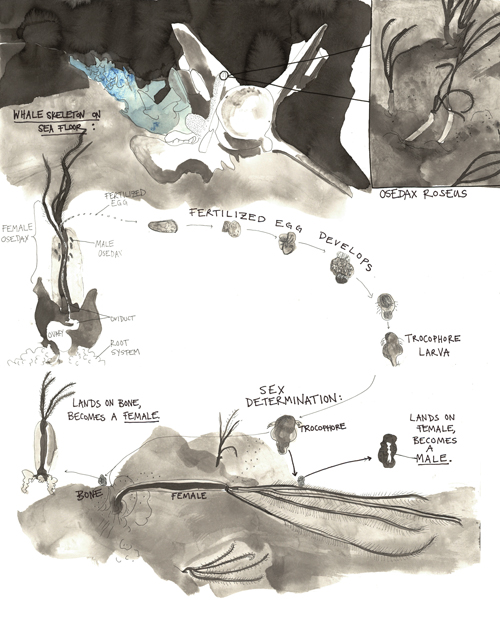
Scientists have categorized four stages of whale carcass ecosystems- first the “mobile scavengers” show up, such as sharks, crabs, hagfish. These guys pick away at what luscious meat remains. Snails, slugs and worms show up next to make use of the nutrient-rich poo (in science speak, “organically rich sediment”) the larger scavengers have left behind. The third stage is comprised of animals that rely on hydrogen sulfide gas emitted from the decomposing bones and organic sediments. These animals, like vesicomyid clams, depend on symbiotic bacteria that live inside their cells to make energy for the animal from sulfur based compounds. Free-living bacteria that also live off sulfur form in mats that coat the bones. The final stage of a whale bone’s community succession is the reef stage, when most of the nutrients the whale bone can provide have been exhausted, and the minerals remaining in the bone provide a surface for suspension and filter feeders, who rely on the ocean currents to bring food their way. (via Bone Boring Worms « Creaturecast)
Read more
jstn:
Janelle Monáe – Tightrope (via totes). This is the best music video I’ve seen in a long time.
Seconded … it’s like it’s from some superior place and time
(Source: https://www.youtube.com/)
Read more

Read moreThis photo is the result of a series of photographs taken by V. Rumyantsev every 10th day in the Crimea during which he tracked the course of the sun for a year. The result is proof of the analemma.
“I should say it is the most complicated photograph I have ever made. It shows position of the Sun on the sky in the same time of a day during one year…”