UNESCO describes Palmyra as a heritage site of ‘outstanding universal value’.

The ancient city stood on a caravan route at the crossroads of several civilisations and its 1st and 2nd century temples and colonnaded streets mark a unique blend of Graeco-Roman and Persian influences.

Observatory head Rami Abdel Rahman said the city was ‘under threat’ as fierce fighting and shelling continued on its eastern edges amid a regime counter-offensive.

The jihadist advance on the well-preserved remains came as an international conference was under way in Cairo to address destruction already wreaked by IS on the ancient sites of Nimrud and Hatra in Iraq. 

Foreign affairs and antiquities officials from 11 Arab countries gathered in Egypt to condemn the jihadists’ demolition of Iraq’s heritage with sledgehammers, bulldozers and high explosives.

Abdulkarim said Syria’s antiquities officials would try to ensure the safety of artefacts found in Palmyra’s archaeological digs over the years and now housed in an adjacent museum.

‘We can protect the statues and artefacts, but we cannot protect the architecture, the temples,’ he said.

‘IS will just destroy it from the outside.’

Abdulkarim said he had no doubt that if Palmyra fell to the jihadists, it would suffer a similar fate to ancient Nimrud, which they blew up earlier this year.

‘If IS enters Palmyra, it will spell its destruction… It will be a repetition of the barbarism and savagery which we saw in Nimrud, Hatra and Mosul.’

The ancient city that has stood for 2,000 years but now faces destruction at the hands of ISIS: Fears for Palmyra, the archaeological jewel of the Middle East Islamists want to reduce to rubble – http://www.dailymail.co.uk/news/article-3081310/IS-jihadists-threaten-Syrias-ancient-Palmyra.html
Read more

Though it’s often called a novel, Noon: 22nd Century is really a collection of stories, bound together by shared characters and settings. In this future, humanity has colonized the moon, Mars, and Venus, and explorers have ventured beyond the solar system to planets like Pandora, a densely forested world whose life-forms are not fully understood. (The Strugatskys’ jungle-planet was a possible inspiration for James Cameron’s Avatar.) Although contact with intelligent alien life hasn’t yet been made, its existence is confirmed thanks to abandoned satellites and other artifacts of an advanced civilization. Most significant, the Noon Universe, as it came to be known, is a world in which socialism has won out over other forms of economic and political organization, leading to universal equality and material wellbeing.

Yet Noon: 22nd Century is more than just an optimistic projection of a forty-something five-year plan. Despite its projection of socialist victory over capitalism, the book isn’t propaganda for the Soviet Union but a set of compassionate stories about characters struggling for scientific and personal fulfillment. As in the Star Trek universe, which the Noon Universe somewhat resembles, humanity has survived its internal crises, but still has discoveries to make and problems to solve. Conflict in the Noon Universe takes place “between the good and the better,” instead of between good and evil forces. Rather than being a stiff work of agitprop, Noon: 22nd Century is a hopeful reminder of why the Soviet promise was so attractive to begin with.

Read more

Haven’t you ever noticed how much more interesting the unknown is than the known?” Snevar asks. “The unknown makes us think—it makes our blood run a little quicker and gives rise to various delightful trains of thought. It beckons, it promises. It’s like a fire flickering in the depths of the night.

Read more

Jetman Dubai : Young Feathers 4K

Actual jetpack trick flying. What’s next? Jetpacks vs wingsuits accompanied by a fleet of drones? OK.

Read more

neuromaencer:

new collage on neuromaencer’s facebook page!

PLANET / DESERTIFICATION // new york by HJALTI GUDLAUGSSON / 3M mask by MISSING ORIGINAL SOURCE /logistics system vehicle by 2ND US MARINE LOGISTICS GROUP

Read more

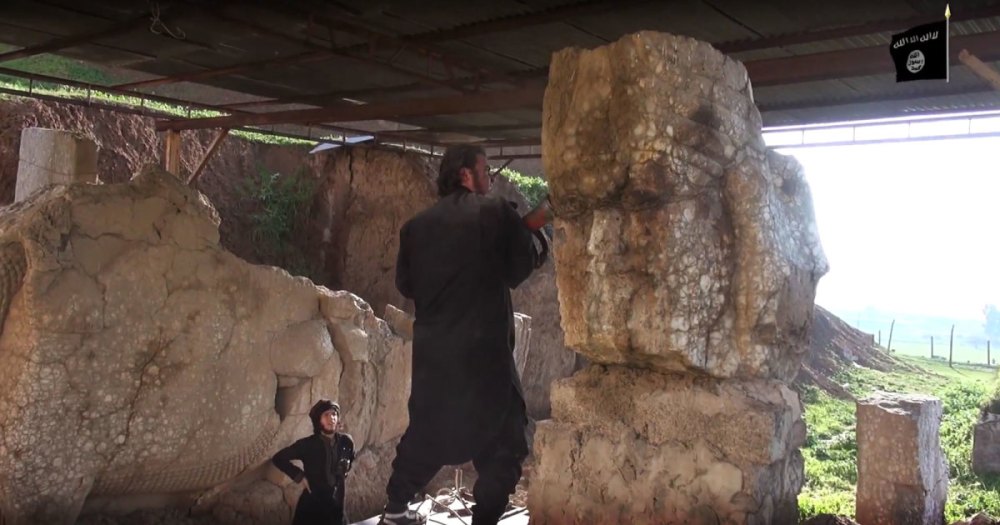
It does something to our sense of ourselves, and of humanity, when we see pictures of men, willfully and with impunity, destroying some of the world’s oldest and rarest archeological treasures. A couple of weeks ago, it was video clips of the Islamic State in Iraq and al-Sham’s extremists wielding sledgehammers and drills, methodically destroying an exquisitely carved stone lamassu, or winged man-bull, at the Assyrian complex of Nimrud, which was created by artists nearly three thousand years ago. A few days later, it was the ancient temple complex of Hatra, in northern Iraq, which was built by the Seleucid Empire around two or three centuries before Christ. Hatra had been the site of a series of glorious colonnaded buildings and statues; it is reported that beginning on March 7th, ISIS destroyed what was left of them. On Monday, there were new images on social media showing ISIS extremists attacking the grounds of St. George’s, a centuries-old Chaldean Catholic monastery outside of Mosul. In this world of all-seeing, all-hearing killer drones, these acts somehow continue.

All around the Middle East, archeological treasures of the ancient world have been stripped of their original glory—often, of what some call graven images.ISIS’s fanatics do so hatefully, as if to spite all others, but they are not the only perpetrators. Muslim extremists have long sought to destroy the physical evidence that any other faith worth valuing existed before their own. In March, 2001, the Afghan Taliban announced to the world that they would destroy the ancient, giant Buddhas of Bamiyan, and then, using explosives and artillery, proceeded to do just that. In the last decade, the Saudis, as the keepers of the Muslim holy places, have razed hundreds of historic sites in the cities of Mecca and Medina to make way for new construction, including shopping malls and hotels.

On a recent trip to Libya, I revisited the ancient Greco-Roman temple complex of Cyrene, overlooking the Mediterranean Sea. I had been there three years ago while Qaddafi was still in power. Most of the statues had already been defaced, but some had their human countenances still intact. On this return trip, on a line of pillars topped by bas reliefs showing the faces of gods, there were signs of even more recent vandalism, and a spray-painted message on the stone wall condemning idol worship. There were no guards that I could see. That evening, I spoke to Ahmed Hussein, who was recently named head of the Department of Antiquities (in one of Libya’s rival governments, anyway), and who attributed the damage to a band of footloose “local boys.” Even without interference from extremists, Cyrene was already succumbing to these casual forms of vandalism and to land grabbers who have been bulldozing sites to build cement-block houses around the edges of the temple complex. “The biggest threat we face is from the mentality of the local people, who don’t realize the economic value Cyrene has for us through tourism,” Hussein said. I pointed out that the city of Derna, which then, as now, was in the hands of ISIS extremists, lay only a short distance down the coast from Cyrene. Hussein acknowledged worryingly that that they “might come here.” He said, “We must be ready, because if they come, it will be like Iraq.”

via ISIS and the Destruction of History – The New Yorker

Read more

Geoffrey Landis’ percolation theory as to lack of detectable Type III Civilisations

Perhaps the best reasoning as to why an advanced civilisation possessing the ability for interstellar travel would fail to colonise an entire galaxy is Geoffrey Landis’ percolation theory. Landis makes the assumption that interstellar travel is short haul only. We might be able to make direct flights to alpha Centauri or epsilon Eridani, but anything […]

Read more "Geoffrey Landis’ percolation theory as to lack of detectable Type III Civilisations"