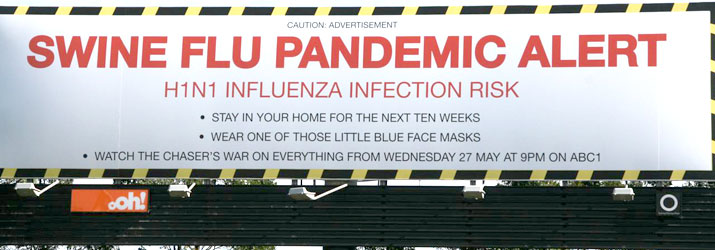
The Chaser boys are swine when it comes to the flu | The Courier-Mail
Read moreRead moreOn the other hand, maybe this is the way that “design fiction” is *destined* to look. My feeling is that good “design fiction” ought to be like good “critical design,” it ought to be subtle and taut and aimed at provoking some cognitive dissonance. But maybe that’s a niche effort doomed to blow right over most people’s heads. Scifi is pop culture. Most design guys I know, who are into science fiction, like big, glossy, popular, sci-fi movies and television shows. They’re not mulling over JG Ballard’s architectural thinking on their way to the Dunne and Raby exhibit.
Instead, they think that science fiction should act as an emollient to loosen up a mass audience, so that one gets a groundswell of useful consumer demand for unrealized objects and services that designers can then design
Read moreThe fundamental change that may be taking place – humans may not be best characterized as the tool-creating animal but as the only animal that has figured out how to outsource its cognition — how to spread its cognitive abilities into the outside world. We’ve been doing that for a little while ten thousand years. Reading and writing is outsourcing of memory. So we have a process going on here, and you can watch to see whether it’s ongoing. So, for instance, in the next ten years, if you notice more and more substitution for using fragments of human cognition in the outside world — if human occupational responsibility becomes more and more automated in areas involving judgment that haven’t yet been automated — then what you’re seeing is rather like a rising tide of this cognitive outsourcing. That would actually be a very powerful symptom.
Read moreWhat is happening is no longer just a crisis for individuals, nor even for individual parties: the political system itself is under attack, threatening the moral legitimacy of mainstream parties to govern. Parliament has failed, the government is paralysed and the will of the people is asserting itself.