In short, while globalization is indeed undermining national political institutions and thus national identities and loyalties, what appears to be replacing the national is not the “global” political identity that “cosmopolitical” dreamers have long aspired to, but rather a return to localized identities rooted in clan, sect, ethnicity, corporation, and gang. In literary terms, this future has more in common with Neal Stephenson’s Snow Crash than it does with Gene Rodenberry’s Federation utopia in Star Trek.
The ultimate losers in all of this, of course, are the middle classes—the people who “play by the rules” by going to school and getting traditional middle-class jobs whose chief virtue is stability. These sorts of people, who lack the ruthlessness to act as criminal insurgents or the resources to act as plutocratic insurgents, can only watch as institutions built over the course of the 20th century to ensure a high quality of life for a broad majority of citizens are progressively eroded. As the social bases of collective action crumble, individuals within the middle classes may increasingly face a choice: accept a progressive loss of social security and de facto social degradation, or join one of the two insurgencies.
Uncategorized
ENIGMA MAN: A Stone Age Mystery
With Enigma Man we follow the groundbreaking research of Aussie paleoanthropologist Darren Curnoe and his Chinese colleague, paleontologist Ji Xueping.
Their study of ancient human remains found in a remote cave in South-west China looks at the idea there may have been another species of human existing alongside our ancestors as recently as 11,000 – 14,000 years ago.
Dubbed the ‘‘Red Deer Cave people’’, these ancient people, or, more precisely, their remains – so similar, yet so physically different from us – are much, much younger than our Neanderthal relatives, posing some seriously interesting questions. Were they really another human species? And if so, what happened to them? Why did they die out? How did they live? And what were their interactions with our own early relatives?
These are indeed big questions, Curnoe says, and that’s what makes the search for answers so fascinating.
“The documentary is about the process of deciding: do we have a new species or not?” Curnoe, who is Associate Professor of evolutionary biology in the School of Biological, Earth and Environmental Sciences at UNSW, explains.
“The fossils just don’t fit with the dominant view in science at the moment about who was around 11,000 years ago or 14,000 years ago, how they relate to us, and how we think of ourselves as humans in relation to nature.
“We tend to think of ourselves as special. So it raises some pretty deep and challenging questions.
“There are views, which I subscribe to, and quite a lot of other people do too, that there are at least 30 different species that are in the fossil record that would be relatives of ours in some sense – some may be ancestors, some may be side-branches that went extinct.
“The classic example is the Neanderthals – everyone has heard of them, even if you don’t know much about them. What we are proposing is that instead of the Neanderthals being the last of the other human-like creatures [before it was] just us, we are in fact saying, well, no, this other group survived until much more recently.”
Herpes viruses have been infecting and co-diverging with their vertebrate hosts for hundreds of millions of years. The primate simplex viruses exemplify this pattern of virus-host co-divergence, at a minimum, as far back as the most recent common ancestor of New World monkeys, Old World monkeys, and apes.
Humans are the only primate species known to be infected with two distinct herpes simplex viruses: HSV-1 and HSV-2. Human herpes simplex viruses are ubiquitous, with over two-thirds of the human population infected by at least one virus.
Here, we investigated whether the additional human simplex virus is the result of ancient viral lineage duplication or cross-species transmission.
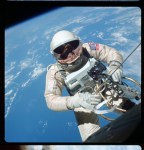
Read more“I felt red, white and blue all over.”
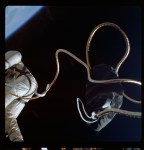
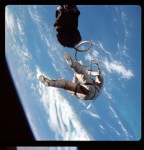
Astronaut Ed White on his walk in space, quoted in Life magazine, June 25, 1965
via astronautfilm

Read moreThe Wells of Memory: Mada’in Saleh, Saudi Arabia photograph by John Stanmeyer for National Geographic
(shot using the iPhone Hipstamatic app)
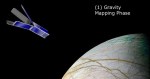
In its first stage, a small satellite about as large as a half-gallon of milk would orbit the moon. Using two highly accurate accelerometers, it could sense small changes in Europa’s gravitational field, eventually mapping the gravity of the entire surface. These detailed gravity maps could then suggest the location of watery oceans below the planet’s surface—or the openings to these oceans.
Once an ocean (or the entryway to one) was found, the probe would begin its second stage. The small satellite would release even smaller instruments over the interesting region. These “chipsats,” each no larger than a fingernail, could enter Europa’s thin atmosphere unharmed and float down to the surface.
“When there is an atmosphere, they flutter down like little pieces of paper, not like a rock,” said John West, leader of the advanced concepts team at Draper. He added that while they expect to lose some of the smaller “chipsats,” enough would be released that useful science could be performed.
Once deployed, the tiny chipsats would then send their measurements back to their orbiting mothership, which would in turn beam them back to Earth.
Read moreISSpresso by Argotec and Lavazza
Coffee in spaaace. Good job Italy!

“How ironic it would be to witness the somber rituals of a Spider-Man cult in 2540 A.D. – or to be present at the "strength olympics” held in honor of the Hulk. New myths created in the twentieth century, and scattered by the printing press throughout the world, may well enlarge the giant puzzle that is humanity and make things much more difficult to decipher.“
Jack Kirby writing in the back pages of The Eternals.
Read more