“TrES-2b is considerably less reflective than black acrylic paint, so it’s truly an alien world,” said astronomer David Kipping of the Harvard-Smithsonian Center for Astrophysics (CfA), lead author on the paper reporting the research.

TrES-2b orbits its star at a distance of only three million miles. The star’s intense light heats TrES-2b to a temperature of more than 1,800° Fahrenheit – much too hot for ammonia clouds. Instead, its exotic atmosphere contains light-absorbing chemicals like vaporized sodium and potassium, or gaseous titanium oxide. Yet none of these chemicals fully explain the extreme blackness of TrES-2b.

“It’s not clear what is responsible for making this planet so extraordinarily dark,” stated co-author David Spiegel of Princeton University. “However, it’s not completely pitch black. It’s so hot that it emits a faint red glow, much like a burning ember or the coils on an electric stove.”

Read more
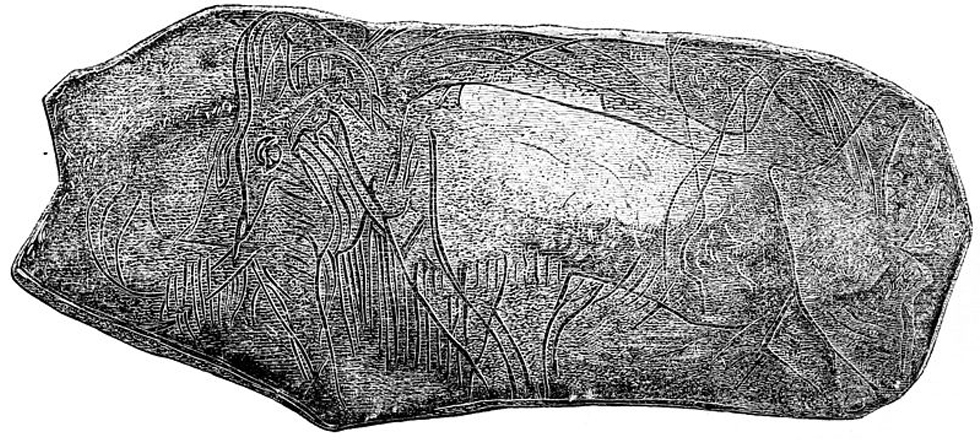
The uncovering of the engraving, in 1864, was the handiwork of a joint British-French archaeological expedition and it provided the first, unambiguous evidence that human beings had once shared this planet with long-extinct animals such as the mammoth. Its discovery was also an act of extraordinary good fortune, it transpires.

“The site has since lent its name to a period known as the Magdalenian era, which thrived across Europe between 12,000 and 16,000 years ago, and which we now appreciate was a time of incredible artistic creativity,” says Professor Chris Stringer, curator of the Natural History Museum exhibition.

The site has certainly produced many wonders, but in terms of their sheer scientific importance none can match the splintered mammoth figurine that was spotted by Lartet and Falconer on that day in May 1864. In their hands lay fragments, freshly dug from the earth, of a beautiful engraving of a mammoth, with its distinctive domed head, that was, for good measure, made of mammoth ivory.

“You couldn’t really top that in terms of proving that humans had lived at the same time as mammoths,” says Stringer. “Indeed, when you examine the piece you can see details of the mammoth’s anatomy that we only know about today from the frozen mammoth carcasses that we have found in Siberia.”

In other words, only an artist who had shared that ancient landscape (the Madeleine mammoth was carved about 14,000 years ago) with these creatures would have been able to record one with such precision and flair – and on a piece of the animal’s own ivory.

***HAPPY 150TH BIRTHDAY, DEEP TIME!***

Read more

spacewatching:

This 1929 Hermann Noordung image depicts a three-unit space station as seen from a space ship. Hermann Potocnik (1892-1929), also known as Herman Noordung, created the first detailed technical drawings of a space station. The three units were the habitat, the machine room, and the observatory, each connected by an umbilical. The Earth is in the background, approximately 26,000 miles away. The station in this image is roughly above Cameroon’s southern tip, in a geosynchronous orbit on the median of Berlin.

Read more

Since music is the only language with the contradictory attributes of being intelligible and untranslatable, the musical creator is a being comparable to the gods, and music itself the supreme mystery of the science of man.

anthropologist Claude Lévi-Strauss (via jtotheizzoe)
Read more

Has the Weirdest Star in the Universe Been Found?

According to Thorne and Żytkow, it is possible for a red supergiant star to collide with a superdense neutron star, the remnant of a supernova, swallowing it. A red supergiant can merge with a binary partner neutron star, or that both occupied a dense globular cluster.

Once the neutron star is eaten, it settles in the core of the supergiant, interrupting normal fusion processes inside the star’s guts. This, according to the theorists, should create a very specific chemical signature in the “host” star’s chemical make up. What’s more, there should be a few dozen Thorne-Żytkow object specimens in our galaxy.

Has the Weirdest Star in the Universe Been Found?

Read more "Has the Weirdest Star in the Universe Been Found?"

As for Dune: [record producer] Allen Klein asked me to adapt The Story of O. I really wanted to get out of my business agreement with Klein. And [film producer] Michel Seydoux showed Holy Mountain in Paris, and loved it. And he said to me, “I want to produce for you a big picture. What do you want to do?” I say, “Dune.” Because a friend of mine tells me that it’s a very good book, though I didn’t know the book! He tells me it’s a science-fiction book about ecology. I say “Fantastic!” When I started to write my film’s script, I read the book. And I thought What have I done? Adapting Dune is impossible! After 100 pages, you understand nothing! 

So I thought, This is so literary … I need to make something more optical. So I made a book called The Optical Book of Dune. But when I didn’t make Dune, I thought I’d take everything of mine and use it for comics:The Incal, Metabarons, Technopriests … I don’t know, 40 volumes of comics.

Read more

raincoasttoast:

catsbeaversandducks:

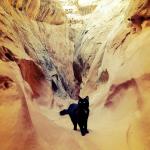
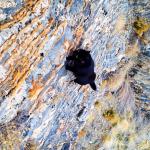
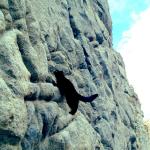
My Adopted Cat Is The Best Climbing Partner Ever

Most pet cats will become timid or defensive when outdoors, but not Millie – after being adopted by her mountain-climbing owner Craig Armstrong, Millie has become a feline hiking and mountain-climbing legend.

“She literally loves to climb things… if there’s high-ground she’ll seek it out,” Armstrong said in an interview with Bored Panda. He had nothing but praise for the tenacious little athlete: “Generally she does best on slabby routes where she can scramble from ledge to ledge. She’s an incredible athlete but steep juggy routes just aren’t her thing. When bouldering, though, she’s done some pretty amazing gaps and dynos.”

“I go on a lot of weekend climbing adventures. It never seemed odd to me, just seemed like something I’d do with my pet, take her places,” explained Armstrong. Ever since Millie climbed up onto his shoulder at the Furburbia adoption center in Utah, Armstrong knew they’d make a good team.

There are, of course, pros and cons to taking your cat hiking – “We camp in my truck; She peed in there one night, but she caught a mouse in there one night, too.” Armstrong hopes that they can become a team in other aspects of his life as well; “I’m still waiting for the day we come across a group of pretty ladies and they love Millie and invite us to their campfire that night.“

He also had plenty of advice for owners who might consider hiking with their own cats. “Get them used to their name and to you as a safe place. In talus fields or thick woods she’ll get distracted and climb trees or explore tiny caves and under boulders and stop following sometimes. It’s taken a lot of practice and many trips to get Millie to the point where she follows me down a trail past areas like thickets that would have distracted her otherwise.”

Via Bored Panda

if I could have only one thing in life….

Read more